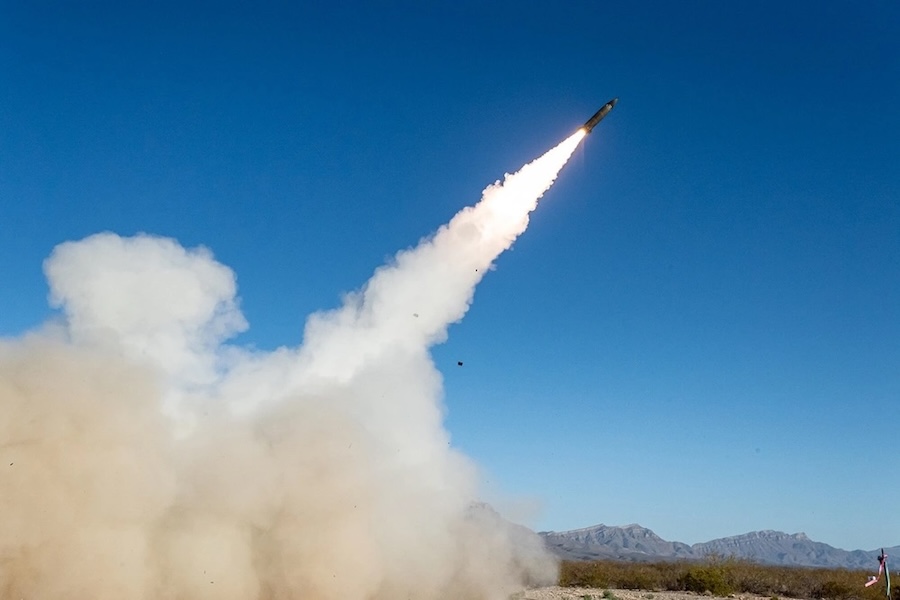


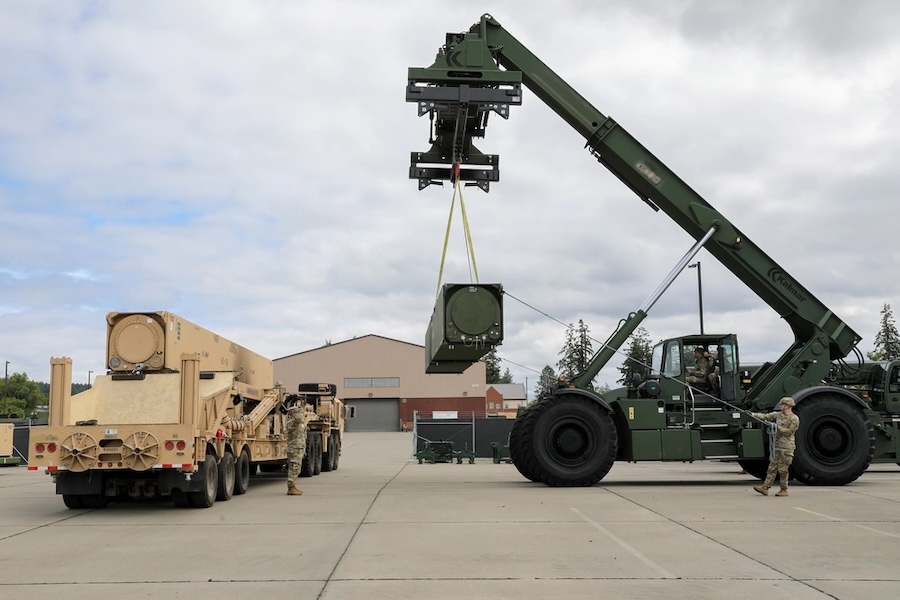
The LRHW is a ground-launched missile system equipped with a hypersonic glide body and associated support equipment. It has a reported range of approximately 1,725 miles and is intended to expand the Army’s ability to conduct deep strikes against high-value targets.
According to the Director of Operational Test and Evaluation, “Army commanders will use the LRHW (Dark Eagle) to engage adversary high-payoff and time-sensitive targets.” The report adds that “U.S. Strategic Command (USSTRATCOM), with direction from the National Command Authority, will serve as the employment authority for LRHW missions”.
The system was formally designated as Dark Eagle on April 24, 2025. It represents a joint effort between the Army and Navy to develop shared hypersonic strike capabilities.
The missile component is being developed by Lockheed Martin and Northrop Grumman. It serves as a common two-stage booster for both the Army’s LRHW and the Navy’s Conventional Prompt Strike system.
The Common Hypersonic Glide Body is based on the Alternate Re-Entry System developed by the Army and Sandia National Laboratories. It is designed to travel at speeds of Mach 5 or higher and remain maneuverable, making it more difficult to detect and intercept.
Organizationally, the LRHW is deployed in battalion structures composed of batteries. Each battery includes a battery operations center, multiple transporter erector launchers, support vehicles and up to eight missiles.
The first operational unit is based at Joint Base Lewis-McChord in Washington state. The 5th Battalion, 3rd Field Artillery Regiment, part of the Army’s 1st Multi-Domain Task Force, has been designated to operate the initial battery.
Development of the LRHW has faced testing challenges and delays. Early test failures in 2021 and 2022 led to postponed flight tests as the Department of Defense assessed technical issues.
Additional planned tests in 2023 were also cancelled following pre-flight checks. As a result, the Army acknowledged it would not meet its initial goal of deploying the system by the end of fiscal year 2023.
Subsequent testing showed progress, including a successful end-to-end flight test in June 2024. The missile traveled more than 2,000 miles and released its glide body, which successfully reached its target.
A second successful end-to-end test was conducted in December 2024. This marked the first live-fire event for the LRHW system using a battery operations center and transporter erector launcher.
On March 26, 2026, another successful launch was conducted from Cape Canaveral Space Force Station. The test was carried out jointly by Army and Navy acquisition organizations.
Initial operational fielding is expected to begin soon. According to the report, “the Dark Eagle battery based at Joint Base Lewis-McChord [JBLM] in the Pacific Northwest will receive its first operational [LRHW] missiles soon” and that “Bravo Battery, 1st Battalion, 17th Field Artillery Regiment, 3rd Multi-Domain Task Force, based at JBLM, has been designated to operate” the system.
The cost of hypersonic missiles remains a key consideration. A Congressional Budget Office study estimated similar systems at approximately $41 million per missile, although Army estimates suggest current costs may be higher before decreasing with larger production volumes.
During congressional testimony, Army Chief of Staff Gen. Randy George said, “We are getting ready to do some tests this summer, with long-range missiles that are a tenth of the price.” He added, “And when you start talking about ‘magazine depth’ … we can invest in things that are much more cost-effective”.
The report notes that Congress may consider increased oversight of the LRHW program. Areas of focus include missile costs, operational testing progress and stockpile requirements.
As the Army continues procurement and fielding of LRHW batteries, additional testing and evaluation are expected. Enhanced oversight could help inform future funding decisions and the overall direction of the program.