Under Secretary of War for Acquisition and Sustainment Michael P. Duffey said the project reflects a shift from discussion to industrial action. “Today, right here in Troy, Alabama, we are turning strategic talk into concrete action,” Duffey said.
“By putting shovels in the ground from Munitions Production Center Building 47, we are physically building the Arsenal of Freedom,” Duffey added. He said the effort followed the launch of the Munitions Acceleration Council last summer and Secretary Hegseth’s Acquisition Transformation Strategy in November.
Duffey said the department moved away from single-year procurement, which he said had created unstable demand, delays in long-lead items and hesitation by industry to invest. “We threw that old model out,” he said.
In January, Duffey signed framework agreements with Lockheed Martin covering PAC-3 and THAAD. He said the model provides industry with a reliable demand signal while companies fund the expansion of their own production facilities.
“Instead of the government issuing grants to build factories, we simply promised to buy the munitions,” Duffey said. “In return, the company promised to foot the bill to scale their production facilities.”
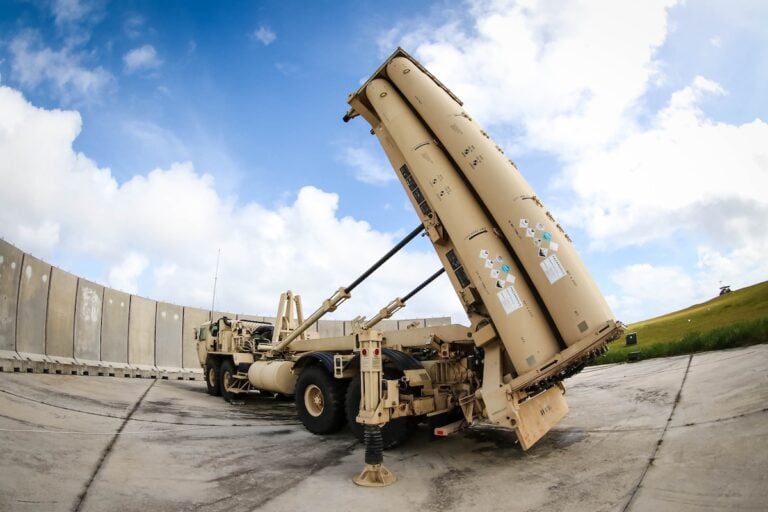
Duffey said the partnership is intended to quadruple THAAD interceptor production and triple PAC-3 production. He added that the department is also seeking to scale production across the wider munitions portfolio, including Tomahawk, Precision Strike Missile and AMRAAM.
Lockheed Martin Chairman, President and Chief Executive Jim Taiclet said the framework agreements are designed to accelerate proven capabilities at scale. “These agreements demonstrate that Lockheed Martin is ready now to meet the urgent demand for air defense missiles and other critical systems,” he said.
Taiclet said Building 47 is focused on THAAD production and forms part of a broader $8 billion to $9 billion Lockheed Martin investment through 2030. He said the company has already spent $1.25 billion to expand capacity.
The Troy investment is expected to range from about $900 million to $1.1 billion over the next several years, Taiclet said. He said the project will essentially double the site’s existing throughput capacity while using technology and workforce efficiency to multiply THAAD production by four.
Taiclet said the acquisition strategy gives industry the clarity needed to invest in facilities, workforce development, supply chains and advanced manufacturing technologies. He said Lockheed Martin recently hosted more than 150 suppliers in Dallas for its inaugural Munitions Acceleration Supplier Conference.
The company is also working with major suppliers on heads of agreement intended to place them under the same economic and commercial framework as Lockheed Martin. Taiclet said the process is moving in parallel with government contracting steps and that “nobody is slowing down, nobody’s waiting.”
Duffey said the government’s payments under the model are intended to go toward missiles, while industry pays for facilities, tooling, test equipment and other non-recurring costs. Taiclet said the government could save “low single digit billions of dollars” on one-time facilitation and related costs compared with the previous approach.
Taiclet said Lockheed Martin is applying digital production management tools and artificial intelligence to the construction and production process. Duffey said the Department of War is also pursuing digitization across acquisition to help monitor and track production capacity increases.
Duffey said the department is open to applying similar models beyond munitions where they could create the speed and volume needed for the warfighter. Taiclet said Lockheed Martin has no announcement outside the munitions acceleration plan, but sees the model as potentially applicable to other systems, including radar programmes.