

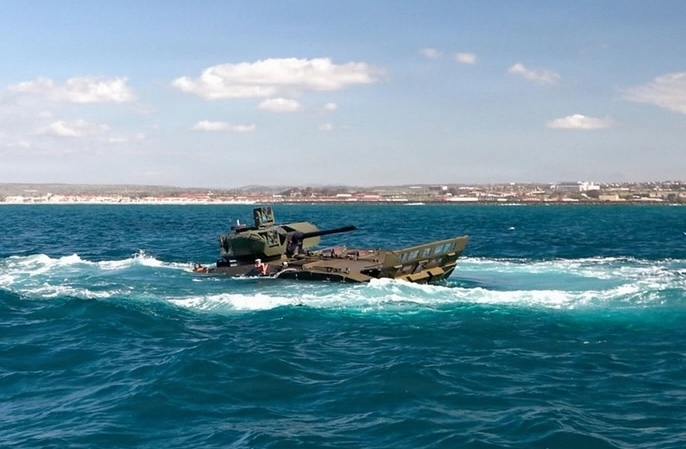
Each vendor developed its own version of two variants within the ARV family of vehicles. The variant that underwent water testing was the ARV-30, a medium-caliber autocannon vehicle.
The ARV-30 entered open waters at the Amphibious Vehicle Testing Branch at Camp Pendleton, California. Testing included still water operations, calm water mobility and other drills, observed by Stephen Bowdren, PEO Land Systems, PM LAV personnel and other subject matter experts, who also received demonstration reports from Textron and GDLS operators.
Officials described the initial swim test as a significant achievement demonstrating the platform’s ability to meet the Marine Corps’ demanding amphibious requirements. Designed for transport and employment in coastal environments, the ARV is intended to be highly mobile, networked, transportable, protected and lethal to address the challenges of peer-to-peer conflict.
“The whole point whether it’s this vendor (Textron Systems) or GDLS is the swim tests provide confidence in the design. These tests give the vendors important feedback so they can go back and refine their designs to make sure they’re offering the best capabilities to the government over the next phase of the program, and we get to a production down select,” explained Col. Stephenson, Program Manager of PM LAV.
Stephenson said the ARV represents a major advance over the legacy Light Armored Vehicle it is set to replace. “There is no question the LAV has been a wonderful vehicle for the Marine Corps for the last 40+ years, but there’s a limit to how much you can iterate on a 40-year-old design. The ARV brings a truly modern platform, designed using the best commercial practices for significant safety and interconnectivity improvements,” he explained.
“Beyond the vehicle itself, the real transformation is how it will enable Marines to communicate and fight. By integrating both manned and unmanned systems, the ARV will host the advanced capabilities required to support the kill webs of a future fight—allowing us to rapidly digest, analyze, and provide critical situational awareness to the commander,” Stephenson added.
The ARV is designed as a purpose-built combat vehicle system to serve as the manned hub of a robotic and autonomous systems-enhanced team. It will employ advanced sensor, communications and combat capabilities to collect and share information, integrating robotics and artificial intelligence to extend awareness and threat detection ranges.
The program also reflects a new acquisition strategy within the Marine Corps. It is the first Marine Corps program to use new legislative reforms aligned with guidance from the Secretary of the Navy, enabling agile contracting authorities to accelerate capability delivery.
PM LAV is using Other Transaction Agreements with both GDLS and Textron Systems to increase flexibility and speed. “The ARV program is a prime example of how we are thinking differently about major acquisitions. By leveraging Middle Tier Acquisition pathways and Other Transactional Authorities, we are empowered to move faster than traditional models. This approach is about making judicial decisions—we identify the most pressing near-term concerns and match them with only the bare amount of process and oversight necessary to get to the next step. It allows us to field, demonstrate, and refine a capability much more quickly,” explained Stephenson.
The successful swim tests represent one of the final events in the rapid prototyping phase before the program transitions to pre-production development. Awards are expected in the coming months for a four-and-a-half-year competition in which each vendor will deliver 16 prototypes of varying ARV variants, with the winner deploying six pre-production vehicles to the Fleet Marine Force and a final down select anticipated around 2030.
For Marines expected to operate the platform, the new system is seen as a significant operational shift. “We’re moving from a vehicle with a couple of switches to a fully electronic, hands-on platform,” explained SSgt. Coffey of 4th Light Armored Reconnaissance Battalion.
“While there might be an initial learning curve, the amount of information and control the ARV will give the crew is a game-changer. That technology directly translates to keeping Marines safe. The ability to have full awareness without physically popping the hatch not only protects the crew but makes us more effective in the fight,” he said.