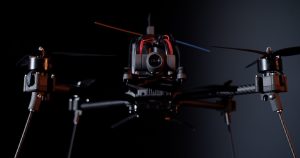
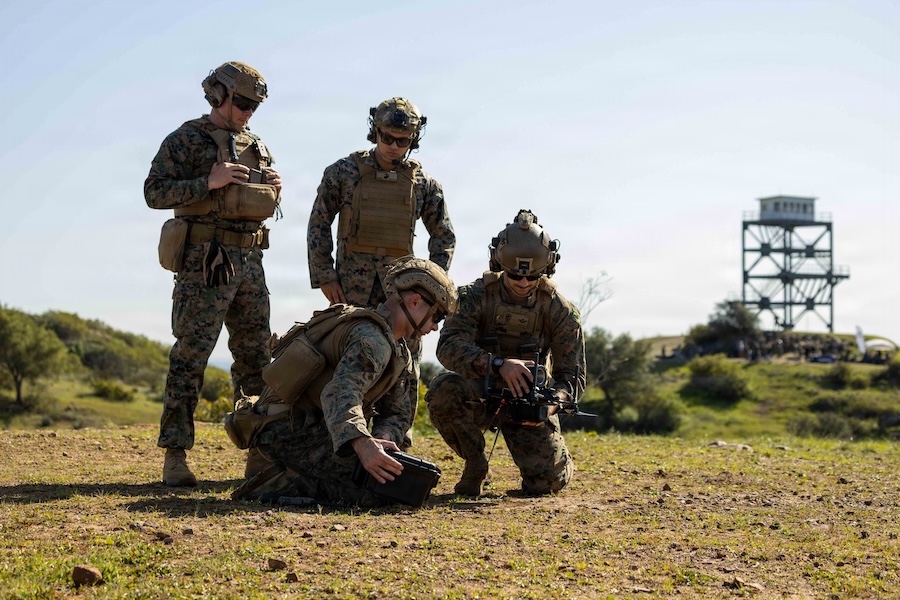
The three-day event focused on “ready now” FPV drone solutions designed to maintain command-and-control and video feeds when radio-frequency links are degraded.
Unlike traditional unmanned aircraft systems that rely on wireless signals, fiber optic cables provide a physical data connection between the operator and the aircraft, reducing vulnerability to electronic warfare and enabling more reliable use in denied environments.
The evaluation brought together Marines from 3rd Light Armored Reconnaissance Battalion and 1st Light Armored Reconnaissance Battalion, with I Marine Expeditionary Force coordinating alongside the Defense Innovation Unit under Project G.I., a Department of War-wide effort to accelerate solutions addressing joint warfighter needs.
Participating vendors included Auterion, Kraken, ModalAI, Neros and Nokturnal AI, with support from Contact Front Technologies.
“Fiber-optic tethered FPV capabilities are required on today’s battlefield,” said Col. Michael Carroll, assistant chief of staff, G-9, I Marine Expeditionary Force. “By deliberately building trained cadres within the command, I MEF is positioned to scale pilots and capability rapidly, and to responsibly leverage every opportunity to integrate, evaluate and familiarize warfighters with proven systems.”
During the assessment, Marines evaluated how quickly operators could transport, set up and employ the aircraft while wearing full combat equipment, and examined the durability of controllers, displays and supporting gear.
They also assessed how effectively each platform integrated with tactical command-and-control tools and how reliably the fiber optic cable performed during over-water control and data transmission, marking the Marine Corps’ first deliberate over-water evaluation of fiber-optic cable performance for FPV sUAS.
The event allowed participating companies to observe operator workflows and receive direct feedback on usability, reliability and mission-driven requirements, while Marines compiled observations and recommendations to guide future refinements.
“The pace of change in robotics and autonomous systems is unlike anything we’ve seen before. Capabilities are evolving daily, not over years,” said Maj. Steven Atkinson, I MEF DIU mission partner. “In that environment, there will never be a single ‘silver bullet’ system, which is why the Blue UAS List must be continuously updated with a diverse set of best-of-breed platforms and components. Through our partnership with DIU, I MEF brings together Marines from multiple units, MOSs, and backgrounds to do exactly that, ensuring the systems added to the Blue List are not only policy-compliant, but operationally lethal, interoperable, and survivable in contested environments.”
Project G.I., launched in June 2025 with prize funding to support live evaluations across multiple design reference missions, uses an accelerated approach to move mature technology from proposal to hands-on testing in months rather than years.
The Defense Innovation Unit structured the effort to involve operators early, test systems under real operational constraints and rapidly iterate toward scalable capabilities across the services.
I Marine Expeditionary Force has led field-based evaluations under the challenge, bringing together Marines with recent operational experience and ensuring end-user feedback is translated into actionable requirements and delivered directly to industry teams.
Last summer, Marines assigned to I MEF partnered with the Defense Innovation Unit and vendors during a larger Project G.I. evaluation at Marine Corps Base Camp Pendleton, combining familiarization training with scenario-based demonstrations that informed follow-on selection and development.
The January event built on that effort by concentrating on fiber optic cable performance, a capability increasingly associated with maintaining drone effectiveness under electronic attack.
Marines assessed how FPV systems connected by fiber optic cables could support tactical kinetic effects while sustaining control and video in environments where traditional links can be disrupted.
“A fiber optic cable connected to an attack drone gives the ground force commander more options when it comes to precision fires in a GPS or communications-denied environment,” said 1st Lt. Kienan Morrissey, an intelligence officer with 3rd Light Armored Reconnaissance Battalion who supported the evaluations. “Operator-to-vendor feedback is critical in this phase of the evaluation to ensure drone systems are mission capable, continuously improved and lethal in the hands of the end users.”
Insights from the evaluation will inform continued refinements as Project G.I. advances, with selected systems expected to move closer to procurement pathways and broader availability for Department of War purchase and operation following compliance and cybersecurity reviews.
I Marine Expeditionary Force provides combatant commanders with a globally responsive, expeditionary and scalable Marine Air-Ground Task Force capable of generating, deploying and employing ready forces for crisis response, forward presence and major combat operations.