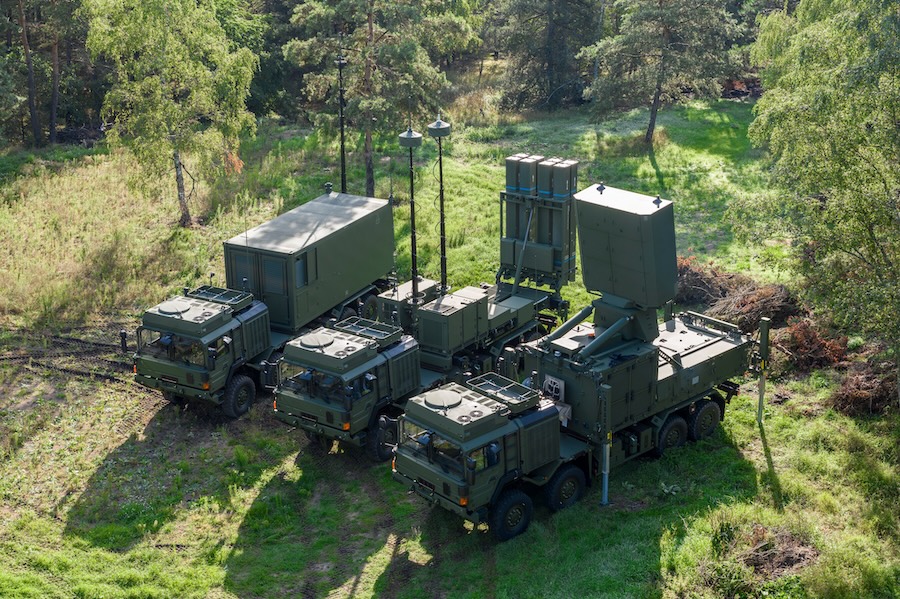

The MADIS consists of two Joint Light Tactical Vehicles, with one vehicle focused on detection and the other on offensive action. Together, they form a manoeuvrable ground-based air defence system designed to counter unmanned aircraft systems as well as manned fixed-wing and rotary-wing threats while on the move or at the halt.
In its full-rate production configuration, MADIS combines 30mm cannons, Stinger missiles and multifunctional electronic warfare equipment. The system provides 360-degree detection and protection, enabling simultaneous engagement of threats using kinetic and non-kinetic effects.
“These systems will increase capabilities of counter-unmanned aircraft systems operations and provide automatic target recognition and weapon assignment to decrease engagement times and reduce the cognitive load on the Marine operator,” said Lt. Col. Mike Billings, product manager for Future Weapons Systems at PM Ground Based Air Defense. He added: “The next step is to deliver the full rate production MADIS to all low altitude air defense battalions and littoral anti-air battalions across the Marine Corps, at a rapid rate.”
Since its reactivation in 2023, 1st LAAD Battalion has advanced Marine Corps force design initiatives, including the activation of Firing Battery Alpha in August 2024 and Firing Battery Mike in December 2025. The fielding of MADIS units represents a further milestone in the battalion’s development.
“Owning these systems gives us direct control capability,” said Master Gunnery Sgt. Mario Guadarrama, battalion operations chief for 1st LAAD Battalion. He added: “Reducing the gap between training and combat employment allows seamless integration with partners and allies throughout the Indo-Pacific region.”
The direct fielding of MADIS to 1st LAAD Battalion enhances expeditionary ground-based air defence in support of 1st Marine Aircraft Wing. The system supports the battalion’s primary mission of providing close-in, low-altitude surface-to-air defence capabilities.