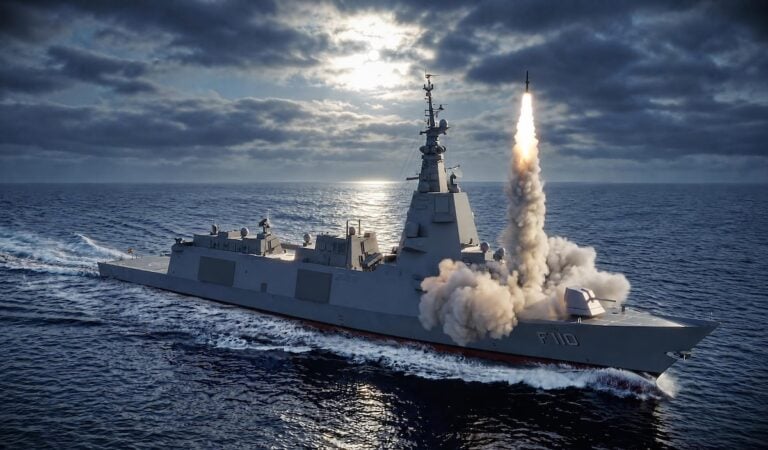
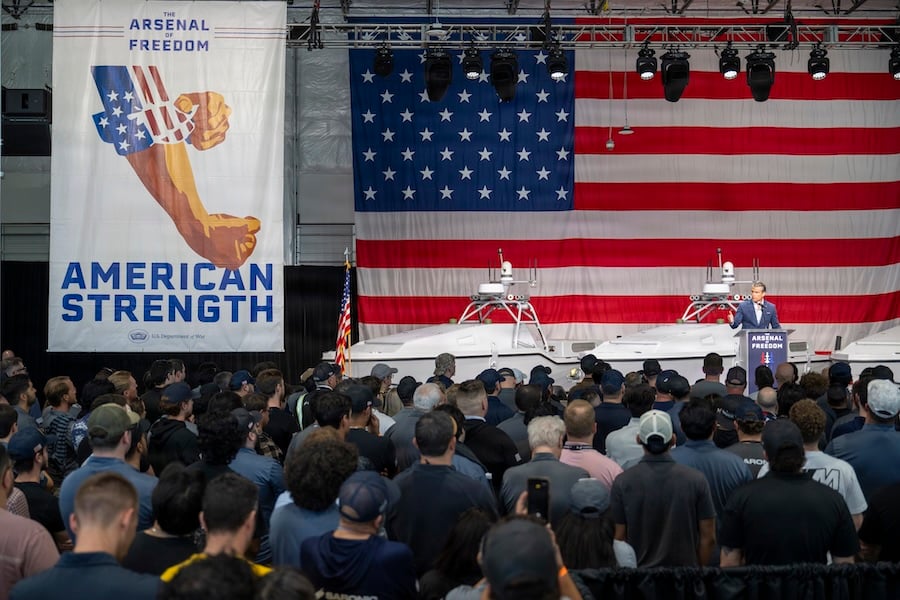
Rebuilding the U.S. defense industrial base is one of the strategy’s four priorities. The department calls for bringing strategic industries back to the United States and investing in factories that can produce weapons and ammunition faster, at greater scale and to the standard the military requires.
The strategy describes the effort as “a national mobilization,” invoking the industrial expansions that supported the United States during the world wars and the Cold War. The task it sets for industry runs from developing weapons and producing them in volume to keeping them in service and replacing munitions as forces use them.
The department wants to strengthen the military’s own capacity to maintain and repair equipment. It also includes transportation, distribution and resupply in its plans for the industrial base, recognizing that additional factory output is useful only if the military can get it to the units that need it.
The Pentagon plans to bring more nontraditional suppliers into defense production while continuing to work with established contractors. It also calls for adopting technologies such as artificial intelligence and removing outdated rules and practices that impede production, leaving specific changes and applications open.
The strategy gives some indication of where the military will need that capacity. It calls for developing Golden Dome to defeat large missile barrages cost-effectively, fielding systems to counter drones and modernizing U.S. nuclear forces.
The strategy’s clearest proposal on defense trade concerns Europe. The Pentagon says it will work to lower transatlantic trade barriers and expand industrial cooperation as it asks European NATO members to take primary responsibility for the continent’s conventional defense and lead support for Ukraine.
The department cites NATO’s Hague commitment to spend 3.5% of gross domestic product on core military needs and another 1.5% on security-related spending. It wants to promote that benchmark beyond Europe and says it will give priority to arms sales and industrial cooperation with allies that spend more and do more to address threats in their regions.
For European manufacturers, the strategy points to two sources of demand: governments building up their own forces and a Pentagon willing to use allied production to meet U.S. requirements. How much of that demand reaches European factories will depend in part on which trade barriers Washington and its partners reduce and what equipment they choose to buy.
The strategy takes seriously the prospect that a crisis in one region could give an adversary an opening in another. It calls for the United States to give priority to homeland defense and the Indo-Pacific while allies take the lead in Europe, the Middle East and on the Korean Peninsula, with more limited U.S. support.
That division of responsibility works only if partners can keep their forces supplied when the United States faces heavy demand of its own. If several crises unfold at once, the same allied factories Washington hopes to draw on could also be filling urgent orders from their own governments.
Go deeper: 2026 National Defense Strategy (U.S. Department of War).