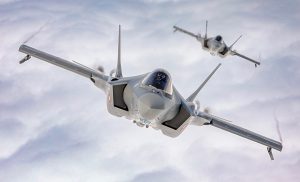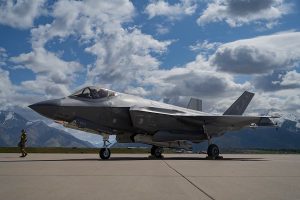

FCLP is mandatory for all pilots of fixed-wing aircraft assigned to the USS George Washington (CVN 73). Participating aircraft included F-35C Lightning IIs, F/A-18E/F Super Hornets, EA-18G Growlers, and E-2D Hawkeyes.
“This is the training that is required for Air Wing 5 air crews to get ready to go to sea,” said Capt. William Fallon, assistant chief of staff for Commander, U.S. Naval Forces Japan/Navy Region Japan. “[There is a great] amount of effort in the practice and the professionalism that goes into learning how to do this.”
The training also involved landing signal officers (LSOs), known as “paddles,” who play a crucial role in guiding aircraft to safe landings at sea. “Today, specifically, the paddles are training on the manually operated visual landing aid system (MOVLAS),” said Lt. Cmdr. Tory West, an LSO attached to CVW-5.
According to Fallon, the training site at Iwo To replicates carrier conditions well, especially at night. “It’s very dark at night, so it feels similar to our carrier environment,” he noted.
Despite its advantages, Iwo To poses logistical difficulties and lacks alternate airfields, limiting its use as a permanent FCLP site. “If there’s a problem, we don’t have any other place to land,” Fallon explained, adding that closer mainland sites would offer improved safety margins.
Air Wing 5 comprises several squadrons, including VAQ 141, VAW 125, HSC 12, VFA 147, and VFA 102. It became the U.S.’s first permanently forward-deployed air wing in 1973, initially aboard the USS Midway (CV 41).