

Navy leaders acknowledged that extended time at sea carries measurable sacrifices for Sailors and their families. “Extended deployments demand endurance,” said Adm. Daryl Caudle, Chief of Naval Operations.
“They ask Sailors to miss births, anniversaries, and everyday moments at home. They ask families to shoulder additional responsibility. That sacrifice is real, and we do not take it lightly. The nation relies on these Sailors to remain forward and ready, and they continue to meet that responsibility with professionalism and pride,” Caudle said.
He emphasized that sustained readiness begins with people and leadership engagement. “The morale aboard Gerald R. Ford remains strong because leadership is engaged, systems are operating, and Sailors understand the importance of their mission,” he said.
“This crew is experienced, disciplined, and committed to one another. That cohesion matters during long deployments,” Caudle added.
Rear Adm. Paul Lanzilotta, commander of Carrier Strike Group 12, said maintaining morale requires deliberate daily attention and frequent communication. “Long deployments are challenging,” Lanzilotta said.
“Fatigue accumulates and time away from home weighs on Sailors. Our responsibility as leaders is to ensure they are supported — with reliable shipboard services, clear communication, and consistent engagement. I have walked the decks of Gerald R. Ford repeatedly during this deployment. What I see is a crew that remains focused, capable, and proud of the work they are doing,” he said.
Recent media reports raised concerns about shipboard systems, including sanitation, but Navy officials stated that systems are operating within expected parameters for a Ford-class carrier with more than 4,000 personnel embarked. During the deployment, the ship’s vacuum collection, holding, and transfer system has processed more than six million toilet flushes, with clog incidents addressed promptly by trained personnel.
“On a ship this size, with this many Sailors, clogs will occur,” said Capt. David Skarosi, commanding officer of USS Gerald R. Ford. “What matters is how quickly they are resolved. Our maintenance teams respond immediately, and the system continues to function as designed with no impact to operational readiness or our ability to meet our mission. I am engaged daily with any concerns regarding the health, wellbeing, and morale of the crew.”
“In most instances,” Skarosi added, “clogs are the result of items being flushed that should not be introduced into the system. When Sailors follow proper procedures, the system performs reliably. We continue to train new Sailors and reinforce those standards across the crew.”
Beyond sanitation, the ship continues to sustain quality of life conditions, producing more than 400,000 gallons of potable water daily to support showers, laundry, food preparation, and drinking water. Since departure, the Supply Department has served more than four million meals, supported by regular underway replenishment operations.
Bandwidth for morale, welfare, and recreation internet access has been expanded through commercial satellite augmentation, including Starlink capability, improving Sailors’ ability to communicate with families and access news and approved streaming services. “Connectivity and routine matter,” Lanzilotta said.
“When Sailors can speak with their families, read trusted news sources, maintain physical fitness, and rely on stable shipboard systems, it strengthens resilience,” he added.
Command-sponsored initiatives have included morale and holiday events when feasible, fitness competitions, movie nights, educational programs, and expanded chaplain and counseling services. Leadership has also conducted routine inspections of berthing and workspaces to address quality of life concerns early.
“Our Sailors understand the importance of their service,” Caudle said. “They are away from home longer than planned because the nation needs them forward and ready. I want them to take great pride in that calling. The American people should be confident that USS Gerald R. Ford remains ready, and they should be proud of the men and women serving aboard her.”
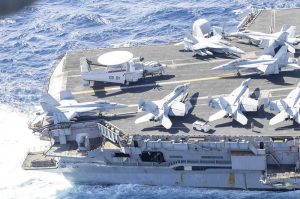
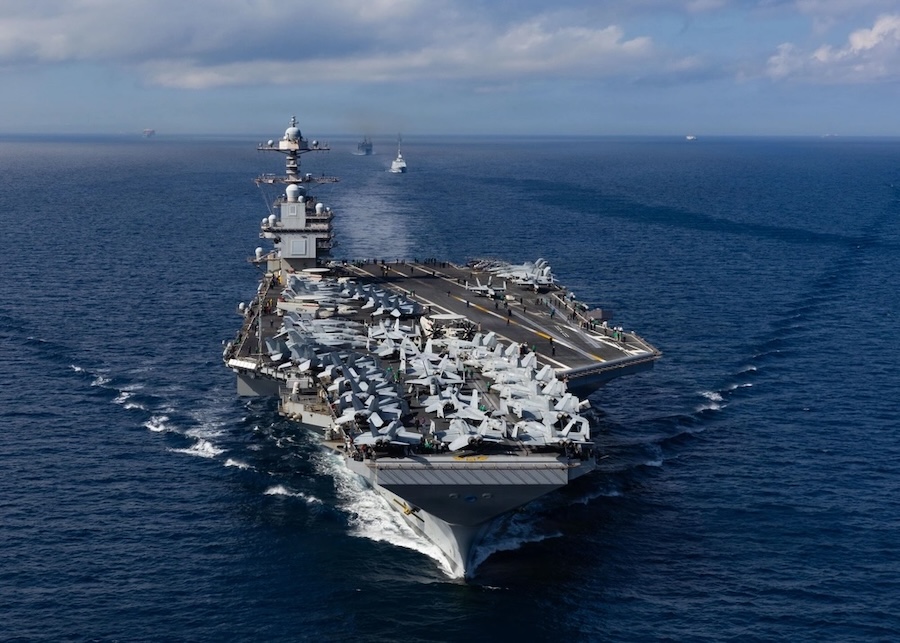
The carrier recently completed a scheduled port call in Souda Bay, Crete, for resupply of food, fuel, and ammunition, providing Sailors time for rest and recreation. USS Gerald R. Ford, the lead ship of its class, features an advanced flight deck design, Electromagnetic Aircraft Launch System, and advanced arresting gear, with preliminary reports indicating increased sortie generation rates compared to Nimitz-class carriers, and continues to carry out scheduled mission tasking as part of Carrier Strike Group 12.
Source: U.S. Navy.