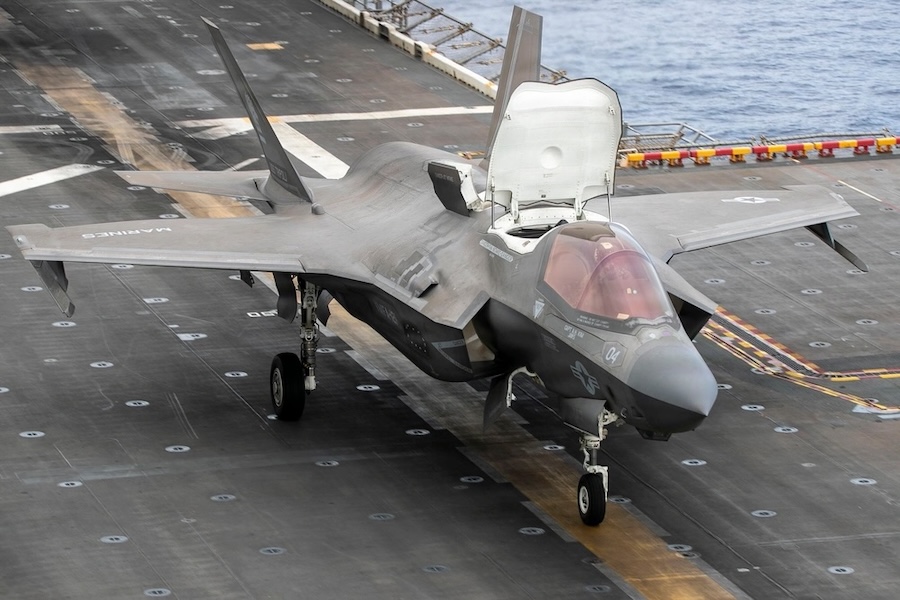
The aircraft’s successful test flight clears the way for deliveries of radar-less jets to the Air Force, Navy and Marine Corps in the coming months. These deliveries could continue into next year until Northrop Grumman completes production of the APG-85 radar.
Under the program structure, the radar is treated as government-furnished equipment and is separate from the aircraft itself. As a result, jets can be delivered before installation of the advanced radar, even though this limits their operational capability.
Fighter aircraft without radars can still perform certain training functions but are restricted in combat and combat training roles. Despite this limitation, officials have opted to continue production and delivery rather than halt the program.
“The Department of War deliberately undertook a highly concurrent development and production program for Block 4 capabilities [including the APG-85] and the largest fighter aircraft production line in the world,” said Marine Corps spokesman Capt. Jacob Sugg. “DOW officials made this decision with full understanding of the risk of having production aircraft ahead of the Block 4 capabilities. The services’ decision ensured that production aircraft could accept Block 4 capabilities, rather than continuing to build Block 3 F-35s that would require extensive retrofit for Block 4 capabilities, thereby saving multiple years of retrofit hardware installation.”
The delays stem from the complexity of integrating the new radar into the F-35’s architecture, including structural changes to the aircraft. The redesigned radar mounting bulkhead is not compatible with the older AN/APG-81 radar, complicating interim solutions.
Industry experts say continuing production is the least disruptive option despite the short-term capability gap. “You can’t turn off an aircraft production line and then turn it on and surge it when all the parts and pieces come together,” said Heather Penney, director of studies and research at the Mitchell Institute.
“If we were to turn off production on the F-35, not only would that then go dark, and we would lose all those skilled workers, you’d lose the running of the production line and how smooth all of that is. … You’re not going to be able to make up for the jets that you didn’t build,” she added.
Penney said the approach reflects a calculated decision to prioritise long-term capability development over short-term readiness. “For a program that is this complex, I think they were smartly leaning into the future,” she said. “They [just] didn’t anticipate the delays with the radar delivery.”
Even without radars, the F-35 retains some operational utility through its advanced sensor suite and data-sharing capabilities. “It’s still a very viable combat asset,” Penney said. “Is it ideal? Is it as fully capable? It’s not. But if you are able to mix the formation, then you can make up for the lack of radar in many ways.”
Source: Air & Space Forces Magazine.




![CENTCOM chief says U.S. forces remain ready after ‘generational’ defeat of Iran despite fragile ceasefire [VIDEO]](https://defence-industry.eu/wp-content/uploads/2026/04/centcom-chief-says-us-forces-remain-ready-after-generational-defeat-of-iran.jpeg)
![Team Lynx details XM30 infantry fighting vehicle concept as U.S. Army program nears key decision [VIDEO]](https://defence-industry.eu/wp-content/uploads/2026/04/team-lynx-details-xm30-infantry-fighting-vehicle-concept.jpeg)