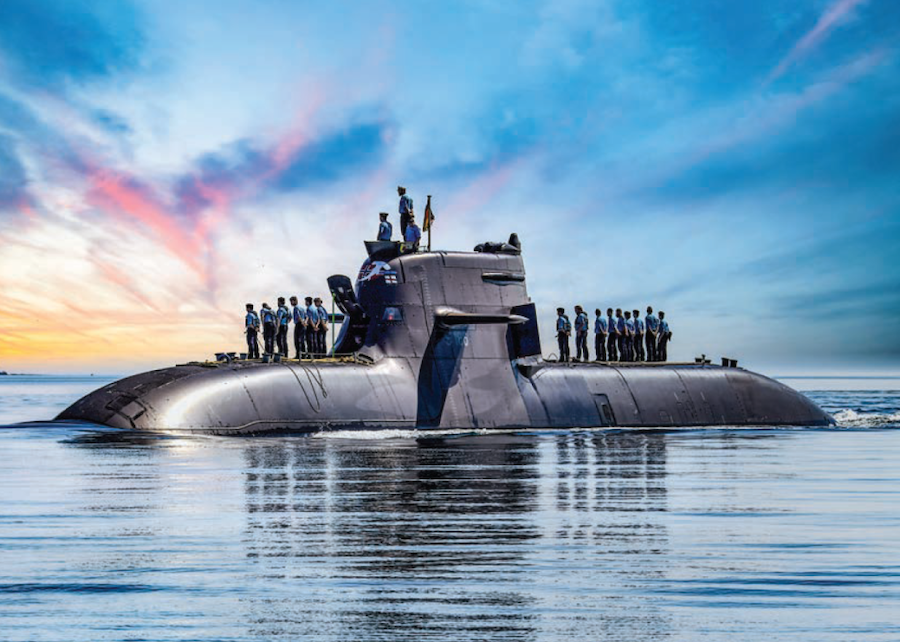

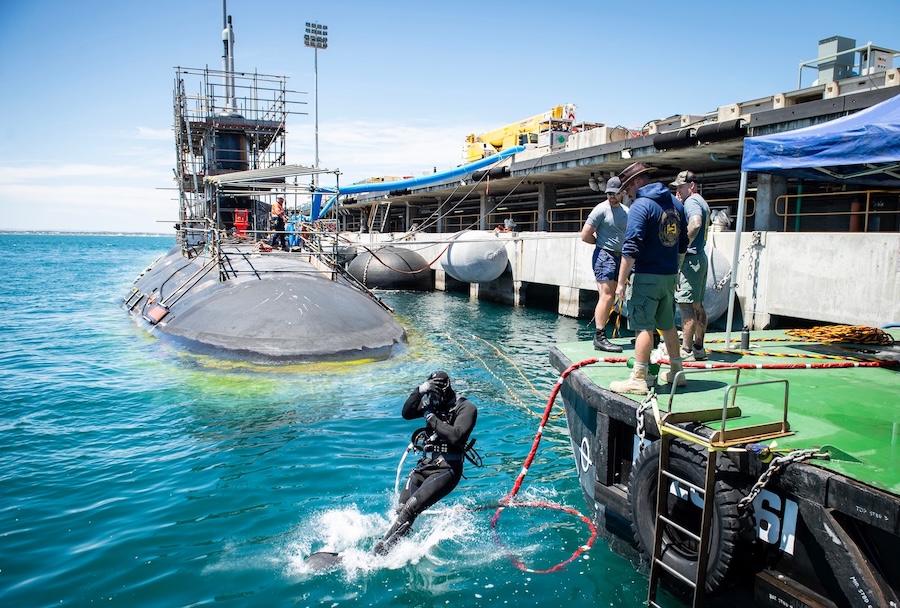
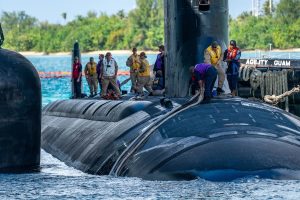
“This was the first time a maintenance availability at this level has ever been done on a Virginia-class outside the United States,” said Cmdr. Matthew Lewis, commanding officer of Vermont. “The ability to work through differences, uphold safety standards and execute all the planned work was huge.”
The maintenance period was carried out at HMAS Stirling by a blended American and Australian team led by Pearl Harbor Naval Shipyard and Intermediate Maintenance Facility. The flyaway workforce from Hawaii provided technical oversight and worked alongside Australian personnel, illustrating an integrated approach to submarine sustainment under AUKUS Pillar I.
“This maintenance period demonstrates what AUKUS Pillar I is designed to deliver,” said Rear Adm. Rick Seif, U.S. Navy, AUKUS Integration and Acquisition program manager. “We are moving from planning to execution. Each successful availability strengthens allied readiness and our ability to sustain submarines forward in the Indo-Pacific.”
Before work began, U.S. and Australian officials had to address how to support a nuclear-powered submarine at a foreign pier without the established infrastructure of a U.S. shipyard. Authority to conduct submarine maintenance in a foreign port was provided through bipartisan legislation in the Fiscal Year 2024 National Defense Authorization Act and approval from Secretary of War Pete Hegseth.
“Seventy-five to 80 percent of any submarine maintenance availability is simply setting the conditions to do the work,” said Capt. Jason Pittman, AUKUS I&A’s liaison to the Australian Submarine Agency. “Temporary shore power, high-pressure air, chilled water and staging all have to be in place before you can even begin.”
Australian industry installed several of those enabling systems, including a mobile pure water purification plant manufactured in Western Australia and placed on the pier for the duration of the maintenance period. U.S. nuclear-powered warships require high purity water, traditionally supplied by fixed facilities.
“We provided the chemical specification for the water we needed, and Australian industry developed the solution,” Pittman said. “It is efficient, affordable, mobile and performs exactly as required.”
More than 200 individual maintenance tasks were completed before the submarine departed, ranging from hull preservation and temporary services to system access, testing and restoration. Royal Australian Navy sailors and civilians involved in the work had previously trained at Pearl Harbor Naval Shipyard and Intermediate Maintenance Facility earlier in the year.
“For me, equally important to the physical work we did on the deck plate were the relationships we forged with the shipyard teams and the U.S. maintenance side,” said Royal Australian Navy Fleet Support Unit Chief Petty Officer Steven Sheakey. “That trust is what makes everything else possible.”
Royal Australian Navy Fleet Support Unit Petty Officer Christopher Warnes said the experience reshaped his view of Australia’s role in submarine sustainment. “This was the first time we’ve performed maintenance at this level on a nuclear-powered submarine,” said Warnes. “We proved we could do it. For instance, in my section, if someone was missing a part or resource, I was able to take them to the amazing facilities that we do have here to find a solution.”
PHNSY & IMF Project Superintendent Maea Lefotu led the technical execution in what he described as a new operational setting. “For me, this is about sharing more than 20 years of experience and applying it in a new environment,” Lefotu said. “The work is familiar, but the environment and logistics are not. Everything here requires more coordination, more communication and more trust.”
“Our meeting rhythm kept everyone on the same plan,” he said. “The Pearl [Harbor] team, along with the ship’s force, the Australian and U.K. sailors and civilians were all working toward the same goal.”
British engineers and officers were embedded throughout the maintenance period as they prepare for their own nuclear-powered submarine maintenance at HMAS Stirling in early 2026. “The U.K. does not consider a U.S. submarine maintenance availability at HMAS Stirling to be a U.S.-only maintenance availability,” said Capt. Shaun Southwood, the U.K.’s liaison officer for AUKUS in Australia. “Every submarine maintenance period here is trilateral.”
“What the U.S. learned here directly supports the upcoming U.K. maintenance period,” Southwood said. Lessons from the 2025 availability are now feeding into preparations for the United Kingdom’s first submarine maintenance period at the site.
Officials said the operational impact is immediate, particularly in reducing transit times for submarines operating in the Indo-Pacific. “A submarine that can receive maintenance here instead of returning to Hawaii saves weeks of transit time,” said Lt. Cmdr. Ryan Willis, the AUKUS I&A representative at HMAS Stirling and maintenance operations liaison during the period.
“This is a huge enabler,” Lewis said. “It gives the forward-deployed operational commander flexibility in how submarines are managed. Having another location where we can safely execute maintenance makes it easier to sustain forward presence in the Indo-Pacific.”
“This is about building a network of trusted partners who can sustain undersea forces forward, at speed and at scale,” Seif said. “What was demonstrated at HMAS Stirling moves us closer to that goal and keeps AUKUS on track to support increased allied submarine presence when and where it matters.”
“This is how submarine sustainment in Australia becomes real,” Pittman said. “Through people, partnerships and proven capability.”
Source: NAVSEA.

![CENTCOM chief says U.S. forces remain ready after ‘generational’ defeat of Iran despite fragile ceasefire [VIDEO]](https://defence-industry.eu/wp-content/uploads/2026/04/centcom-chief-says-us-forces-remain-ready-after-generational-defeat-of-iran.jpeg)
![Team Lynx details XM30 infantry fighting vehicle concept as U.S. Army program nears key decision [VIDEO]](https://defence-industry.eu/wp-content/uploads/2026/04/team-lynx-details-xm30-infantry-fighting-vehicle-concept.jpeg)