

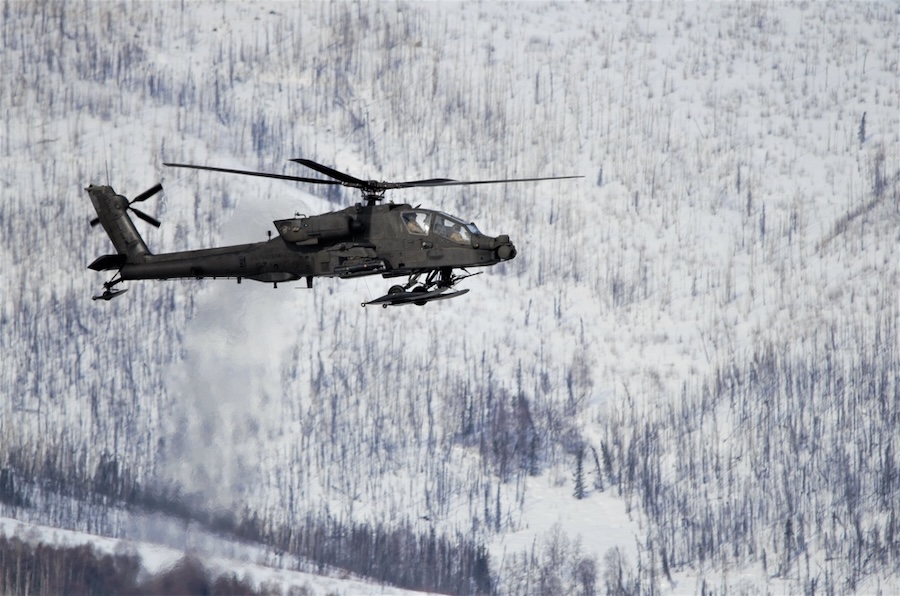
Operating in limited visibility and extreme cold, the Apache crews located and engaged enemy positions threatening inbound assault forces. The mission cleared the battlespace to enable a follow-on air assault by the 1st Infantry Brigade Combat Team (Air Assault), 11th Airborne Division.
The attack created a window for lift aircraft carrying brigade Soldiers to move into contested terrain. The exercise demonstrated the division’s ability to synchronize aviation fires with ground maneuver across Alaska’s austere environment.
Flying the newest AH-64E Apache variant, crews used digital connectivity and long-range targeting capabilities to conduct the mission while maintaining standoff from simulated threats. The aircraft were also equipped with Arctic-specific survival pods designed to sustain crews in the event of an emergency landing in remote, subzero conditions.
“D-model Apaches had fairly limited power and still fairly short range. With the E-models here, we finally have the right tool to make the best use of the mountains, the flats, restricted area, the emitters, all of the things Alaska offers,” said Lt. Col. Jeff Hayes, commander of 1-25th Attack Reconnaissance Battalion.
According to the Army, the upgraded aircraft improve the battalion’s ability to operate across Alaska’s complex terrain while integrating with ground maneuver forces. The mission required detailed coordination between attack aviation units, air assault planners and ground leaders to align timing, communications and target handoff procedures.
By suppressing threats and clearing the airspace ahead of the assault force, the Apaches reduced risk for lift aircraft inserting Soldiers onto the objective. This allowed ground forces to transition rapidly from movement to combat operations in demanding Arctic conditions.
The operation also highlighted the ability of Arctic Aviation Command to launch and sustain aircraft in extreme cold weather. Maintenance teams and ground crews worked continuously to keep aircraft mission capable despite deep snow, freezing temperatures and limited daylight.
Lt. Col. Jeff Hayes said operating in Alaska requires additional discipline and resilience. “Everything is tougher on the frontier,” he said, underscoring the division’s focus on refining its ability to fight, survive and operate effectively in one of the world’s most demanding environments.


![CENTCOM chief says U.S. forces remain ready after ‘generational’ defeat of Iran despite fragile ceasefire [VIDEO]](https://defence-industry.eu/wp-content/uploads/2026/04/centcom-chief-says-us-forces-remain-ready-after-generational-defeat-of-iran.jpeg)
![Team Lynx details XM30 infantry fighting vehicle concept as U.S. Army program nears key decision [VIDEO]](https://defence-industry.eu/wp-content/uploads/2026/04/team-lynx-details-xm30-infantry-fighting-vehicle-concept.jpeg)