

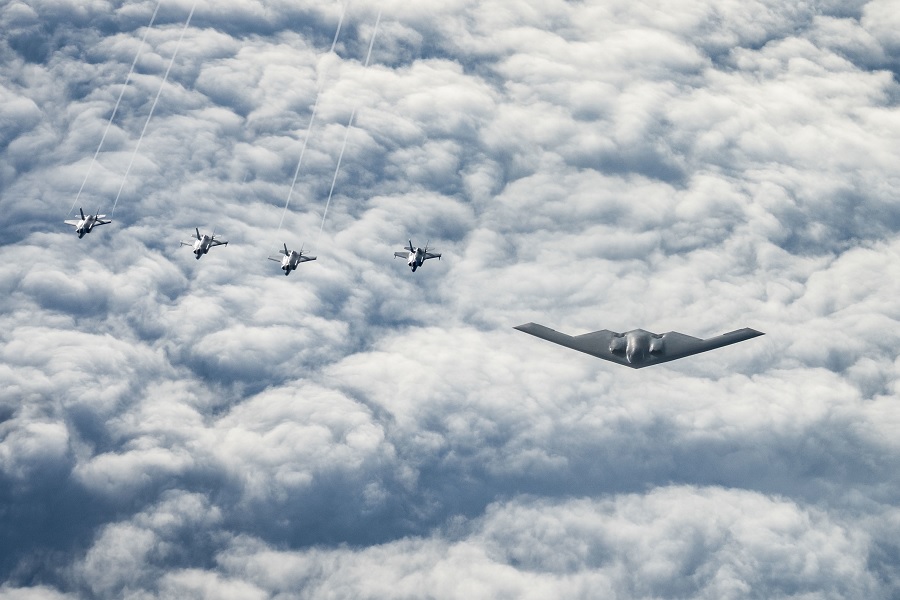
Central to the test was the U.S. Air Force’s B-2 Spirit stealth bomber, operated by the 53rd Wing, which carried and released the Air Force Research Laboratory’s QUICKSINK maritime weapon. The bomber engaged and sank a maritime target with precision-guided munitions, underscoring its strategic deterrence role as well as its enduring advantages of stealth, range, and payload flexibility.
The exercise, conducted in close partnership with Royal Norwegian Air Force F-35s and personnel, was designed to demonstrate seamless cooperation and interoperability between the two nations. Norwegian support, including access to airspace and infrastructure, enabled the U.S. forces to operate in a strategically relevant and operationally demanding environment.
“This test is a clear example of how we work with trusted allies to bring new capabilities into play faster and smarter,” said U.S. Air Force Col. Scott Gunn, 53rd Wing commander. “We’re not just preparing for tomorrow; we’re shaping it together.”
The B-2 Spirit’s role in this mission highlighted its continuing relevance beyond nuclear deterrence, reinforcing its evolving use in maritime strike operations. By employing the QUICKSINK precision strike system against a realistic surface vessel target, the aircraft demonstrated how stealth bombers can adapt to emerging operational demands while maintaining their central role in long-range strategic deterrence.
In addition to the strike itself, the test advanced tactics, techniques, and procedures for long-range sensor-to-shooter operations. These included integrating beyond-line-of-sight communications and multi-domain targeting, both crucial in contested theatres where resilient connectivity and coordination are essential for mission success.
“We are building readiness on both sides of the Atlantic and creating options that make maritime strike more distributed, survivable, and integrated,” said Lt Col. Stephen Bressett, commander of the 72nd Test and Evaluation Squadron. “We anticipate, adapt, and respond to what our senior leaders need at a speed that’s relevant to the strategic environment we’re in – that’s what the 53d Wing does best!”
The event also supported the development of both large and small variants of the QUICKSINK precision strike system. By validating prototype performance and refining operational concepts in a real-world setting, the test expanded the range of options available to commanders for maritime-focused operations.
Through this joint effort, the 53rd Wing and its Norwegian partners demonstrated the ability to accelerate innovation and integrate new technologies in realistic operational conditions. The cooperation reinforced both nations’ commitment to ensuring readiness in the High North, a region of growing strategic importance, while advancing the capability to deliver agile and resilient combat power across multiple domains.