

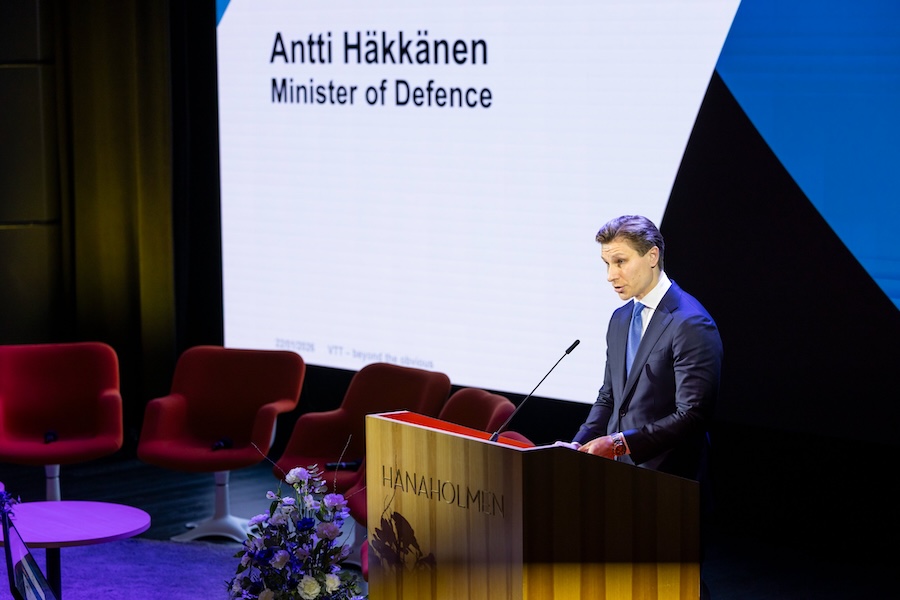
Finland’s Minister of Defence Antti Häkkänen said the decision to establish the site was based on national strengths in technology and defence. He stated: “We set out to get a NATO accelerator site in Finland because, as a country, we have high technology and strong defence expertise.”
Mr Häkkänen said the new accelerator supports both security and economic objectives. He said: “The accelerator inaugurated today will be good for research, defence and economic growth,” adding that “new technologies have significant growth potential across NATO.”
In his speech at the opening gala, the minister described the launch as “an important milestone – not only for Finland as a dedicated Ally, but for the entire Alliance.” He said that in the current security environment, “innovation is not a luxury – it is a necessity,” noting that defence innovation shapes future military capabilities and responses to emerging threats.
He explained that DIANA was created to help NATO maintain its strategic technological advantage as defence innovations emerge faster and strategic competitors invest heavily in new technologies. According to Mr Häkkänen, DIANA “offers a unique platform for fielding and maturation of defence innovations” by bringing together start-ups, researchers, industry and defence end-users across the Alliance.
The Finnish accelerator focuses on next-generation communication systems and quantum technology, providing business development training for companies participating in DIANA challenge programmes. Its main users are start-ups and small and medium-sized enterprises with limited prior experience in defence and security markets.
The site is operated by VTT Technical Research Centre of Finland in cooperation with Aalto University and the University of Helsinki. Mr Häkkänen highlighted VTT’s contribution, calling the new accelerator the “crown jewel” of Finland’s DIANA footprint.
He said the accelerator demonstrates Finland’s commitment to NATO’s innovation agenda and supports national objectives set out in Prime Minister Petteri Orpo’s government programme. Mr Häkkänen added: “By integrating defence considerations into national innovation policy landscape, we create stronger foundations for resilience, competitiveness, and international collaboration,” stressing that the ultimate aim is to strengthen the deterrence of the Alliance.