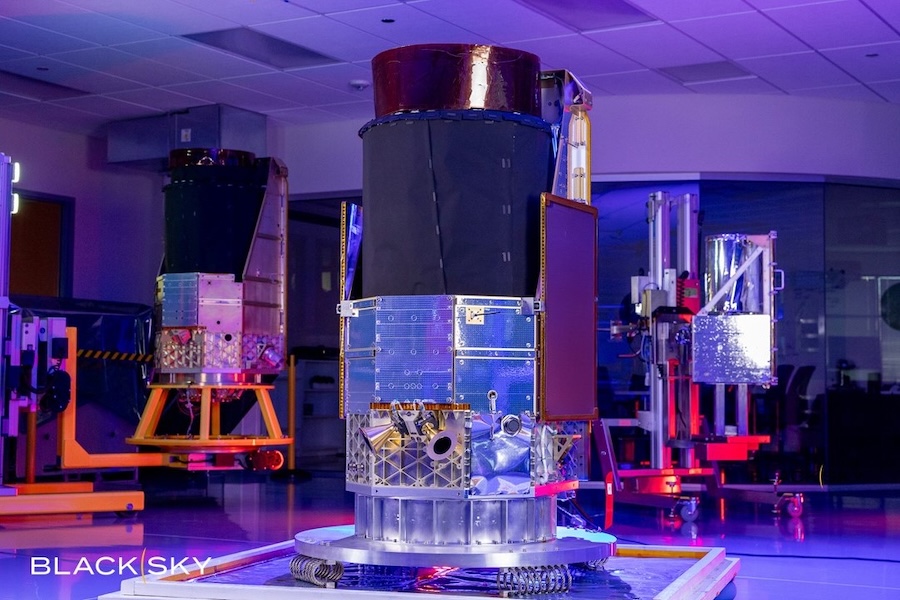



The programme will complement the existing fleet of EUMETSAT, Europe’s meteorological satellite agency, and is funded by its member states. It builds on the Arctic Weather Satellite demonstrator, which OHB Sweden previously developed and placed in orbit for the European Space Agency using a “New Space” approach.
The demonstrator satellite was developed in just three years from contract award to launch. It established the technical foundation for a larger constellation designed to deliver continuous meteorological data from the Arctic region.
OHB Chief Executive Marco Fuchs said the project highlights the company’s rapid development capabilities. “OHB Sweden developed a high-performance satellite in an exceptionally short time and demonstrated what is possible with clear goals. We can do New Space – the Arctic Weather Satellite, which now forms the basis of a large constellation, has proven that impressively,” Fuchs said.
He added that the contract reflects confidence in the company’s ability to scale up production. “We are proud of our team in Sweden and grateful for the trust placed in us by our partners, who believe in our ability to build a large satellite constellation. I am pleased that EPS Sterna will strengthen Europe’s top tier capabilities in Earth observation and that Sweden is receiving the largest satellite contract in its space history.”
The EPS-Sterna programme is intended to address gaps in weather data coverage over polar regions, where geostationary satellites are less effective. The Arctic Weather Satellite has demonstrated that small satellites equipped with microwave radar can deliver accurate temperature and humidity data even in dense cloud cover and extreme conditions.
The constellation will consist of three generations of six satellites each to ensure continuous data availability. These measurements are expected to support more accurate weather forecasting and improvements to global climate models.
Fredrik Sjöberg, Managing Director of OHB Sweden, said the contract represents a significant step for the company and the national space sector. “This contract represents an extraordinary milestone for OHB Sweden, and for the entire Swedish space community. We built the precursor satellite to this constellation, the Arctic Weather Satellite and demonstrated the functionality of the satellite and quality of data received from it, to improve European weather forecasting. The EPS-Sterna contract is the cumulated evidence that OHB Sweden and its partners are ready to lead, industrialize and deliver critical space infrastructure for Europe”, he said.
OHB Sweden will act as prime contractor for the constellation, leading a consortium that includes around 30 companies. Among them is Sweden-based Omnisys, which will supply the microwave instruments forming the core meteorological payload.
The satellites will be procured by EUMETSAT through the European Space Agency, while EUMETSAT will develop the ground segment and oversee operations. The organisation will also manage launches, operate the constellation and distribute the data, with the system expected to have a planned operational lifetime of 13 years.