Lockheed Martin opens First Digital Engagement Centre (DEC) outside the U.S. in Brussels
Lockheed Martin has inaugurated its first Digital Engagement Centre (DEC) outside the United States, located in Brussels.
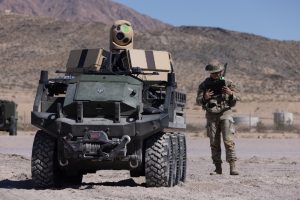
In March, over 6,000 soldiers, defence partners and multinational forces gathered at the National Training Center for Project Convergence Capstone 5 (PC-C5).
L3Harris Technologies and Air Tractor have delivered the first OA-1K Skyraider II aircraft to support the U.S. Air Force Special Operations Command.
Fincantieri has officially commenced construction of the first of two new-generation FREMM EVO frigates for the Italian Navy.
Defence technology company Rohde & Schwarz has unveiled ARDRONIS Effect, a next-generation multi-band jammer designed to counter increasingly sophisticated drone threats.
The F-35 Joint Program Office (JPO) and Norway, an F-35 Lightning II partner nation, have achieved a major milestone with Norway receiving its final two F-35As April 1.
Finnish technology firm KNL has signed a significant framework agreement with the Finnish Defence Forces and the Swedish Defence Materiel Administration.
Yet Europe is persisting with an old, tired model. Why? Because it’s peaceful. Europe is the world’s single greatest […]
Swedish defence technology company Nordic Air Defence (NAD) has announced the development of its first anti-drone missile, the Kreuger 100, aimed at tackling growing aerial threats across Europe.
Defence technology company Rohde & Schwarz has partnered with MILTON, a provider of autonomous airborne systems, to integrate advanced signals intelligence (SIGINT) technology into MILTON's drone platforms.
The Portuguese Air Force has officially joined Embraer and the Brazilian Air Force in a collaborative study to explore the adaptation of the KC-390 Millennium aircraft for Intelligence, Surveillance and Reconnaissance (ISR) missions.
Finland has announced plans to raise its national defence spending to at least three percent of GDP by 2029, significantly exceeding NATO’s current guideline.
Categories: