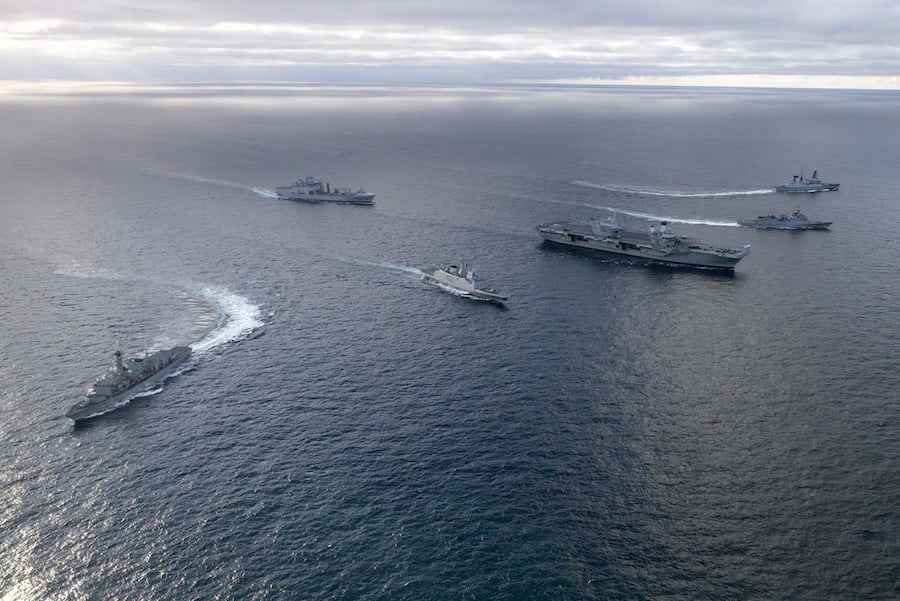
The Bear appeared while the carrier was leading an allied task group in Neptune Strike, one of NATO’s largest exercises. The Royal Navy said the size of the force had drawn Russian attention.
The Oslo visit follows a fortnight of intensive training in and around Norway and brings the active phase of the carrier’s 2026 Firecrest deployment to a close. The deployment has centred on operating the Portsmouth-based ship in Arctic and sub-Arctic waters to strengthen the defence of the North Atlantic, including the Iceland-Greenland-UK gap.
The carrier, her air group and supporting ships have worked alongside NATO allies to show they are ready to defend the alliance’s Northern Flank. The Royal Navy says the work should also lead to closer integration with allies in the future.
One of the more significant moments came at Hammernesodden, a military jetty near Namsos about 70 miles north of Trondheim, where the ship took on ammunition. No Queen Elizabeth-class carrier had done so in a foreign port before.
The Royal Navy said this gives the Carrier Strike Group more options if a solid support ship, such as RFA Fort Victoria or one of the future Resurgent-class vessels, is not available for resupply. It described the step as a way of widening the carrier’s warfighting capabilities.
Norway’s Home Guard secured the visit, with boats patrolling the fjord and heavily armed positions set up on the jetty. Out at sea, the Norwegian frigate KNM Fridtjof Nansen escorted the carrier, and Skjold-class corvettes joined the group to exercise with it.
Earlier in the phase, the carrier’s F-35Bs flew with Norwegian Air Force F-35As to escort a US B-52 bomber. The Royal Navy called it an extremely rare exercise between naval aviation and the US Air Force’s strategic bomber force.
After leaving Hammernesodden, the carrier switched to NATO duties for Neptune Strike 26-4. Her air group included F-35B Lightnings of 617 Squadron, the Dambusters, and Merlin helicopters from CHF and 820 Naval Air Squadron.
The latest round of the exercise began at the end of October and involved 17 nations, 20 warships and 40 aircraft across land, sea and air. Italy and Turkey each led a naval task group in the Mediterranean, while HMS Prince of Wales led the third off Norway.
Her group included her escort HMS Dauntless, KNM Fridtjof Nansen, the frigate HMS St Albans, a French frigate and the Norwegian tanker HNoMS Maud. Apart from the intercept, the F-35s worked on their strike role, loading and eventually dropping live Paveway IV bombs.
The carrier will berth at the head of Oslofjord, below the city’s historic Akershus Fortress, as the spring-and-autumn Firecrest deployment ends. She will host the Atlantic Future Forum and the International Sea Power Conference, with First Sea Lord General Sir Gwyn Jenkins leading the Royal Navy’s involvement.
The events will bring together defence chiefs, industry and policymakers to discuss the future of Euro-Atlantic security. Organisers describe the backdrop as an increasingly dangerous world.
HMS Prince of Wales is the UK’s fully operational front-line carrier, while her older sister HMS Queen Elizabeth works up after a long maintenance period. She remains at very high readiness should the government need her to respond to events abroad.