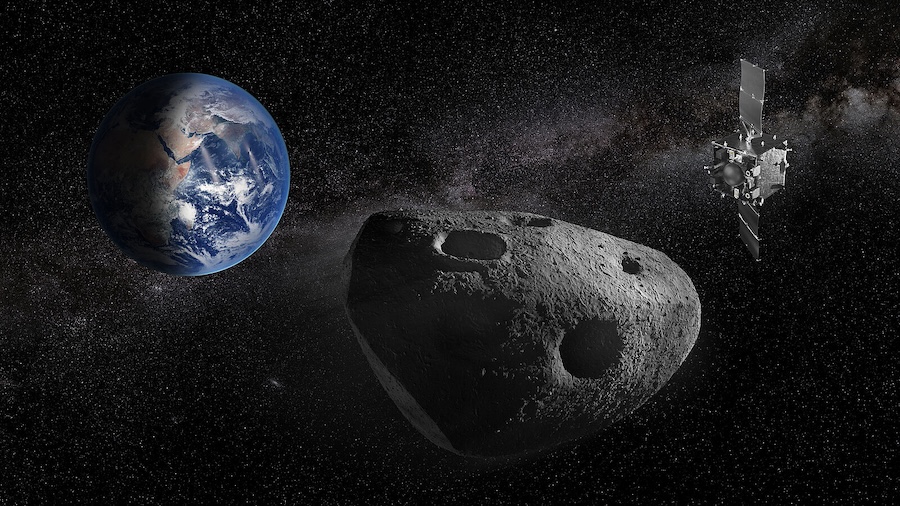
Including a preparatory contract awarded in 2024, the total value of the programme now amounts to approximately €150 million. The mission is designed to study the asteroid Apophis during its close approach to Earth in April 2029.
The contract has been awarded to OHB Italia, a subsidiary of the OHB Group. The mission builds on technological experience gained during the Hera mission, another European asteroid exploration programme currently en route to the Didymos–Dimorphos asteroid system.
OHB Chief Executive Officer Marco Fuchs emphasised the importance of meeting the demanding mission schedule. “RAMSES must launch in 2028 to reach asteroid Apophis about two months before its close approach to Earth. With Hera, we have already demonstrated together with ESA that we can move fast — and I’m even more pleased that we can now leverage our Hera heritage so quickly again,” he said.
Fuchs also highlighted the progress of the Hera mission, which continues to provide the technological foundation for the new programme. “Hera has successfully completed all maneuvers so far, and we are eagerly awaiting its arrival at its destination toward the end of the year,” he added.
The RAMSES spacecraft will be developed on an accelerated schedule, with construction, integration and testing planned within just three and a half years. This is possible because the spacecraft will reuse several technologies and design concepts originally developed for the Hera mission.
Hera itself was completed in approximately four years, roughly half the time normally required for missions of similar complexity. The RAMSES programme aims to reduce development time even further while adapting existing technologies to new mission objectives.
The mission focuses on the asteroid Apophis, which will pass Earth on 13 April 2029 at a distance of about 32,000 kilometres. This distance is closer than the orbit of Europe’s MTG weather satellites, which operate at around 36,000 kilometres above the planet.
RAMSES will perform optical and gravitational measurements of the 375-metre asteroid before, during and after its close flyby. Two accompanying CubeSats, including a lander, will investigate the asteroid’s gravitational field and conduct seismic measurements on its surface.
Marco Fuchs stressed the broader importance of the mission for planetary protection efforts. “With RAMSES and Hera, we are maintaining our leading position in the field of planetary defense. Protecting Earth from external threats is of the highest importance to OHB; in addition to our two asteroid missions, we are also contributing to asteroid detection through the Flyeye telescope,” he said.
The information collected by RAMSES is expected to help scientists better understand the behaviour of near-Earth asteroids. The mission’s data will support improved risk assessment and help develop potential strategies for deflecting hazardous asteroids in the future.