


“President Trump ensures that our enemies understand we’ll go as far as we need to go to advance American interests. But we’re not dumb about it. You don’t have to roll 200,000 people in there and stay for 20 years,” Hegseth said. The U.S. war in Afghanistan lasted nearly 20 years, while the conflict in Iraq under President George W. Bush extended for more than eight years.
“We’ve proven that you can achieve objectives and advance American interests without being foolish about it,” Hegseth told reporters. Although President Trump has urged Iranians to topple their leaders, Hegseth said the U.S. goal is not regime change as it was in previous wars.
“This is not a so-called regime change war … but the regime sure did change, and the world is better off for it,” he said. Iran’s Islamic regime announced new leadership over the weekend following the death of Supreme Leader Ayatollah Ali Khamenei, who had clashed with the United States for more than four decades.
The conflict began early Saturday with Israeli strikes on Iran and has since widened, with Tehran launching retaliatory attacks on Israel and Gulf states hosting U.S. bases, including the United Arab Emirates, Kuwait, Saudi Arabia, Qatar and Bahrain. Hegseth outlined U.S. military objectives, including neutralizing Iran’s ballistic missile sites and preventing it from obtaining a nuclear weapon.
“Iran has an ability to project power against us and our allies in ways that we can’t tolerate, so whether that’s ballistic missiles and drones, or offensive capabilities, effectively their navy, which would attempt to set other terms and impose different costs, drone capabilities, which we laid out there,” Hegseth said. “Those nuclear ambitions, which never ceased, are something that had to be addressed as well,” he added. “So that’s a discrete sense of what’s being addressed here to ensure that they can’t use that conventional umbrella to continue a pursuit of nuclear ambitions.”
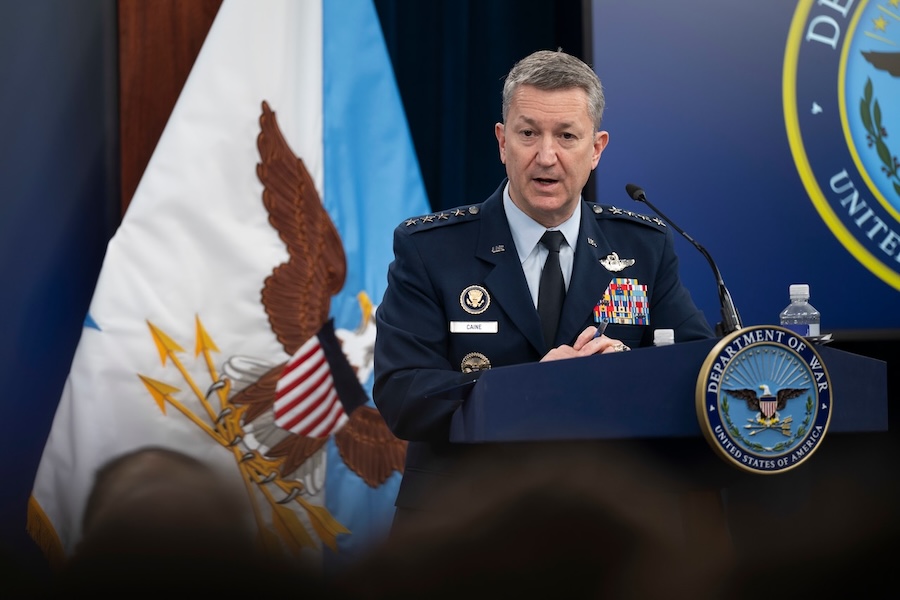
Joint Chiefs of Staff Chair Gen. Dan Caine said more U.S. military casualties are expected as the death toll rose to four. U.S. Central Command confirmed that a fourth service member died after sustaining injuries in Iran’s initial attacks.
“We expect to take additional losses, and as always, we will work to minimize U.S. losses,” Caine told reporters. “But, as the secretary said, this is major combat operations.”
“This is not a single overnight operation,” Caine said. “The military objectives that Centcom and the Joint Force have been tasked with will take some time to achieve, and in some cases, will be difficult and gritty work.”
Caine said part of the U.S. mission is to prevent Iran from being able to “project power outside its borders.” He added that additional forces would be deployed to the Middle East to support the operation, joining tens of thousands of service members already in the Central Command region.
When asked whether U.S. troops are currently on the ground in Iran, Hegseth declined to provide details. “No, but we’re not going to go into the exercise of what we will or will not do,” he said.
“I think it’s one of those fallacies for a long time that this department or presidents or others should tell the American enemies, by the way, here’s exactly what, here’s exactly how long we’ll go, here’s exactly how far we’ll go, here’s what we’re willing to do and not do — it’s foolishness,” Hegseth told reporters. He also declined to specify how long the operation might last after Trump suggested it could continue for four to five weeks.
“President Trump has all the latitude in the world to talk about how long it may or may not take. Four weeks, two weeks, six weeks. It could move up. It could move back,” Hegseth said.