
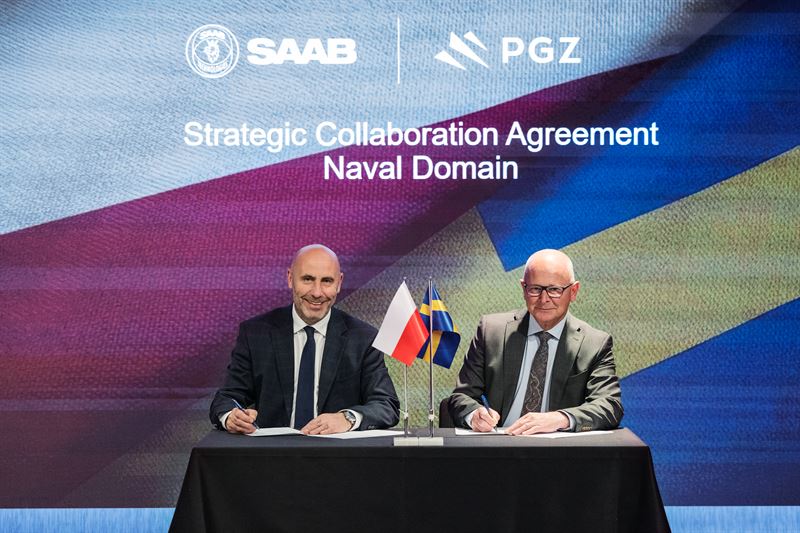
According to the companies, the agreement includes cooperation on the service and lifecycle support of surface vessels and submarines. Saab and PGZ also stated that they intend to integrate Polish naval entities within PGZ Group into Saab’s wider supply chain.
The companies said the partnership will also focus on selected export opportunities involving both surface and underwater platforms, including rescue vessels. In addition, Saab and PGZ announced plans to jointly evaluate the establishment of an Underwater Technology Centre in Poland.
The agreement also includes plans to assess future cooperation on the production and marketing of Saab’s Autonomous Ocean Drone. According to the companies, discussions will additionally explore potential collaboration on a heavyweight torpedo programme.
Micael Johansson, president and chief executive of Saab, said, “I am pleased to have signed this agreement today with PGZ and to see the speed at which our cooperation is advancing.”
“This agreement reflects a strong commitment to a deepening partnership between Polish and Swedish industry, while also contributing to enhanced security in the Baltic Sea and NATO’s eastern flank,” Johansson added.
The companies stated that the new agreement builds on a memorandum of understanding signed during the MSPO 2025 exhibition in Kielce in September 2025. According to Saab and PGZ, the earlier memorandum established the basis for expanded industrial and naval cooperation.
In March 2026, Saab and PGZ also signed a separate agreement related to submarine maintenance, repair and overhaul capabilities within Poland’s Orka submarine programme. The companies said the initiative is intended to support in-country industrial capabilities for future submarine operations.
Saab and PGZ further stated that they are exploring additional cooperation opportunities linked to multi-domain defence solutions and the production of mortar ammunition in Poland. According to the companies, the broader partnership is intended to strengthen regional defence capabilities and industrial cooperation within NATO’s eastern flank.