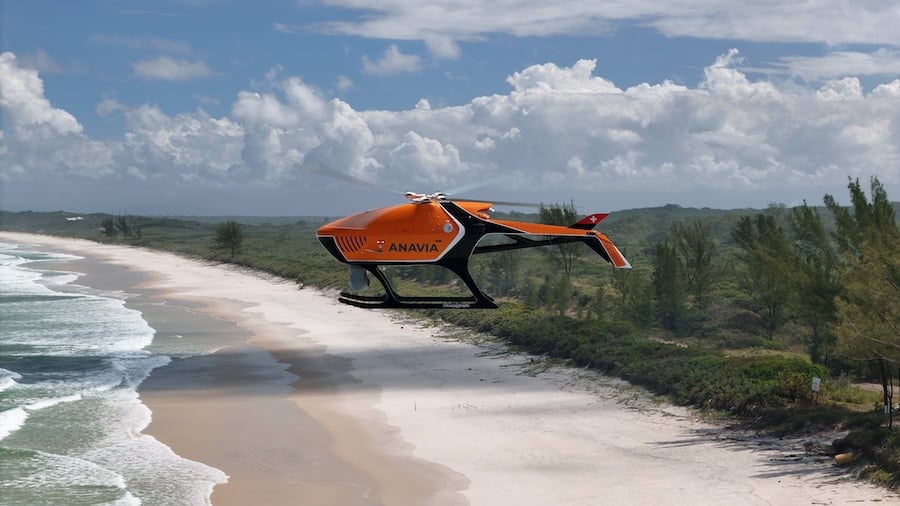
The Swiss manufacturer ANAVIA provides an example of how these requirements shape unmanned helicopter development. Its HT-100 accommodates different mission payloads, supporting applications ranging from maritime and border surveillance to energy infrastructure inspection. In an interview with Defence Industry Europe, ANAVIA founder Jon Andri Jörg discussed the thinking behind the platform and why customers increasingly expect a complete operational solution, encompassing mission equipment and long-term support.
“The idea behind setting up ANAVIA in 2019 was to develop an unmanned helicopter that could fly longer missions while carrying heavier payloads. There were already many sophisticated smaller drones on the market, but they were typically battery-powered and had limited endurance. We wanted to go beyond those limitations. We designed the powertrain around those requirements and then sought feedback from potential users across different markets. Their response was extremely positive,” Jörg said.
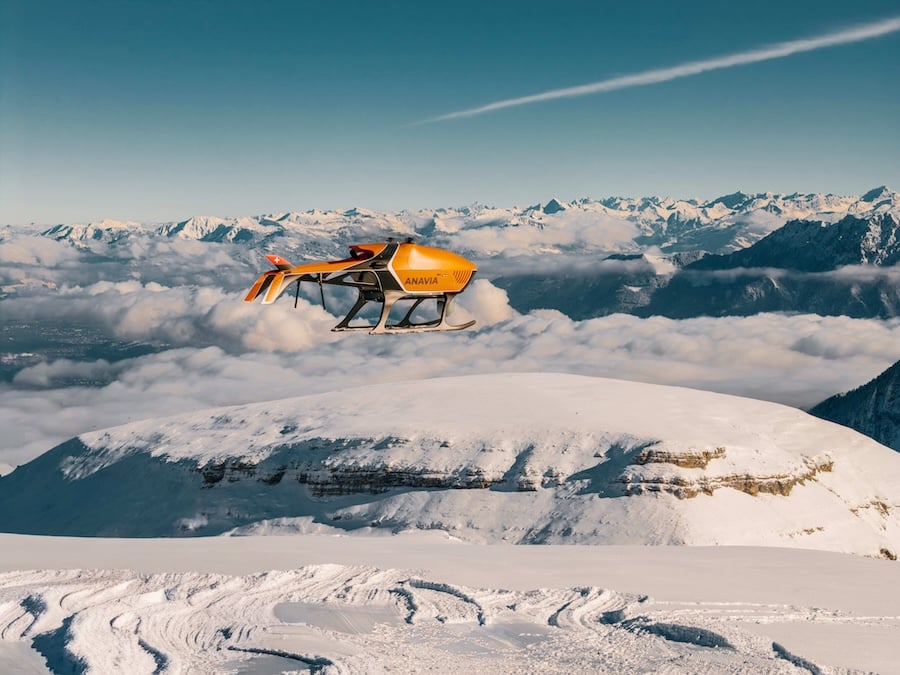
The HT-100 is a turbine-powered unmanned helicopter with a maximum take-off weight of 120 kg. It uses two intermeshing main rotors in a Flettner configuration, eliminating the need for a conventional tail rotor. ANAVIA advertises endurance of up to six hours, depending on payload and mission configuration.
Adapting the aircraft to the mission
For customers, the value of a platform also depends on whether it can accommodate their preferred equipment and fit into existing operational arrangements. Operators use different command-and-control (C2) systems, electro-optical sensors and other mission equipment, making integration an important part of the procurement decision.
“Customers want to work with a manufacturer who understands their missions and can integrate the right payloads, ideally in a modular configuration. They may fly one mission in the morning and need a different configuration in the afternoon. The ability to reconfigure the aircraft quickly is therefore important. Our role is to understand what data, surveillance capabilities and flight missions the customer needs, and to provide an integrated solution rather than simply a flying asset,” Jörg explained.
Jörg also outlined how the company handles customer-specific integration:
“The HT-100 is designed to be highly flexible and modular. Integrating a payload requires both mechanical and electronic work, and we carry out that integration for the customer to ensure that the complete system functions correctly. A customer may already be familiar with a particular sensor, know how to operate it and use it on a manned aircraft. If they want to use that same payload on the HT-100, we can integrate it. If a customer requires integration with an existing C2 system, we can certainly develop and deliver this, with the appropriate time and planning.”
Operational flexibility also depends on how quickly the aircraft can be prepared for its next task. According to Jörg, a flightworthy HT-100 can be airborne in around 15 minutes with a two-person crew ready to operate it, although mission-planning time must also be considered.
However, that flexibility operates within physical limits. Payload weight affects endurance, while the available electrical power determines which sensors can be supported. The relevant question is therefore how the aircraft performs with the equipment required for a particular mission.
“The main trade-off is between payload weight and endurance. With a payload of approximately 45–50 kilograms, endurance falls to around one hour. However, I would say that about 90% of customer requirements involve payloads weighing between 10 and 20 kilograms,” Jörg said.
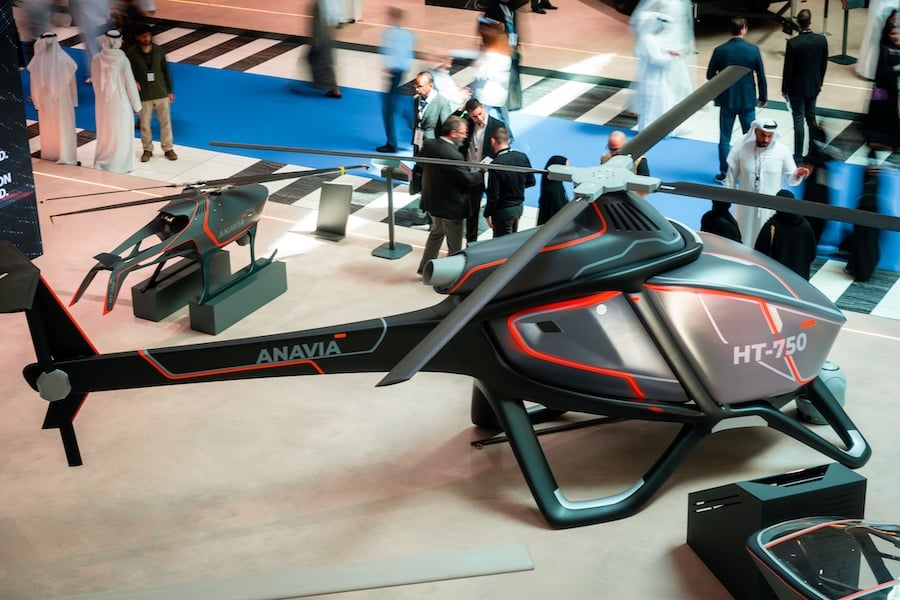
“Alongside weight, the other constraint is the electrical power required by the payload. The HT-100 provides up to 1,000 watts. A sensor requiring 2,000 watts would therefore be beyond the platform’s capabilities. For most of the payloads we encounter, however, the available power is sufficient, including configurations with two or three payloads operating simultaneously. Once the weight or power requirement exceeds those limits, a larger platform is needed. That is one of the reasons we are developing the HT-750.”
The larger HT-750 is being developed primarily for logistics missions, with a manufacturer-stated maximum payload capacity of 750 kg and endurance of up to 15 hours, depending on the mission configuration.
Dual-use applications
The range of potential missions also extends across military and civilian markets. Depending on its equipment, an unmanned helicopter can support border surveillance, maritime reconnaissance or infrastructure inspection. In the maritime domain, that includes both security operations and support for offshore energy infrastructure.
“When we started the company, we identified three main segments: intelligence, surveillance and reconnaissance (ISR), inspection and logistics. Inspection includes the energy sector, from offshore wind farms to installations in remote areas on land.
“The HT-100 can also support certain logistics tasks. If an offshore platform needs a spare part weighing 15 kilograms, for example, it can be a suitable solution, depending on the distance involved. But it is not designed to address every logistics requirement. ISR remains our largest market, while inspection is also an important part of the business,” Jörg explained.
International growth and the role of EDGE
ANAVIA’s international presence spans military and civilian markets, with publicly announced programmes in Angola, the UAE, Austria, Canada and Australia. The company’s expansion is supported by UAE-based EDGE Group, which acquired a 52% majority stake in ANAVIA in November 2023. Jörg identified both long-term investment and access to international customers as important benefits of that relationship.
“One of EDGE’s strengths is its long-term commitment to developing technology and bringing products to market. Good solutions do not appear overnight; they require focus, investment and sustained commitment. Another reason for bringing EDGE into ANAVIA was its international network. That network extends beyond the Middle East and Africa and has helped us expand our commercial opportunities,” Jörg emphasized.
“The UAE Ministry of Defence is one of our key customers, and we want to support it as it operates our helicopters. We also see the UAE as more than a commercial base. There is a strong pool of talent, including Emirati professionals and international specialists, and we want to develop it as an engineering hub as well,” Jörg said.

Protecting Europe’s maritime infrastructure
For European users, protecting critical maritime infrastructure against sabotage is a potential application for unmanned helicopters. Subsea power and telecommunications cables, offshore platforms and wind farms create a surveillance challenge that extends well beyond individual installations.
The expansion of offshore energy in the Baltic and North Seas adds to the infrastructure requiring protection. At the North Sea Summit in January 2026, nine governments backed an investment pact supporting the deployment of 15 GW of offshore wind capacity annually between 2031 and 2040. That planned expansion reinforces the need for sustained surveillance around offshore assets and their connections to shore.
Unmanned helicopters could contribute by monitoring vessel activity around offshore installations and along cable routes, investigating suspicious behaviour and providing imagery to authorities. Their role would be to strengthen awareness of activity at the surface and support a timely response.
These missions also illustrate the dual-use potential of unmanned helicopters. Beyond security surveillance, suitably equipped platforms can support search and rescue by helping locate people or vessels in distress, assess accidents and relay imagery to emergency responders. Longer endurance than smaller battery-powered drones can also support infrastructure inspection over larger areas in a single flight.
The HT-100 illustrates both the potential and the limits of unmanned helicopters. Their usefulness depends on matching payload, endurance and support requirements to a defined task. As operators consider a wider range of missions, the ability to integrate suitable equipment and sustain reliable operations will be central to turning technical capability into a practical service.