One of the clearest indicators of the changing balance is the number of vertical launch missile cells deployed across both fleets. In 2004, the U.S. Navy possessed more than 200 times the number of vertical launch systems installed on Chinese warships, but by 2023 that advantage had reportedly fallen to approximately two-to-one.
Military analysts project that China could surpass the United States in total vertical launch system capacity by 2027. These launch systems are regarded as a key measure of naval firepower because they support anti-aircraft missiles, cruise missiles such as Tomahawk and anti-submarine weapons.
Over the past decade, China has commissioned around 100 major surface combatants, while the United States built fewer than 50 during the same period. As a result, the American fleet has become both smaller and older while China’s navy continues expanding at a significantly faster pace.
Chinese naval planning reportedly aims for a fleet of 435 major surface combatants by 2030 and nine aircraft carriers by 2035. Current U.S. Navy plans target 381 manned vessels and 134 unmanned systems by 2035 while maintaining the existing force of 11 aircraft carriers.
To meet those targets, the United States would need to build 94 additional warships within the next decade. However, current American shipbuilding rates and growing programme delays are raising concerns about whether those objectives can realistically be achieved.
The U.S. Navy is expected to temporarily decline to around 287 ships during 2026 before fleet numbers gradually begin rising again. At the same time, Chinese shipyards are increasingly focusing on large ocean-going combatants rather than smaller coastal vessels.
In 2025, China commissioned the aircraft carrier Fujian, the country’s third carrier and the first equipped with electromagnetic catapult systems. The vessel displaces more than 80,000 tonnes and represents China’s first fully indigenous carrier design.
China is also reportedly constructing its first nuclear-powered aircraft carrier, with some sources suggesting that two such vessels may already be under construction. Additional Chinese naval expansion during 2025 included new Type 093B nuclear-powered attack submarines, Type 039C conventional submarines equipped with air-independent propulsion systems, Type 076 amphibious assault ships and further Type 052D and Type 055 destroyers.
Chinese shipyards now routinely launch multiple warship classes simultaneously, commissioning two or three ships annually across several production lines. By comparison, the United States continues to rely heavily on production of the Arleigh Burke-class destroyer as its primary large surface combatant.
Although procurement plans call for an average of two destroyers annually, U.S. shipyards are delivering fewer ships than scheduled and delays continue to grow. The destroyer USS Ted Stevens (DDG-128) required approximately seven years between contract award and delivery, reflecting what has increasingly become standard for major U.S. naval programmes.
Congressional budget documents for fiscal year 2026 found that delays within the DDG-51 programme increased by roughly 18 months over two years. Current construction timelines for destroyers and submarines now average eight to nine years, compared with five to six years during the early 2000s.
Submarine production trends have also shifted in China’s favour. Between 2016 and 2020, the United States launched seven nuclear-powered submarines while China launched three, but from 2021 to 2025 China reportedly launched 10 submarines compared with seven American boats.
Despite the increase in Chinese production, the United States still maintains a substantial qualitative and numerical advantage in nuclear submarines. By the end of 2025, the U.S. Navy operated approximately 71 nuclear-powered submarines, including attack submarines, ballistic missile submarines and guided missile submarines.
China currently operates nine Type 093 and 093A nuclear-powered attack submarines, but it has expanded its overall nuclear submarine fleet rapidly enough to reportedly surpass Russia in total numbers during early 2026. China also operates 46 modern conventional submarines, a category currently absent from the U.S. Navy inventory.
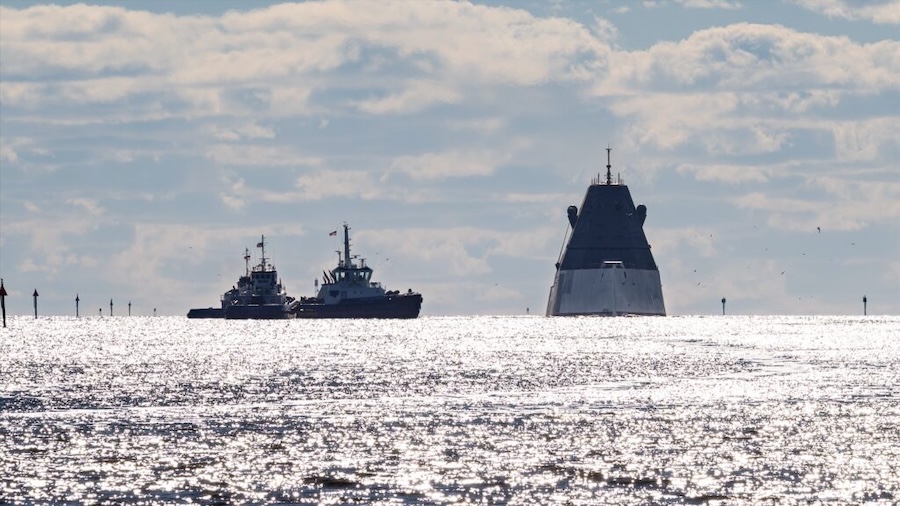
The United States’ naval modernization efforts have also faced repeated programme difficulties over the past two decades. The Zumwalt-class destroyer programme produced only three ships after costs rose to approximately $4 billion per vessel.
The Littoral Combat Ship programme was terminated because of design problems, high costs and limited combat capability. Meanwhile, the Constellation-class frigate programme experienced major delays after repeated modifications increased ship size, complexity and documentation requirements.
The lack of modern frigates has created a capability gap within the U.S. Navy’s escort and patrol forces following the retirement of the Oliver Hazard Perry-class frigates. China, by contrast, operates dozens of modern frigates supporting escort and maritime security operations.
One of the most significant structural challenges facing the United States remains shipbuilding capacity. The United States currently accounts for approximately 0.1% of global shipbuilding output, while China produces more commercial vessels than the rest of the world combined.
According to figures from the U.S. Office of Naval Intelligence, China’s shipbuilding capacity is estimated to be 232 times greater than that of the United States. China’s civil-military fusion strategy has allowed commercial shipbuilding investments to simultaneously strengthen naval construction capability.
John Phelan, U.S. secretary of the navy, described American shipbuilding programmes during a June 2025 congressional hearing as a “mess” that was “delayed and over budget.” The concerns have prompted efforts to rebuild U.S. industrial capacity with assistance from allies including South Korea.
Under a broader trade agreement signed in 2025, Seoul reportedly committed $150 billion in loans and guarantees to support cooperation under the “Make American Shipbuilding Great Again” initiative. The effort is intended to help revive U.S. shipbuilding capacity after decades of industrial decline.
The United States is currently pursuing several major naval modernization programmes, including the DDG(X) destroyer programme, the FF(X) frigate initiative and the proposed BBG(X) heavy surface combatant programme known informally as the “Trump-class.” The future warships are expected to displace between 30,000 and 40,000 tonnes and carry large numbers of missiles, hypersonic weapons, laser systems and advanced defensive capabilities.
President Donald Trump announced the concept publicly in late 2025 alongside Defense Secretary Pete Hegseth, Secretary of State Marco Rubio and Navy Secretary Phelan. Trump described the planned vessels as “the fastest, biggest and one hundred times more powerful than any battleship ever built.”
Despite ongoing modernization plans, analysts warn that the United States faces increasing difficulty matching China’s industrial pace and naval expansion. While the U.S. Navy still retains significant advantages in aircraft carriers, submarine quality and global operational experience, those advantages are gradually narrowing as China continues expanding both its fleet and shipbuilding infrastructure.