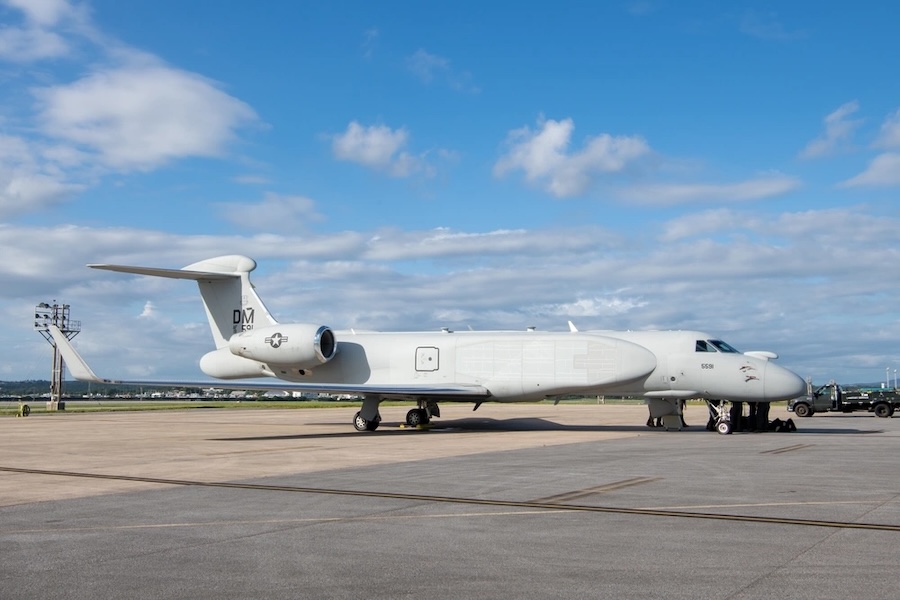
According to the Air Force’s fiscal 2027 budget request, the service is seeking $660 million to procure three additional EA-37B aircraft. The Air Force also plans to acquire seven more aircraft by 2031, expanding the planned fleet to 22 aircraft.
The Air Force had originally intended to stop procurement after acquiring 10 aircraft, despite an earlier stated requirement for 12. However, Congress approved funding for two additional aircraft in the fiscal 2026 appropriations bill.
The EA-37B is designed to jam enemy communications, navigation systems and radar networks while suppressing hostile air defenses. The platform is intended to disrupt adversary kill chains and support operations in heavily contested environments.
Troy Meink, secretary of the Air Force, said in written testimony submitted for a congressional budget hearing that the planned increase to 22 aircraft would “expand our electronic attack capability.”
The first five EA-37B aircraft delivered to the Air Force were equipped with the Baseline 3 configuration, which includes the Advanced Radar Countermeasure System. Subsequent aircraft will receive the Baseline 4 configuration, incorporating the System-Wide Reconfigurable Dynamic Architecture designed to support future electronic warfare upgrades.
According to Air Combat Command, the EA-37B can operate at speeds approaching 600 miles per hour, altitudes up to 45,000 feet and ranges of approximately 5,000 miles. The aircraft’s high-altitude jamming capability is regarded as important for operations against advanced integrated air defense systems such as those fielded by China.
The EA-37B complements the Boeing EA-18G Growler operated by the U.S. Navy. Both aircraft are intended to support broader U.S. electronic warfare operations across multiple combat environments.
“The bottom line is it is a hugely important airframe and mission capability in the modern era,” said Douglas Birkey, executive director of the Mitchell Institute for Aerospace Studies.
Birkey said the U.S. military significantly reduced investment in electronic warfare following the Cold War, affecting both equipment and specialist expertise. “And the cuts weren’t just to the equipment, it was to the human capital and the knowledge that understood it,” he said. “We’ve got to recreate it fast.”
The 55th Electronic Combat Group at Davis-Monthan Air Force Base is currently the only Air Force unit operating the EA-37B. The group’s 43rd Electronic Combat Squadron conducted the aircraft’s first combat sortie in May 2025.
The EA-37B carries a crew of nine personnel, compared with 13 aboard its predecessor, the Lockheed EC-130H Compass Call. The Air Force selected L3Harris Technologies in 2017 to develop the replacement platform.
The first EA-37B arrived in 2023, and the Air Force has continued retiring the aging EC-130H fleet. By 2025, 10 of the service’s 14 EC-130H aircraft had been retired.
The planned fleet expansion comes amid the Trump administration’s proposed $1.5 trillion defense budget. Analysts said congressional support for electronic warfare programs remains generally positive, although such capabilities often face competition for funding against larger aircraft programs.
“It’s very hard to advocate for funding at scale for the electronic warfare capability, simply because they don’t have, as usual, the constituency,” Birkey said. “They’re smaller in number. You can’t see it as easily. It’s hard to understand. It’s very classified.”
Future electronic warfare capabilities could eventually be integrated into additional systems such as the planned Collaborative Combat Aircraft drone program. However, Birkey said the EA-37B’s broad range of capabilities will remain critical for enabling other aircraft to operate safely in contested airspace.
“So, it could be going after radars. It could be going after cyber things. I mean, it could be going after command-and-control centers, it’s where are these linkages and how do you break them up or add friction so that they can’t operate,” Birkey said.
Source: Air & Space Forces Magazine.