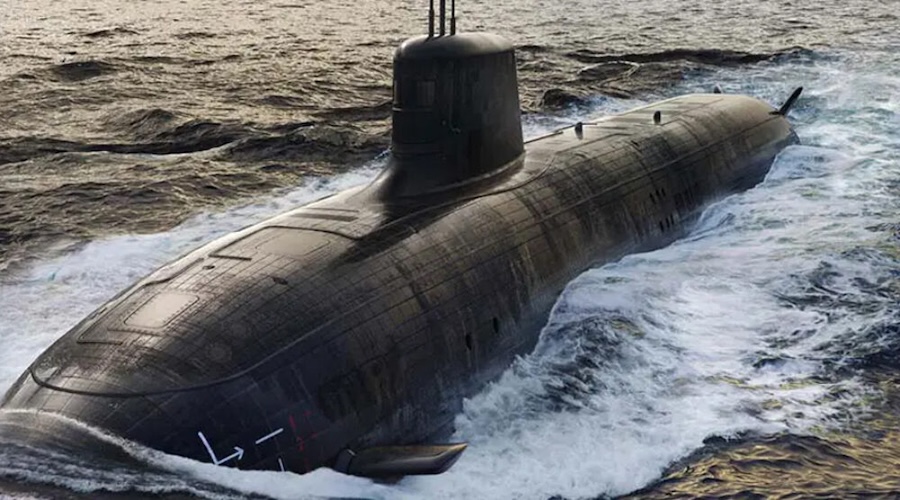
The ministers confirmed that AUKUS Pillar I remains on track to support Australia’s acquisition of conventionally armed, nuclear-powered submarines. They also announced the finalisation of arrangements needed to establish Submarine Rotational Force-West at HMAS Stirling in 2027.
Submarine Rotational Force-West will support submarine deployments by expanding maintenance options and sustainment infrastructure in the region. It is also intended to accelerate Australia’s readiness to own, operate, maintain and regulate a sovereign conventionally armed, nuclear-powered submarine capability.
The United States has authorised the establishment of U.S. Navy support elements for SRF-West and will begin rotating its first Navy personnel to HMAS Stirling later this year. The first rotation of a nuclear-powered U.S. submarine to the Australian base is expected in 2027, followed by a UK Astute-class submarine.
The United Kingdom reaffirmed its commitment to a rotational presence at SRF-West. The ministers also noted the first successful Submarine Maintenance Period conducted on a UK Astute-class submarine at HMAS Stirling earlier this year, involving HMS Anson.
The ministers acknowledged Australia’s planned investments of up to AUD 8 billion at SRF-West for infrastructure and logistics support at HMAS Stirling. They also noted Australia’s initial down payments of AUD 3.9 billion for the new Submarine Construction Yard in South Australia and AUD 12 billion for the Henderson Defence Precinct.
The Henderson investment includes support for contingency docking and depot-level maintenance capabilities. The ministers said these measures support the wider AUKUS submarine pathway.
The ministers welcomed a proposed approach to streamline Australia’s acquisition of Virginia-class submarines. The approach would simplify supply chain management, operational and maintenance requirements, and maximise cost efficiencies.
Under the proposed approach, Australia would acquire three in-service Virginia-class submarines instead of a mixture of new and in-service variants. The ministers also acknowledged significant progress in the design and delivery of SSN-AUKUS.
SSN-AUKUS is intended to provide the United Kingdom and Australia with an advanced warfighting capability. The ministers said this progress has been supported by investments from both countries, including GBP 6 billion committed by the UK in 2025.
The ministers also announced the first AUKUS Pillar II Signature Project. The project will develop cutting-edge payloads and enabling systems for uncrewed undersea vehicles operated by AUKUS partners, with the first capabilities expected in service by 2027.
The project will support the development of payloads such as sensors and weapons systems that can be deployed across the three nations’ UUV fleets. The UK Ministry of Defence said this would increase collective strength and deterrence across the Indo-Pacific and Euro-Atlantic.
The project is intended to improve the ability of AUKUS partners to protect critical national seabed infrastructure. It will also support surveillance, reconnaissance and strike capabilities, logistics operations, anti-submarine and anti-surface warfare, mine countermeasures, electronic warfare and contested littoral manoeuvre.
Defence Secretary John Healey said: “AUKUS is delivering for our security and for our economy. Together we are announcing ground-breaking underwater capabilities that will keep Britain safe, backing British businesses that are driving growth, and standing shoulder to shoulder with our closest allies.”
“This is what modern defence looks like. We’re stepping on the accelerator to develop cutting-edge tech to boost our collective deterrence and support our shared security,” Healey said.
The UK said the new capabilities will support the Royal Navy’s transition to a Hybrid Navy, combining crewed and uncrewed platforms. The payloads will help the Royal Navy detect underwater threats to the UK and allied critical undersea infrastructure.
The Royal Navy will be able to integrate payloads from the United States and Australia. The UK said the technology will also reinforce the future SSN-AUKUS attack submarine fleet.
Healey also announced the winners of the 2025 AUKUS Maritime Innovation Challenge. The challenge focused on companies developing technologies that support command, control and teaming of undersea systems.
Three of the four winning suppliers are based in the UK: Decision Analysis Services Ltd. in Basingstoke, SEA Ltd. in Frome and A-2i in Dorchester, Dorset. The fourth winner is MSI Transducers, based near Boston in the United States.
The winners will receive a share of £3 million to develop and test their capabilities. The UK Ministry of Defence said the investment demonstrates how defence can support economic growth, skilled jobs and companies of different sizes.
The ministers also confirmed support for expanding the AUKUS licence-free environment between the three partners. They said this would involve practical steps to narrow the list of excluded technologies.
The ministers reaffirmed the value of the Advanced Capabilities Industry Forum and deeper collaboration across the trilateral defence industrial base. The UK said the latest announcements build on the Geelong Treaty signed in July 2025, which established a framework for the deepest level of UK-Australian defence cooperation in generations.