
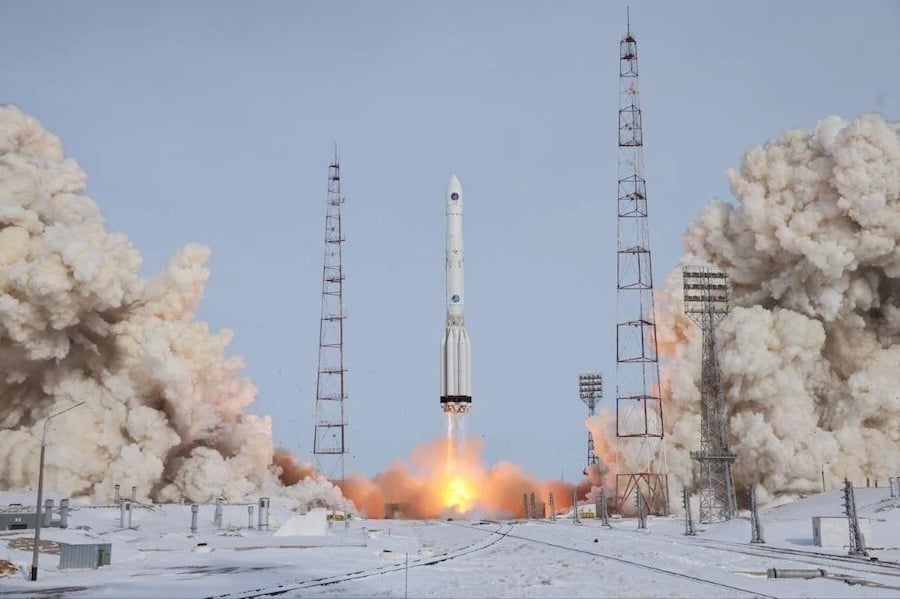
Russia launched 16 satellites on March 23 and another 16 on July 19, with one from each batch later falling out of orbit, the agency said. Of the 30 remaining satellites, 26 had settled into orbits at about 500 to 520 kilometers and four were still maneuvering, with none yet at the planned altitude of 800 kilometers.
Moscow wants to speed up deployment of the low-Earth-orbit network, which is intended to support military communications. Ukraine’s intelligence agency said difficulties reaching the intended orbits and developing compact user terminals, along with a reliance on foreign components, had held back the project.
Russia’s coverage plans
Russia had expected its planned year-end constellation to provide up to an hour of communications availability a day, according to the agency. Moscow plans to launch another 240 satellites in 2027, which it expects would extend coverage to 94% of Russian territory.
The longer-term plan calls for 408 satellites no earlier than 2031 to provide global coverage, with the constellation projected to grow to 924 by 2035. The roughly 280-kilogram satellites use laser links to pass data directly between spacecraft and have a stated guaranteed service life of five years.
Russia completed testing of its Ultra terminal in September and expected to deliver about 1,000 units to customers by the end of 2026, the agency said. Russia plans to develop four more terminal models in 2027 and introduce a version for aircraft in 2028.
Bureau 1440, part of Russia’s X Holding group, leads the project. The Ukrainian agency said at least 46 Russian and three Belarusian companies were involved in building and launching the satellites and that the project relied on electronic components imported from China.
Source: Defence Intelligence of Ukraine.