The contract also creates a structure for the Air Force to buy additional lots of production FQ-44 aircraft over the next several years. Anduril said this gives the Air Force a path to expand fighter capacity rapidly and affordably.
The company described the decision as a major milestone in military aviation. It said the FQ-44 is the first semi-autonomous fighter aircraft to move into serial production.
Anduril said the CCA program is intended to address the need for autonomy and affordable mass in airpower. The company said crewed fighters and bombers remain technically impressive but cannot be produced at the timelines or scale needed to deter or sustain a high-end fight.
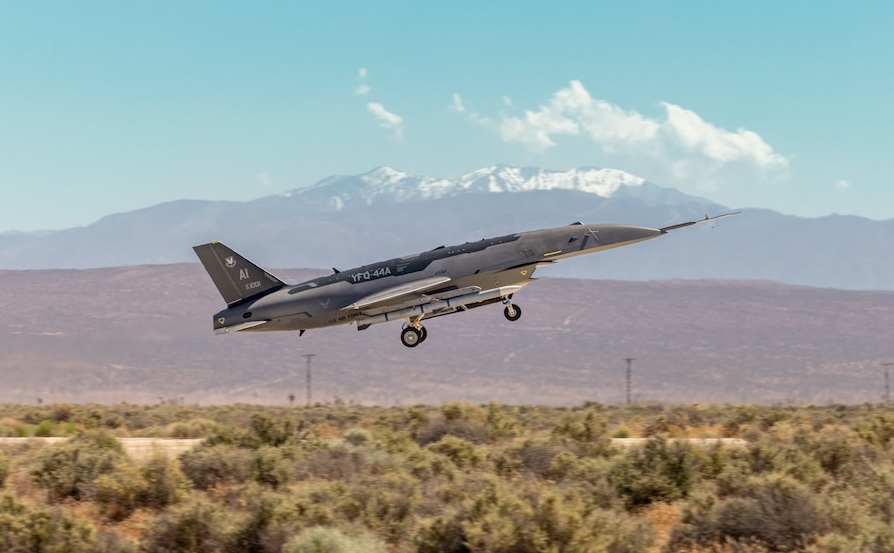
The FQ-44 moved from prototype award in April 2024 to ground testing in April 2025. It completed its first flight in October 2025 before receiving the production contract in June 2026.
Anduril said that timeline represented the fastest path from prototype to production for a fighter aircraft in more than 50 years. The company said the Air Force’s production decision, made months ahead of schedule, reflected confidence in the program and the capability built by the combined Anduril-U.S. Air Force team.
In its current configuration, the FQ-44 has the ferry range needed to deploy anywhere in the world. Anduril said the aircraft can take off and land on a short field, has the speed to keep up with crewed fighters and has a combat radius that significantly exceeds that of current crewed fighters.
The company also said the aircraft has the payload capacity needed to make a real battlefield impact. It said hundreds of hours with Air Force experts and thousands of simulations had shown that the FQ-44 could do more than survive in a high-end fight.
Anduril said multiple aircraft are already flying regularly. The company has completed dozens of sorties from multiple airfields and in several mission configurations, expanding the demonstrated portions of the flight envelope.
The FQ-44 has flown two different mission autonomy software suites, with switching between them conducted in flight. Anduril has also integrated and flown the aircraft with inert air-to-air munitions.
The aircraft was also used in an exercise with the Air Force’s Experimental Operations Unit. Anduril said the event showed that a small crew with only days of training could launch, recover and turn multiple FQ-44 sorties without the infrastructure of a large, established base.
Anduril said the program’s goal is to deliver a real operational capability on the ramp and ready by the end of the decade. The company said it had moved quickly to produce an aircraft that meets the Air Force’s core air superiority mission, on time and on budget.
The FQ-44 was designed to evolve as operational needs change. Its modular design and open hardware and software architectures are intended to support rapid integration of new capabilities demanded by real-world operations and program partners.
Anduril said scale has been central to the aircraft and production system from the start. The company said it has spent the past two years refining, testing and iterating its production system in parallel with aircraft development.
The company said it has already applied full-rate production processes and tooling to prototype aircraft. This was intended to identify and resolve production issues during prototyping and streamline the move into production.
Production work at Anduril’s Arsenal-1 facility is already active. The production line is capable of delivering up to 150 aircraft per year in its current configuration.
Anduril said everything on the line is on wheels. The company said this allows it to continue changing the production system as the aircraft evolves and to scale further if demand increases.
The Air Force’s decision also marked the first time since the 1970s that a new company had won a fighter aircraft program. Anduril said the milestone showed that what began as an early concept had become a production-ready capability in record time.
The company said the next phase would focus on scaling production and fielding an operational capability. It said the FQ-44 had been selected to spearhead America’s response to the need for a step change in airborne capability.