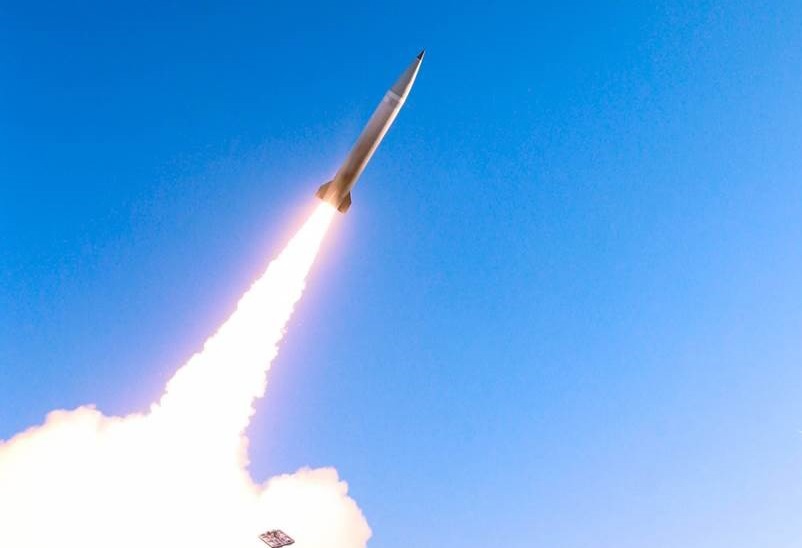
PrSM forms part of the broader Long-Range Precision Fires program. The initiative is intended to give U.S. forces the ability to strike high-value targets, operational infrastructure and critical facilities deep inside enemy territory.
The missile sits in the lower tier of a wider U.S. long-range strike architecture. The middle tier is formed by the Typhon system, which uses SM-6 and Tomahawk missiles fired from land-based launchers derived from the naval Mk 41 Vertical Launch System.
The upper tier is expected to be provided by the Dark Eagle hypersonic weapon. That system is described as capable of reaching almost 2,800 kilometers and traveling at speeds of up to Mach 17.
PrSM is the direct successor to ATACMS, the Army Tactical Missile System used by the U.S. Army since the 1990s. Older MGM-140A/M39 and MGM-140B/M39A1 ATACMS missiles can strike targets at ranges of about 165 to 300 kilometers, depending on the variant.
The newer missile was developed to extend the reach and flexibility of ground-based rocket artillery. Its range is expected to exceed 500 kilometers, with later versions planned to reach about 700 kilometers and possibly more than 1,000 kilometers.
Development of this capability became possible after the United States withdrew from the Intermediate-Range Nuclear Forces Treaty. The 1987 agreement had restricted land-based missiles able to strike targets at distances between 500 and 5,500 kilometers.
U.S. Central Command reported the first combat use of PrSM in early March during Operation Epic Fury. Video material from the operation showed an M142 HIMARS launcher fitted with a two-cell ammunition container compatible with ATACMS and PrSM missiles.
The location of the launch was not disclosed. The terrain suggested a desert area in one of Washington’s allied countries in the Middle East, with Kuwait cited as a possible location because U.S. M142 launchers are stationed there.
From the Persian Gulf region, PrSM missiles could reach important targets in western, southern and central Iran. Potential targets included air bases, command sites and air defense positions.
The launchers were linked to soldiers from the 3rd Battalion, 27th Field Artillery Regiment. That unit belongs to the 18th Field Artillery Brigade based at Fort Bragg, North Carolina.
The U.S. side did not disclose the scale of PrSM use in the attacks. For deep strikes into Iranian territory, HIMARS launchers would need missiles such as ATACMS or PrSM rather than shorter-range GMLRS or GMLRS-ER rockets.
PrSM differs from ATACMS in its shape, fin configuration and dimensions. It is about four meters long, has a diameter of 430 millimeters and flies at more than Mach 3.
The missile uses a solid-fuel rocket motor. It carries a 91-kilogram warhead that can be configured as a cluster or high-explosive fragmentation payload.
The warhead is designed to create a fragmentation effect during detonation. This increases the destructive effect against selected target types.
One of PrSM’s main operational advantages is its smaller diameter. Because ATACMS has a diameter of 610 millimeters, only one ATACMS can be carried in a standard launch pod, while two PrSM missiles can be loaded into the same type of pod.
This doubles the number of ballistic missiles available on a single launcher. The combination of more missiles per launcher and a longer reach gives commanders more flexibility in planning and executing fire missions.
PrSM Increment 1 is the initial version of the missile. It is designed to strike stationary targets at about 500 kilometers, while U.S. documents describe the range as more than 400 kilometers.
The U.S. Army received its first batch of four PrSM Increment 1 missiles in November 2023. They were part of an accelerated Early Operational Capability procurement path covering 80 planned missiles after tests at White Sands Missile Range in New Mexico.
By January 2025, the U.S. Army was expected to have received a total of 30 PrSM missiles through the faster procurement route. The source also referred to September 2025 testing at White Sands, where four Increment 1 missiles were fired from M142 and M270A2 launchers at targets 200 kilometers away.
The original program plan covered 51 test missiles and 2,422 production missiles. Its total value was estimated at nearly $3 billion, including $895 million for research and development.
The first verification firing took place on December 10, 2019, at a range of 240 kilometers. In 2021, the program added the accelerated Early Operational Capability route alongside the standard development process.
By August 2024, the estimated program cost had risen to $7.68 billion. That figure included $1.2 billion for research and development and covered 35 test missiles and 3,986 production missiles.
The estimated unit cost of PrSM was given as $2 million. Initial operational capability for Increment 1 was expected in the first quarter of 2026.
Funding was allocated for 98 missiles in fiscal year 2024, 230 in fiscal year 2025 and 152 in fiscal year 2026. U.S. Army budget documents also indicated that funds had been secured for 10 Increment 2 missiles.
A multiyear production agreement was signed between the Department of War and Lockheed Martin on March 28, 2025. The contract covered deliveries through the end of March 2030 for an undisclosed number of missiles, estimated at about 1,200 to 1,600, with a maximum value of $4.94 billion.
Lockheed Martin signed another agreement with the Pentagon on March 25, 2026, to invest in production capacity. The funds were to support advanced tooling, plant modernization and key test equipment to shorten production time and increase PrSM output.
The current agreement provides for a fourfold increase in annual production of the newest PrSM missiles. Final production capacity is expected to reach 550 missiles per year.
The PrSM production push is part of a wider U.S. effort to expand missile stocks. It was linked with framework agreements to quadruple production of THAAD interceptors and triple production of PAC-3 MSE missiles for the Patriot air defense system.
The production decisions reflected concerns that modern conflicts require not only advanced weapons but also sufficient ammunition stocks. The recent conflict with Iran was cited as confirmation that prolonged operations can rapidly consume missile inventories.
The Royal United Services Institute was cited as assessing that, if the intensity of the war with Iran had continued until April 17, the United States would have exhausted THAAD ammunition and PrSM missiles by April 12. The contracts were therefore framed not only as stock replenishment but also as preparation for larger future requirements.
A potential conflict with China was identified as a key reference point for those requirements. Such a scenario would demand large stocks of missiles able to strike land, maritime and air targets, including maritime targets in the case of PrSM.
PrSM Increment 2 is planned to add a self-guiding, multi-mode seeker. This would allow the missile to attack moving ground targets and maritime targets, including enemy warships and support vessels.
Lockheed Martin reported the first launch of PrSM Increment 2 on March 12. The missile was fired from an M142 HIMARS launcher as a land-based anti-ship ballistic missile, or LBASM, at a target 350 kilometers away.
The range of that firing was not the main point of the trial. The key result was the demonstration of a warhead able to destroy moving land and maritime targets, rather than only fixed-coordinate objects.
Two additional Increment 2 tests were planned for the same year. Those tests were expected to use data gathered during the March firing.
Increment 2 had not been formally introduced into service at the time described. The missile remained in development, although the Department of War had announced an acceleration of work and the version was expected to enter service in 2027, with some indications that it could happen earlier.
PrSM Increment 3 is expected to receive modified warheads. These could allow the missile to release Coyote loitering munitions or small Hatchet precision glide bombs.
The Raytheon Coyote family includes several variants. The basic Block 1 has a pusher propeller, electric motor, extendable wings and tail, while Coyote Block 2 and Coyote LE SR are self-guided interceptor drones.
The Coyote LE SR, or Launched Effect Short Range, has a larger warhead. That feature is intended to help engage swarms of hostile drones.
Coyote Block 1 and Block 3 have modular designs. They can be configured for roles including loitering munition missions, reconnaissance, observation, electronic warfare and other tasks.
Using such payloads would allow a single PrSM to attack multiple targets across a wider area. This could be especially useful against enemy air defenses, including mobile systems that are difficult to find and destroy.
A fourth version, known as Long Range Maneuverable Fires, is expected to represent a larger step in the program. It was previously associated with the PrSM-ER, or Extended Range, designation and is expected to reach about 1,000 kilometers.
The U.S. Army is expected to seek independent target recognition and tracking capability for this version. That would support attacks against strategic targets located far beyond the traditional battlefield.
Potential targets for this longer-range version include command centers, missile launch complexes, air bases, logistics infrastructure and maritime infrastructure. The concept would allow PrSM to affect the enemy military system throughout its depth.
A future Increment 5 version is also expected to extend the range further. Its development is linked to autonomous ground launch systems and longer missiles with additional fuel.
These missiles could be launched from the Autonomous Multidomain Launcher, a crewless system based on the HIMARS concept. Such launchers could conduct fire missions remotely or with a minimal crew presence.
The use of autonomous launchers would reduce the need to expose personnel in dangerous firing positions. Launchers could also be placed in concealed locations and activated remotely when needed.
PrSM has not been widely exported. The missile was approved for Australia, which was also included in development work on later versions, including Increment 2.
A potential sale to Norway was refused. Australia has already fired a PrSM missile during the Talisman Sabre 2025 exercise, which took place from July 13 to August 4.
The Australian firing was conducted from an M142 HIMARS launcher. Australia is acquiring 42 M142 HIMARS launchers under the LAND 8113 Long Range Fires program.
The first Australian launchers were received at the beginning of 2025. They were delivered to the 10th Fires Brigade in Adelaide.
Australia plans to expand its HIMARS fleet to 90 launchers. That expansion reflects a broader effort to strengthen long-range rocket artillery capability among U.S. allies.