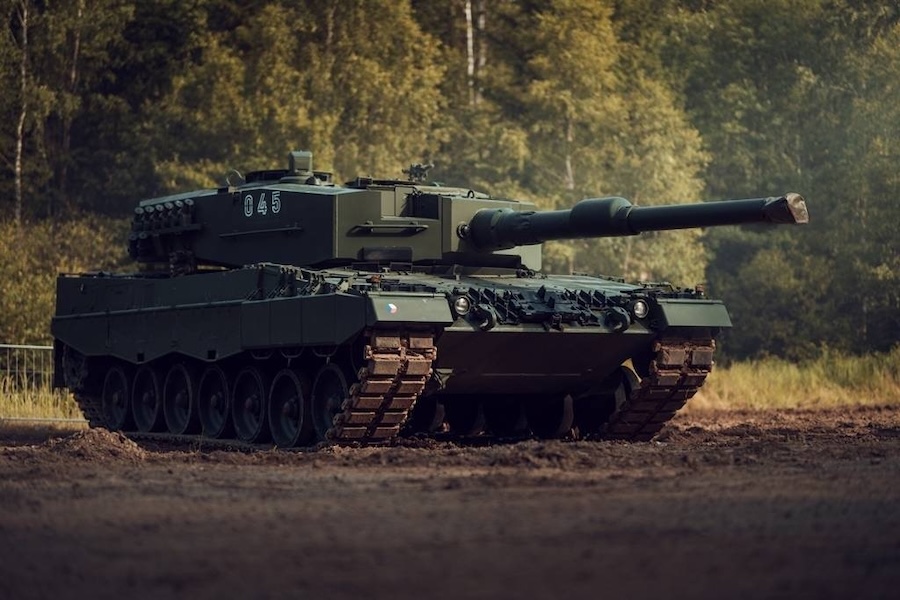
Prague first received 28 Leopard 2A4 tanks and two Büffel 3 armoured recovery vehicles in return for its military assistance to Ukraine. Half of the tanks were taken over by the Czech Armed Forces in 2022 and 2023, while the remaining vehicles were delivered by the end of 2025.
In December 2024, the Czech Ministry of Defence also purchased 14 additional tanks from Rheinmetall Landsysteme. The final tank from that batch has now been received, meaning the contract was completed ahead of the original plan, which had expected all vehicles to be delivered by the end of 2026.
In addition to the used vehicles, the Czech Republic is due to receive 44 new Leopard 2A8 tanks between 2028 and 2031. The new vehicles will be delivered in two main variants, combat and command, under a contract signed on 11 September 2025.
An industrial cooperation agreement was also concluded as part of the programme. Under that arrangement, Czech industry will participate in the supply chain linked to the new tanks.
According to the head of the Czech Armed Forces General Staff, Gen. Miroslav Hlavacz, the land forces will dispose of their older T-72 tanks. He said spare parts are no longer available for them and that the tank no longer meets the basic standards required by NATO.
The 73rd Tank Battalion in Přáslavice near Olomouc, which belongs to the 7th Mechanised Brigade headquartered in Hranice, is ultimately to be rearmed with 44 Leopard 2A8 tanks. There are also plans to increase the order to 58 new tanks.
The older Leopard 2A4 tanks are intended to give Czech tank crews experience in operating German-built vehicles. On 16 June 2026, Leopard 2A4 tanks appeared on a motorway in the Olomouc region for the first time.
Six tanks and one Büffel 3 armoured recovery vehicle travelled along the D35 motorway and conducted their first practical road movement exercise. The exercise tested whether a modern NATO armoured unit could move quickly, safely and in an organised way on roads and bridges, accompanied by a police escort.
Crews practised convoy driving, while commanders worked on road movement organisation. Military police supported the operation by providing traffic control, medical cover, evacuation support and crew rotation.