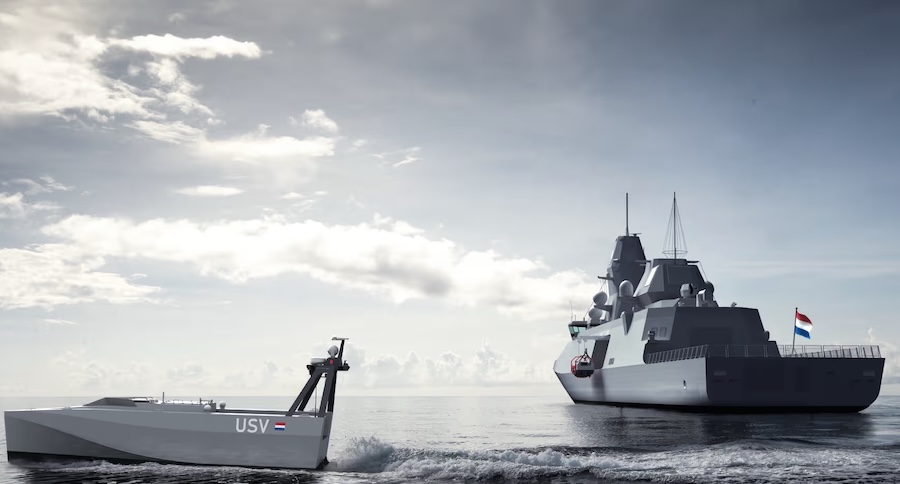
The wider ASW frigate programme is being developed jointly for the Royal Netherlands Navy and the Belgian Navy. The unmanned vessels are intended to support both countries’ future maritime anti-submarine capabilities.
The Dutch Ministry of Defence assigned the design work to Dutch Naval Design, a partnership linking government, industry, universities and research organisations. A group of participating companies and institutes submitted the proposal through the USV Alliance.
The agreement was signed in Rotterdam on 29 July in the presence of representatives from the ministry, Dutch Naval Design and Thales. The design phase is scheduled for completion in the first quarter of 2027.
The work builds on a framework agreement signed by the ministry and Dutch Naval Design on 10 April 2024. That agreement established the broad requirements for the future vessel and estimated a four-year path towards technological readiness.
The design must accommodate several mission systems from the outset, including the Compact Flash dipping sonar from Thales Underwater Systems France. A separate agreement covering delivery of the sonar systems was concluded alongside the design arrangement.
Compact Flash is intended to widen the frigate’s underwater surveillance area without revealing the crewed ship’s position. Deploying the sonar from an unmanned vessel will allow the frigate to search for submarines from greater distance.
The Royal Netherlands Navy plans to use the vessels to detect and track hostile submarines. They could also support deterrence operations in areas with elevated levels of submarine activity.
The unmanned vessel is expected to assume some tasks traditionally performed by an embarked helicopter. Its longer operating endurance could help sustain anti-submarine missions for extended periods.
Operating the vessels alongside the frigates will create a more distributed underwater surveillance architecture. The ministry said this would increase operational reach, improve reaction times and strengthen the effectiveness of maritime operations.
The programme also reflects the growing role of unmanned systems in future anti-submarine warfare. Dutch planners expect the vessels to improve operational efficiency while reducing the need to position crewed frigates closer to suspected threats.
According to the additional report, Belgium’s defence minister has recently criticised aspects of the wider frigate programme and raised the possibility of seeking an alternative to Dutch shipbuilder Damen. The Dutch ministry’s announcement did not report any change to Belgium’s participation or to the unmanned-vessel design work.