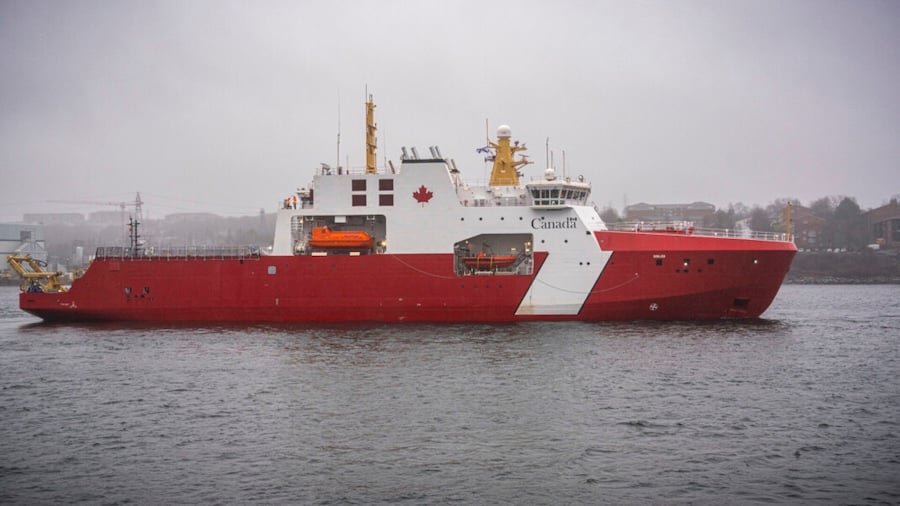
Irving said the second ship, the future CCGS Sermilik, is scheduled for delivery in 2027.
Donjek will carry out fisheries enforcement and surveillance off Canada’s East Coast, including Northwest Atlantic Fisheries Organization patrols, and support offshore search and rescue and environmental response.
The ship can support icebreaking in the lower Arctic in summer and off the East Coast in winter.
“From the Atlantic to the Arctic, the vessel’s modern capabilities will support key operations including fisheries enforcement, icebreaking and maritime security, while also strengthening our at-sea collaboration with the Royal Canadian Navy,” said Coast Guard Commissioner Kevin Brosseau.
“Protecting Canada’s sovereignty means having the capabilities to operate in our waters, including in the Arctic,” said David J. McGuinty, Canada’s minister of national defence.
Representatives of the Department of National Defence, Public Services and Procurement Canada and the Coast Guard signed the ship’s documents at the ceremony.
Irving presented the ship’s bell, logbook and builder’s plaque to Captain James Webber, while Lloyd’s Register presented the ship’s certificates to Captain Aaron O’Brien.
The ship is named after Donjek Glacier in Yukon’s Kluane National Park, and its name means “white or silver berries” in Southern Tutchone.
Canada announced in May 2019 that Irving would build two Coast Guard variants in addition to six Harry DeWolf-class patrol ships for the Royal Canadian Navy, all of which have now been delivered.
The Coast Guard variant has changes to the bridge layout, accommodation and mission spaces, with room for a crew of 31 and 57 berths in total.
Irving lists Donjek at 104.7 metres long, while the Coast Guard gives a length of 103 metres for the class.
The ship is 19 metres wide and displaces about 6,677 tonnes, with space for command and control and a flight deck and hangar that can accommodate Coast Guard Bell 429 and Bell 412 EPI helicopters and the Royal Canadian Air Force’s Cyclone.
A 20-tonne stern crane supports work on aids to navigation, an A-frame supports scientific research and the ship can carry containers for resupply missions.
The ship also has an onboard medical facility and can support humanitarian assistance.
“We are leveraging the knowledge and expertise of earlier Arctic and Offshore Patrol Ships construction to deliver the CCGS Donjek,” said Stephen Fuhr, secretary of state for defence procurement.
Donjek is the fifth large vessel delivered to the Coast Guard under Canada’s National Shipbuilding Strategy, following one Offshore Oceanic Science Vessel and three Offshore Fishery Science Vessels.
The Coast Guard estimates the Arctic and Offshore Patrol Ship programme will contribute C$459 million a year to Canada’s economy and create or sustain 3,425 jobs annually over the 14 years from 2015 to 2028.
“Building on the successful delivery of Arctic and Offshore Patrol Ships for the Royal Canadian Navy, this vessel reflects the strength of Canada’s shipbuilding industry and our commitment to equipping the Coast Guard with the modern vessels it needs,” said Joël Lightbound, minister of government transformation, public works and procurement.
“From design to first steel to delivery, CCGS Donjek is a testament to the skill and professionalism of a Canadian workforce dedicated to building the best ships for Canada,” said Irving Shipbuilding President Dirk Lesko.
Irving laid the keel for the future HMCS Fraser in June, the first of 15 River-class destroyers it plans to build in Halifax.