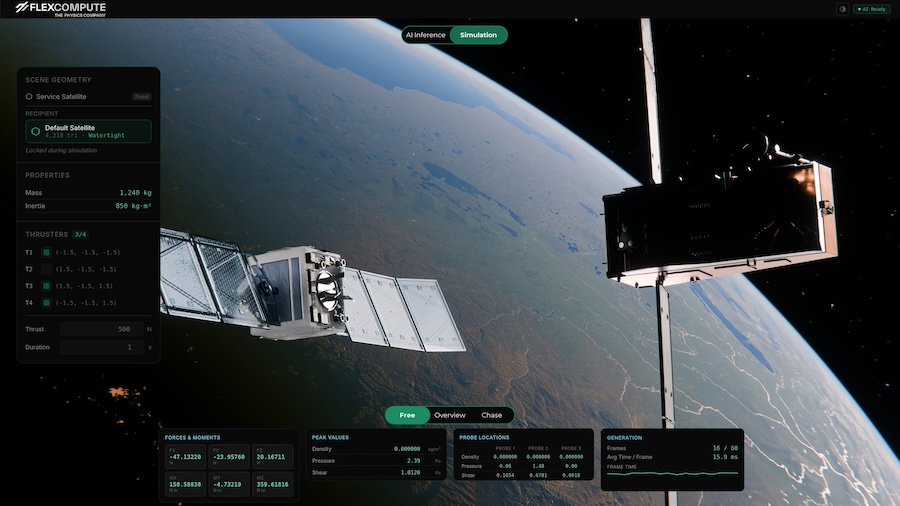
The system was developed using technology from NVIDIA. It is designed to predict thruster impingement effects in real time while providing uncertainty estimates for mission-critical decisions.
Thruster impingement refers to the interaction between rocket exhaust plumes and nearby spacecraft structures. Companies said the issue is particularly important during docking, station-keeping and space robotics missions.
Traditional mission preparation has often taken months because engineers must generate large datasets through complex simulations. Conventional models typically require millions of simulations to achieve sufficient reliability.
Flexcompute said its AI Physics approach reduces that burden by using physics-informed training models that can generate accurate predictions in seconds. The company said the system is designed to improve both speed and reliability.
The platform is built on NVIDIA PhysicsNeMo, an open-source framework that Flexcompute modified with custom model designs and training methods. The system also incorporates physics-based constraints tailored to spacecraft plume interactions.
Fahad Khan, Director of AI Foundations at Northrop Grumman, said: “At Northrop Grumman, we’re pioneering physics AI to accelerate design and solve complex simulation and modeling problems like plume impingement—critical for station keeping, rendezvous, and space robotics. Simply put: we’re pushing the boundaries of advanced space operations.”
“Partnering with Flexcompute and NVIDIA, we’re accelerating innovation and mission timelines to deliver superior space capabilities for customers at the speed they need,” Khan added.
Companies said improved plume modeling could support more efficient spacecraft operations. They said it may allow for lighter structures, improved fuel efficiency and longer mission durations.
Vera Yang, President and Co-Founder of Flexcompute, said: “Northrop Grumman’s confidence reflects what sets Flexcompute apart.” She added: “This work shows how we are transforming the role of simulation, not just speeding it up, but expanding what engineers can confidently solve and how quickly they can act.”
Tim Costa, vice president and general manager of computational engineering at NVIDIA, said: “The industry’s most ambitious space missions now demand a level of speed and precision that traditional engineering cycles can no longer sustain.”
“By integrating NVIDIA PhysicsNeMo, Northrop Grumman and Flexcompute are transforming complex simulations like plume impingement from days of compute into seconds of insight, drastically accelerating the path from mission concept to orbit,” Costa said.