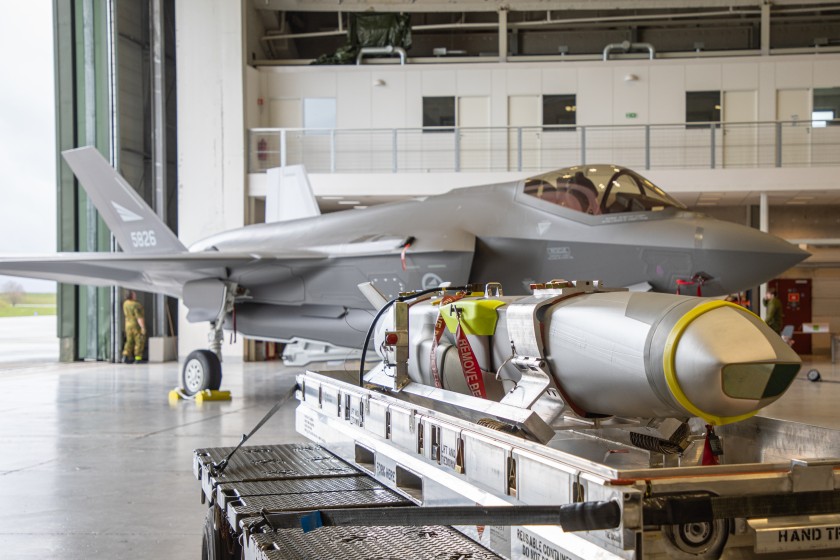
The new contract follows Germany’s first JSM order, signed on 30 June 2025 and valued at about NOK 6.5 billion. Germany selected the Joint Strike Missile in June 2025, becoming the fifth country to choose the weapon after Norway, Japan, Australia and the United States.
The contract is structured as a government-to-government sale between Norway and Germany, with Norway’s Defence Material Agency acting as the contract partner. Kongsberg said the additional order reflects Germany’s effort to build up missile readiness for its F-35 force.
“The new order shows the importance of JSM for F-35, where Germany has started building up its readiness level of the missiles,” said Øyvind Kolset, Executive Vice President, Kongsberg and head of the Missiles and Aerostructures division.
The Joint Strike Missile is developed by Kongsberg and is the only weapon of its class designed to be carried internally by the F-35A and F-35C variants. Certification for both aircraft variants is planned together with the introduction of the F-35 Block 4 software standard.
Germany has ordered 35 F-35A Lightning II aircraft through the U.S. Foreign Military Sales process. The aircraft are intended to replace part of the German Air Force’s Panavia Tornado IDS strike fleet.
Deliveries of the first German F-35A aircraft are planned to begin this year, with initial aircraft to be based at Ebbing Air National Guard Base in Fort Smith. The fighters are expected to arrive in Germany the following year, where their home base will be Büchel.
“This agreement is another example of the strong bonds between Kongsberg and Germany, where we are engaged in a range of projects with local partners,” said Eirik Lie, President and Chief Executive Officer of Kongsberg.
Norway’s Minister of Defence Tore O. Sandvik said the missile agreements reflect the wider strategic defence relationship between Oslo and Berlin. “When Norway and Germany entered into the historic Hansa Agreement earlier this year, the goal was to establish even closer and more operational defence cooperation between our two countries,” Sandvik said.
“The JSM agreements show how we are already translating the strategic partnership into concrete capabilities that strengthen both our own defences and NATO,” Sandvik added.
Kongsberg said its cooperation with Germany extends beyond Joint Strike Missiles. “In addition to delivering strike missiles, combat systems for the 212CD submarines and remote weapon stations, Kongsberg is developing a new supersonic strike missile with industry partners Diehl Defence and MBDA and we have teamed up with Helsing and other partners to accelerate the realisation of critical European space capabilities,” Lie said.