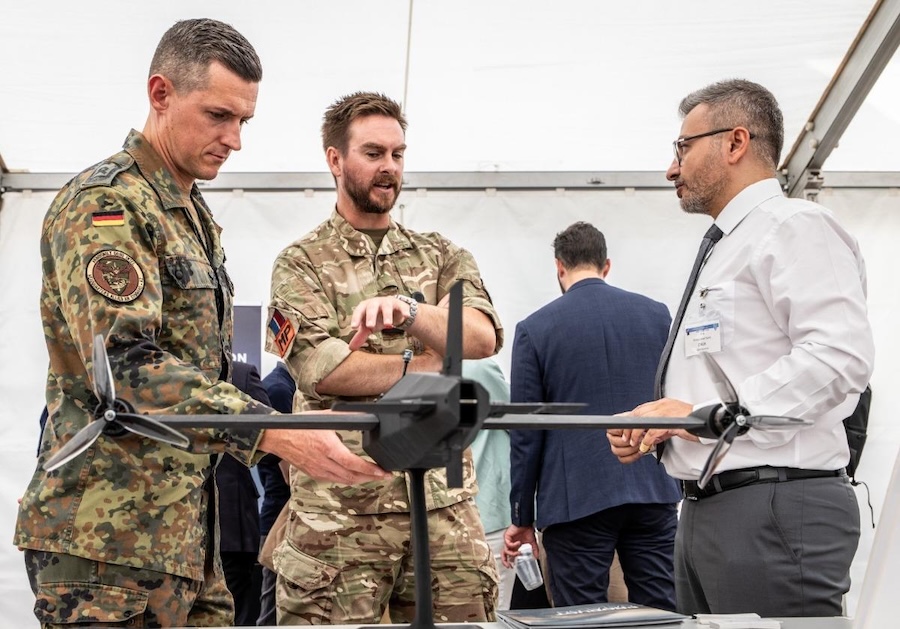
The event brought together representatives from 34 hi-tech companies and participants from more than 20 countries, including Allied nations and partner organisations. Around 15 countries were represented by exhibitors, creating a forum for operational experts and industry to exchange knowledge and examine emerging counter-drone technologies.
Deputy Commander AIRCOM Lieutenant General Guillaume Thomas welcomed the guests and highlighted the speed at which the aerial threat environment is changing. “The air threat has changed. It has evolved faster than many of our structures, processes, and procurement cycles were designed to handle.”
Lieutenant General Thomas said AIRCOM Industry Day gave national and NATO experts a venue to meet defence industry leaders and explore practical solutions. “AIRCOM plays a key role as a facilitator between Nations and Industry,” Lieutenant General Thomas added.
“We help ensure that NATO and Allied forces are equipped to counter evolving aerial threats, especially those from unmanned systems.” The statement linked this work to the growing operational need to counter small, low-cost and increasingly autonomous drones.
AIRCOM Industry Day focused on translating innovation into operational capability. Participants used panel discussions, technical briefings and technology demonstrations to examine the full C-UAS engagement chain, from detection, identification and tracking to mitigation and neutralisation.
The discussions placed strong emphasis on interoperability, command and control, and integration across NATO’s air, land, maritime, cyber and space domains. NATO said this work directly supported Eastern Sentry, which is intended to strengthen the Alliance’s defensive posture along its Eastern Flank.
Lieutenant General Thomas said Eastern Sentry is part of NATO’s response to the drone threat. He highlighted ”eVA EASN is part of the response to the threat posed by drones, recognizing that the solution can only be a collective one, and that success depends on our shared ability to innovate quickly, adapt continuously and stay one step ahead of emerging threats”.
Eastern Sentry represents AIRCOM’s transition from a traditional Air Policing construct towards a broader multi-domain Air Defence approach. The activity integrates sensors, effectors and decision-making across the Alliance to respond more effectively to emerging airborne threats, including one-way attack drones.
Major General Arnoud Stallman, Assistant Chief of Staff Multi-Domain Capabilities at NATO Allied Command Transformation, outlined the Layered Counter-UAS Initiative eXperimental. The initiative consists of threat-informed events designed to accelerate the development and operational integration of Allied counter-drone capabilities.
NATO said LCI-X rapidly connects experimentation with operational requirements. The aim is to deliver interoperable and deployable C-UAS solutions that directly support Eastern Sentry while shortening the path from innovation to fielded capability.
Keynote speaker Dr Ulrike Franke, Senior Policy Fellow at the European Council on Foreign Relations, examined the opportunities and challenges facing industry. Her remarks addressed military requirements that increasingly demand faster innovation, closer collaboration and more agile procurement processes.
Industry leaders and NATO organisations also joined a panel discussion on the future of counter-drone capability development. Panelists included Sven Weizenegger of the Cyber Innovation Hub of the Bundeswehr, Eric Lenseigne of Thales Group and Juan Tarazona of the NATO Support and Procurement Agency.
The panel focused on strengthening cooperation between operational users, acquisition organisations and industry. NATO said this cooperation is needed to ensure new technologies can be integrated rapidly into Allied capabilities.
Another panel featured a Ukrainian drone specialist who shared operational observations on tactics, techniques and procedures for countering large-scale one-way attack drone employment. The discussion focused on lessons for capability development, innovation and operational adaptation.
NATO said AIRCOM Industry Day underscored that industry remains an essential partner in strengthening the Alliance’s Integrated Air and Missile Defence architecture. The event brought together military operators, scientists, engineers, established defence manufacturers and startup enterprises.
The statement said the event reinforced NATO’s commitment to interoperability, innovation and collective defence. It added that initiatives such as AIRCOM Industry Day help ensure Allied forces remain ready to protect NATO territory, populations and airspace through a defensive, proportionate and multi-domain approach.