
More than 18 Allied nations took part, using more than 200 aircraft and assets at over 20 locations, including main operating bases and highway strips. NATO said the exercise generated more than 1,000 sorties, supported by over 75 tanker sorties and more than 2 million litres of fuel.
Ramstein Flag 26 tested Integrated Air and Missile Defence, Counter Anti-Access/Area Denial operations, rapid information sharing and Agile Combat Employment. Synthetic training also supported live flying by allowing Allied personnel to rehearse complex scenarios, refine tactics, techniques and procedures, and test operations at scale in contested environments.
Command and control formed the framework for the exercise, with Combined Air Operations Centre Bodø serving as the lead CAOC less than a year after its activation. It oversaw the Mission Planning Cell, coordinated Air Tasking Orders and synchronised aircraft, personnel and capabilities across NATO airspace.
The command structure linked activity across the Nordic region, the Baltic Sea, the North Atlantic and the High North. NATO said this reinforced the Alliance’s ability to plan and direct air operations across a wide and complex operating area.
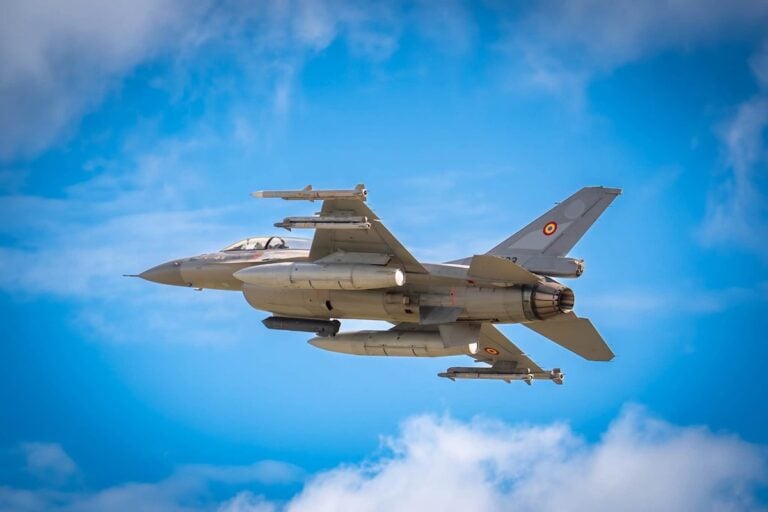
A major element of the exercise was the testing of Agile Combat Employment across the Nordic region. In Tervo, Finland, Allied aircraft carried out several highway landings from 8 to 12 June, including the first U.S. Marine Corps F-35B Lightning II landing and take-off from a Finnish highway strip, alongside Spanish F/A-18s and Polish F-16s.
The activity demonstrated how NATO can operate beyond established air bases. It also showed how dispersed operations can increase resilience and help preserve combat air power in contested conditions.
Fifth-generation fighter integration and airborne command and control were also central to the exercise. F-35 aircraft from Denmark, Italy, Norway and the United States operated across northern Europe, while NATO AWACS supported the exercise from Šiauliai, Lithuania.
On 15 June, a NATO E-3A landed in Sweden for the first time. NATO described the landing as a milestone for Alliance air operations in the High North and a contribution to stronger airborne battle management across the exercise area.
Persistent intelligence, surveillance and reconnaissance provided another layer of support. NATO’s Intelligence, Surveillance and Reconnaissance Force supported Ramstein Flag 26 from Pirkkala Air Base in Finland, operating RQ-4D Phoenix remotely piloted aircraft while mission crews and ISR specialists continued support from Sigonella, Italy.
The force’s new mission operations support centre also contributed to ongoing mission operations. NATO said this demonstrated how the Alliance can collect, analyse and share intelligence from distributed locations while maintaining mission support across the Alliance.
Deployed tactical command and control linked air and ISR activity to the wider scenario. From Kallax, Sweden, the Deployable Air Command and Control Centre supported the exercise through its Deployable Air Control Centre, Recognised Air Picture Production Centre and Sensor Fusion Post.
The deployment used 30 NATO vehicles and covered more than 5,000 km by sea and land. It planned 10 missions and controlled approximately 300 aircraft, supporting Integrated Air and Missile Defence and Counter Anti-Access/Area Denial training.
Ramstein Flag 26 also included Norwegian air defenders at Ørland Air Base, the UK Carrier Strike Group centred on HMS Prince of Wales, and southern Joint Operations Area activity from Albacete Air Base in Spain. The exercise followed synthetic preparation during Athena Warrior 26 and moved into live-fly operations across Europe.
NATO said the activity strengthened its defensive, non-provocative and proportionate posture. It also improved interoperability, readiness and the Alliance’s ability to deter aggression, defend NATO territory and protect NATO populations and NATO airspace.
Ramstein Flag 26 was Allied Air Command’s most ambitious version of the exercise to date. By operating at the same time across NATO’s northern and southern Joint Operations Areas, it connected command and control, combat aircraft, intelligence, surveillance and reconnaissance, air defence, tanker support, maritime forces and synthetic training into one coherent air operation.
The exercise showed NATO’s ability to train at scale across distance, climate and domain. It also reinforced collective defence and demonstrated that Allied air forces can rapidly integrate, adapt and operate wherever the Alliance requires.