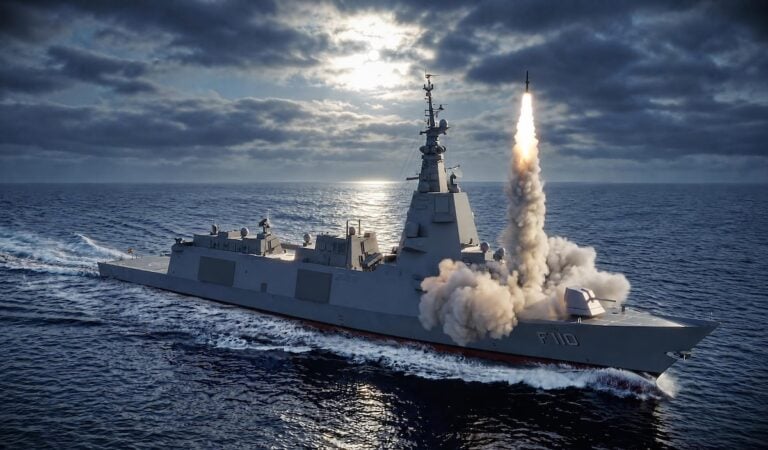
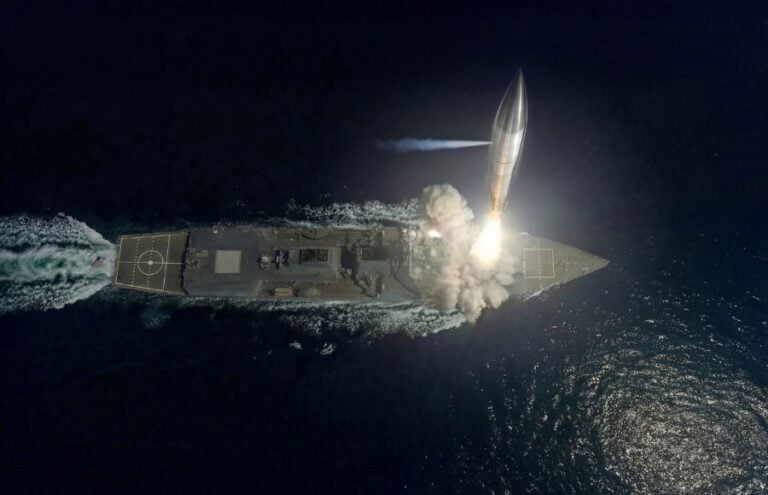
Danish company OSK Design introduces its latest design, the Arctic frigate, an exceptional vessel meticulously crafted for operations in the North Atlantic, High North, and Greenland regions.
This multi-purpose Arctic frigate is set to redefine maritime capabilities with its significant features and capabilities. One of the notable features of the Arctic frigate is its fully operational helicopter, ready to take on a key role in its missions. This helicopter is a critical asset for Arctic operations, allowing for airborne scouting, transport, and search and rescue missions in the challenging Arctic environment, OSK Design said in a press release.
Image: OSK Design.
Mission-ready versatility, arctic-ready and an exceptional mobility
The Arctic frigate is a true workhorse, designed to excel in a wide range of missions.
The Arctic frigate is classed for year-round operation in the arctic, capable of withstanding the most challenging ice conditions while maintaining optimal performance. With a length of 125 meters, a beam of 18.0 meters, a maximum draught of 6 meters, and a top speed of 23+ knots, this frigate is built for swift and agile navigation in the most unstable waters.
Equipped to handle any situation, the Arctic frigate boasts an impressive arsenal, including a gun, missile launcher, and overhead weapon systems, ensuring readiness for both offensive and defensive maneuvers. Operating in one of the harshest environments on Earth demands extraordinary capabilities.
Mission flexibility redefined
The Arctic frigate is powered by a state-of-the-art diesel-electric system (PODs), offering both efficiency and maneuverability. A crew capacity of 60-125+ depending on the task, a fully equipped helicopter, and a drone capacity for air, surface, and underwater operations ensure that the Arctic Frigate is ready for any mission. With two RHIBs (Rigid-Hulled Inflatable Boats) up to 9 meters in length and one stern-launched boat up to 12 meters, the vessel is equipped for swift and effective search and rescue missions.
The mission bay is designed to accommodate various modular systems and stores, such as the ACTAS ASW system, mine-laying modules, oil spill booms and equipment for the Arctic Standby Force, allowing for mission-specific adaptability. With its large, modularized mission bay, this vessel is adaptable for Anti-Submarine Warfare (ASW), surface and air surveillance, maintenance of sovereignty, search and rescue, disaster relief and enhanced self-defense.
With the Arctic frigate, OSK Design has designed a vessel that represents the pinnacle of maritime engineering and innovation. It is uniquely prepared to meet the demands of operations in the Arctic, offering a combination of versatility, power, and adaptability.
The 46,000-square-foot building will be the first at Dyess dedicated solely to the new bomber, with secure workspaces and communications networks for planning and preparing strike missions.
The U.S. Space Force is setting up an operations center to coordinate satellite networks from different providers and direct data where it is needed most.
BWX Technologies has begun work on a project to supply a 22-megawatt nuclear microreactor to Fort Campbell, the first U.S. Army base slated to receive the company’s reactor under the Janus program.
Saab expects to deliver its first Gripen E fighters to Ukraine in 2029, after a planned donation of 16 Gripen C/D aircraft, Chief Executive Micael Johansson told investors.
The U.S. Army tested the FD-1 drone interceptor in Poland to see whether it could give air defense units a lower-cost way to respond to attacks involving large numbers of drones.
Rolls-Royce Submarines will work with INFINITY to build and test full-scale prototypes of advanced defence components at a planned technology park in Derby.