
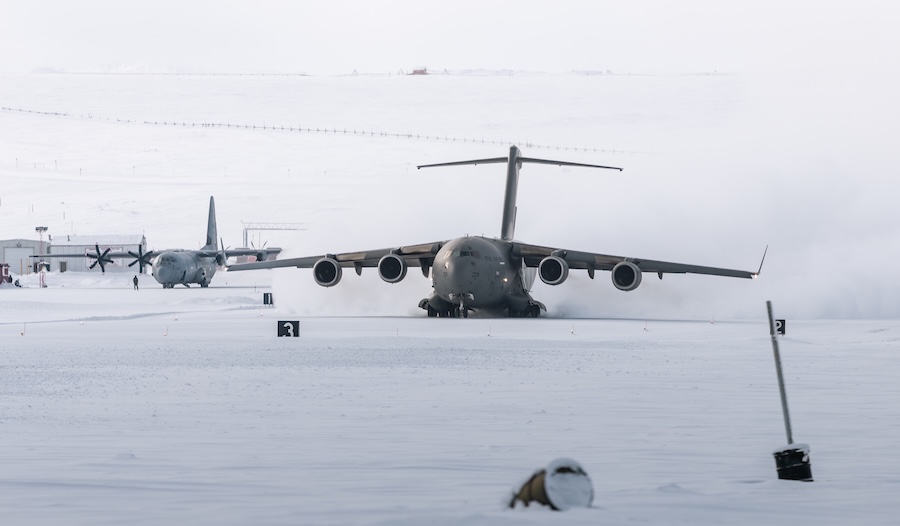
Located at 82.5 degrees North, CFS Alert serves NATO as a critical signals intelligence base and hosts an important climate change research station. The site is almost entirely encapsulated by Arctic ice, which thaws for only 30 days a year and remains too shallow for resupply vessels, making air delivery via a semi-prepared gravel and compacted snow runway — less than half the length of a standard airport strip — the only viable means of supply.
To keep its few hundred inhabitants warm and its technology operational, the RCAF dispatches C-17s twice a year to deliver nearly one million litres of jet fuel, powering everything from heaters to communications equipment. For the first time, the RAF joined the mission as part of the United Kingdom’s effort to develop its operational capabilities in the Arctic region.
Operating from Pituffik Space Force Base in Greenland, crews from 99 Squadron completed eight trips to Alert, delivering close to 300,000 litres of fuel to the station, known among personnel as the “Frozen Chosen.” The deployment represented a significant step in expanding British expertise in frozen runway operations.
Flight Lieutenant Mike Chandler, a 99 Squadron pilot, reflected on the challenges and significance of the mission. “Flying into the High Arctic is demanding, especially when the weather can change on a dime, but that’s exactly why this activity is so important,” he said. “Working with our Canadian colleagues has shown just how closely our air forces operate together. The C-17 performs superbly in these conditions, and it’s a real privilege to contribute to a mission that is so vital to sustaining operations at Alert,” he added.
Beyond the resupply task, the crews worked to deepen bilateral cooperation with the RCAF by fully integrating operations, logistics and engineering functions. Mixed crews flew on each other’s aircraft — a level of interoperability rarely seen between the two nations since the Second World War.
Air Commodore James, Commander Air Mobility Force, underlined the broader strategic importance of the deployment. “This is a powerful demonstration of the RAF’s reach, readiness, and capability. Operating thousands of miles from the UK, in the extreme cold and with limited infrastructure, proves that we can generate operational air mobility wherever it is needed,” he said. “Our partnership with Canada is strong; we are committed to working alongside one of our closest allies on security and stability in the High North,” he added.
The C-17s of 99 Squadron, based at RAF Brize Norton, have served as the backbone of the RAF’s strategic airlift for 25 years, operating across Afghanistan, Iraq and numerous humanitarian missions. The squadron is now at the forefront of developing the United Kingdom’s aerial capabilities in the High North, as global interest in the Arctic continues to grow.
The UK remains committed to contributing to collective NATO security in the far north, with Arctic operations enhancing the RAF’s readiness for extreme environment deployments. Through exercises and operations such as Boxtop, the RAF continues to strengthen alliances and demonstrate its capability to operate at the very edge of the Arctic.