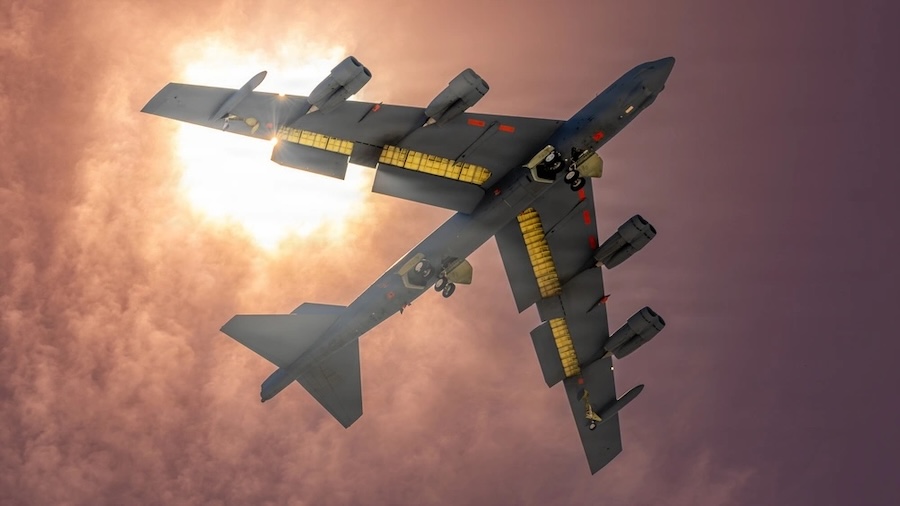
The study will consider several options, including additional upgrades for the B-52, development of a completely new aircraft or a combination of both approaches. Budget documents state that the first stage of the analysis will focus on defining key performance parameters and operational requirements for future heavy bombers.
The Air Force spent $3.9 million in 2025 on a classified proof-of-concept demonstration involving the B-52 and is requesting another $1 million in fiscal 2027 to begin the new analysis. The service is also preparing to start modernisation work this year on the first of 76 B-52H bombers, which will be upgraded to the B-52J configuration.
The overhaul programme includes new Rolls-Royce engines, upgraded avionics, radar improvements, new landing gear and a redesigned glass cockpit. The work, which will be carried out by Boeing in San Antonio, is intended to keep the aircraft operational into the 2050s.
Current Air Force bomber plans call for retaining the upgraded B-52J fleet while introducing at least 100 B-21 Raider bombers and retiring the B-1B Lancer and B-2A Spirit fleets during the 2030s. Analysts said the new study is expected to consider a broad range of strike capabilities and aircraft combinations.
Mark Gunzinger, a former deputy undersecretary of defense and retired Air Force colonel who previously flew the B-52, said the Air Force was likely to evaluate multiple future concepts. He said options could include a new stand-off bomber, additional modifications for the B-52, a cruise missile carrier aircraft or expanded procurement of B-21 bombers.
“While the [B-52] aircraft is old, the airframe is still relatively young in terms of flight hours and the stresses it’s absorbed over the years,” Gunzinger said. “So it’s a perfectly viable airframe.”
Gunzinger said the review extends beyond simply replacing the B-52. “I think it might be better characterized as saying, they’re taking a look at the stand-off strike mission area itself, and what’s the best solution for the distant future?” he said.
According to Gunzinger, the Air Force study is expected to assess factors including stealth, speed, weapons capacity, electronic warfare capabilities and self-defence systems. He said stand-off weapons could reduce the need for some aircraft to penetrate heavily defended airspace directly.
The pending retirement of the B-1B is also expected to influence future bomber planning because of the aircraft’s high speed and large payload capacity. The B-1B can carry up to 75,000 pounds of conventional weapons and reach speeds above Mach 1.2, while the B-52 carries up to 70,000 pounds with a top speed of about 650 miles per hour.
Gunzinger said the Air Force would likely continue seeking a mix of penetrating and stand-off strike aircraft to maintain operational flexibility. “Both are needed,” he said. “It really gets down to, what’s the ultimate mix you want?”
The B-21 Raider, designed to penetrate defended airspace while avoiding radar detection, remains central to future bomber plans. Adm. Samuel Paparo, commander of U.S. Indo-Pacific Command, told lawmakers in April that he supported expanding the planned B-21 fleet to 200 aircraft.
Source: Air & Space Forces Magazine.