

Pistorius: Germany should have the strongest armed forces in EU
“Germany is the largest economy in Europe, so it should also be our goal to have the strongest and best-equipped army in the EU," said Germany's defence minister Boris Pistorius.
“Germany is the largest economy in Europe, so it should also be our goal to have the strongest and best-equipped army in the EU," said Germany's defence minister Boris Pistorius.

Director-General Timo Pesonen has signed, on behalf of the European Commission, a Copernicus Cooperation Arrangement with the Ministry of Economy, Trade and Industry (METI) of Japan.

European defence budgets are increasing in the wake of Russia’s war on Ukraine. But if member-states don’t co-ordinate their spending better, fragmentation will persist and Europe’s defence industry could weaken.

NATO and the EU agreed to create a taskforce on resilience and critical infrastructure protection.

"We all know that we now need to ramp up the production capacity of our defence industry. And we need to coordinate the replenishment of military equipment," said President of the European Commission Ursula von der Leyen.

NATO Secretary General Jens Stoltenberg, the President of the European Council, Charles Michel, and the President of the European Commission, Ursula von der Leyen signed the third Joint Declaration on NATO-European Union cooperation.

Macron aims to make France lead in European initiative so Europe can organise its tools to guarantee its security through a credible European defence, highly interoperable with NATO.

The enhancement of European defence cooperation in a variety of aspects is one of the priorities of the Swedish Presidency of the Council of the EU

The creation of an EU space communication infrastructure would largely decrease congestion in space, resulting from space traffic and space debris that hinders the appropriate execution of operations in that domain.
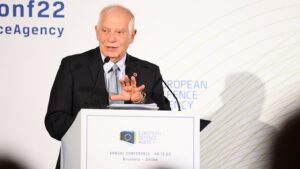
Europeans are clearly increasing their defence spending and capabilities. This is what the report of the European Defence Agency says. This is very much needed, writes Josep Borrell.

The unprecedented level of NATO-EU cooperation in recent years further accelerated in the aftermath of Russia’s invasion of Ukraine this year.

"Common European armed forces would be capable of more cost-effective procurement than individual member states are", writes Mikuláš Dzurinda, President of Wilfried Martens Centre for European Studies.
Categories: