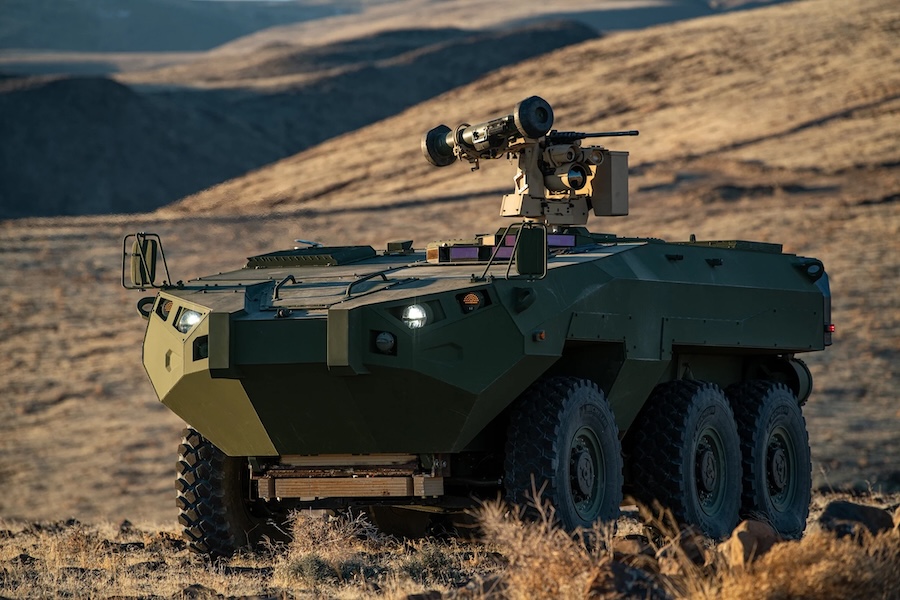
The Advanced Reconnaissance Vehicle is intended to replace the Light Armored Vehicle and support mobile reconnaissance operations. According to the Marine Corps, it is designed to be highly mobile, networked, transportable, protected and lethal, integrating sensors, communications systems and weapons capabilities.
Chris Stephenson, programme manager for Light Armored Vehicles, said: “[The Advanced Reconnaissance Vehicle] is designed to be highly mobile, networked, transportable, protected, and lethal, providing sensors, communication systems, and lethality options to counter threats traditionally addressed with more heavily armored systems.” He added: “In the future fight, the Marine Air-Ground Task Force Command and Control (MAGTF C2] must out-cycle the fight for information to shape the battlespace and deliver precision fires.”
He continued: “This highly contested environment is drastically more complex, and Mobile Reconnaissance Battalions must have a purpose-built capability such as the ARV that can sense, communicate and fight by incorporating manned and unmanned systems and sustaining effective sensor webs tied to kill chains.” The programme aims to provide new capabilities tailored to evolving operational demands.
Textron Systems said it will deliver 16 Cottonmouth pre-production vehicles across three variants, including command and control with unmanned aerial systems, a 30mm autocannon version and a logistics variant. The company will also provide systems integration laboratories and additional supporting components.
David Phillips said: “Starting as a clean-sheet design in 2019 and shaped by the voice of the customer, the Cottonmouth vehicle is poised to transform the Marine Corps’ reconnaissance missions with adaptability, mobility and as a battlefield quarterback for the USMC.” He added: “Textron Systems invested early on in prototype vehicles to reduce risk and increase maturity for the warfighter.”
He said: “The system design considers today’s mission requirements while also employing a Modular Open System Architecture that enables ease of future integration for the future needs of the USMC, embodying the very essence of innovation and partnership that define us as an organization.” The approach is intended to support long-term adaptability of the platform.
General Dynamics Land Systems said its prototype has undergone extensive testing in earlier phases. The current development phase will include validation of the final design and the construction of multiple vehicles for government testing and evaluation.
Keith Barclay said: “Our ARV prototype has been thoroughly tested throughout the previous phases, and we are confident in its ability to meet and exceed the requirements of the Marine Corps.” He added: “We are proud to continue working side-by-side with the Marines through this next phase to ultimately deliver a transformational capability.”
Deliveries of prototype vehicles are expected by the fourth quarter of fiscal year 2028. A production decision is planned for early 2031 following testing and evaluation.
Separately, the Marine Corps has opened a new Joint Light Tactical Vehicle integration laboratory at Naval Information Warfare Center Atlantic in South Carolina. The facility is intended to support the integration of new systems into the service’s tactical vehicle fleet.
Eric Smith, Commandant of the Marine Corps, said: “It is the workhorse of our ground tactical fleet.” He added: “And that’s going to negatively impact the Marine Corps’ ability to fulfill its ground tactical vehicle mobility strategy, which has me concerned.”
The integration lab, operational since December 2025 and formally opened in March, is designed to centralise testing and validation efforts. The Marine Corps said the facility enables multiple teams to work simultaneously on vehicle integration, reducing costs and accelerating development timelines.
Jeff Wade said: “The opening of the lab sends a message to not only integrating programs but also sends a message to the fleet.” He added: “We’ve been working with all the different MEFs to try to figure out any type of capability gaps that they’re currently seeing out in the fleet, and we’re also assisting them on integration as well.”
Source: USNI News.