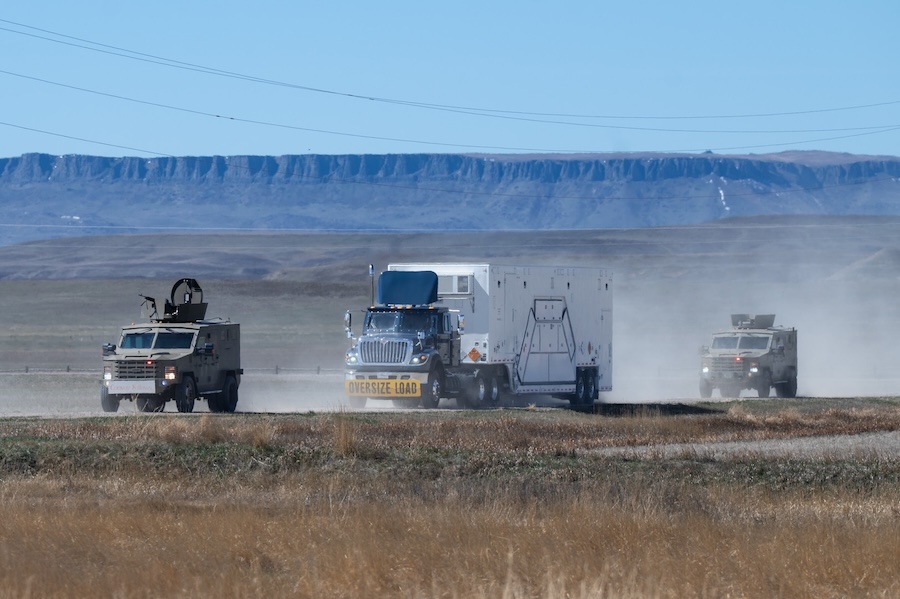
The vehicle was escorted by helicopters and security units to the launch facility where on-site maintenance was conducted. The mission marked the first operational use of Air Force Global Strike Command’s new payload transporter system.
Luke Stover, commander of the 341st Maintenance Group, said: “The first operational convoy with the Payload Transporter Replacement culminates months of hard work by the professional Airmen across the 341st Maintenance Group.” He added: “In the hands of our dedicated maintainers, the PTR is a powerful tool that will ensure the Minuteman III remains a viable deterrent for as long as our nation requires.”
The inaugural mission was carried out by Senior Airman Jose Ruiz and Senior Airman Jeffrey Essers, who served as missile maintenance quality assurance evaluators. Their work marked the first certified operational use of the system in the field.
The mission represents a step in modernizing the 20th Air Force’s nuclear missile operations as the PTR begins replacing the aging Payload Transporter III system. The legacy system is currently used across multiple bases, including Malmstrom Air Force Base, F.E. Warren Air Force Base, Minot Air Force Base, and Vandenberg Space Force Base.
The PTR will support ICBM field maintenance operations until the next-generation LGM-35 Sentinel system fully replaces the Minuteman III. The modernization effort is intended to maintain operational readiness during the transition to new systems.
The PTR program began in 2012 and led to a 2019 contract for the delivery of 25 vehicles to replace the older fleet. The new system is designed to meet updated security and operational requirements, including protection against cyber and physical threats.
Compared with the legacy system, the PTR includes an armored tractor cab, ballistic-protected windows, and an integrated auxiliary power unit. The trailer is equipped with internal and external lighting, supporting operations in varied conditions.
Senior Airman Jose Ruiz described his experience with the new system, saying: “When I was first told I was going to be the one getting certified on PTR, I was pretty excited.” He added: “It was a new truck. Nobody in the world was certified on it, and nobody really knew about it. So for me to be hand-selected – to be the first one certified on this new truck and trusted by the Air Force – I was excited. I wanted to get hands-on right away and help shape the future generations of the ICBMs.”
Ruiz and Essers underwent months of training and certification before the first mission. The process included familiarization, repeated operational runs, and adapting to differences from the older system.
Ruiz said: “Since the truck was so new, the training began with just basic AETC [Air Education and Training Command] training, just getting familiar with the truck and the book itself.” He added: “From there we had months of runs and getting familiar with the truck and finding the ins and outs of it. That led to us being the ones…getting it certified for the base as a whole.”
He also noted operational improvements introduced by the system, stating: “The way the inside of the [PTR’s] trailer is designed, it changes the way that we perform our maintenance and the job as well.” He added: “We’re still finding little things here and there to make things faster and find a better flow.”
Jeffrey Essers highlighted both challenges and benefits, saying: “I was also still missile maintenance for a while when we were initially starting our training.” He added: “I was doing field operations and maintenance as well, while I was doing training for the truck.”
Essers said: “Though there is a steep learning curve to utilizing the PTR, the benefits that this system brings are great for the weapon system.” He added: “I’m proud to be one of the first two members in the world to utilize the PTR and implement new processes for future generations.”
Officials said the primary objective remains ensuring the safety, security, and reliability of the missile system. The introduction of the PTR is expected to improve long-term sustainment and operational efficiency across the force.
Source: U.S. Strategic Command.