

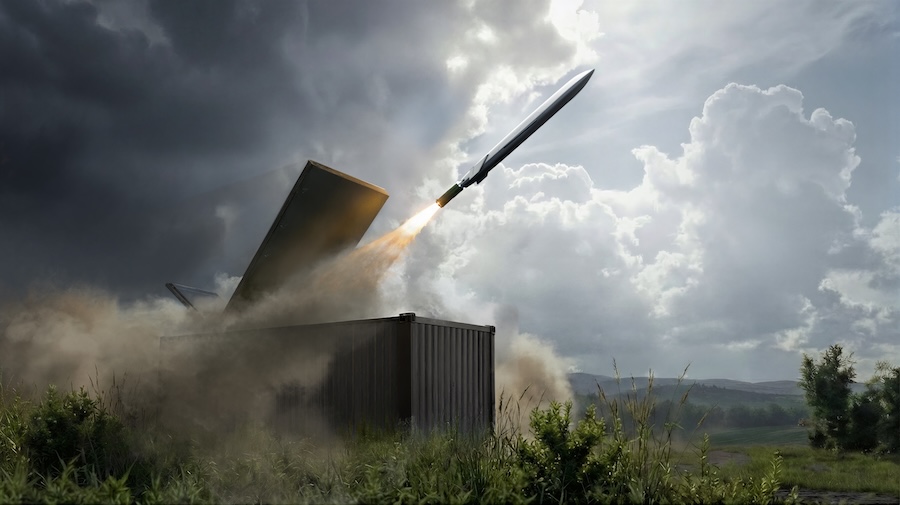
RUTA Block 3 will build on the existing RUTA architecture, which Destinus said has moved from battlefield validation into serial industrial production. RUTA Block 1 is already in serial production in the Netherlands, while RUTA Block 2, developed with support from Ukraine’s Brave1 and currently undergoing flight testing in Ukraine, is planned to enter production ramp-up in 2026.
The Block 3 programme is designed to move European long-range strike capabilities from limited inventories toward sustained industrial production. Destinus said the system will preserve sovereign European design authority, scalable production and containerised deployment.
The programme will be structured across industrial hubs in the Netherlands, Ukraine and Germany. In the Netherlands, Destinus will serve as the engineering and design authority and as the primary RUTA production site, while Ukraine will support development, operational testing and production of essential components.
In Germany, the planned Rheinmetall Destinus Strike Systems joint venture is expected to provide high-rate manufacturing, qualification and final integration capacity for the Bundeswehr and other European institutional customers. Production at Rheinmetall’s Unterlüß site is planned to begin with RUTA Block 1 and Block 2 in 2026-2027, with Block 3 to follow after flight testing and qualification.
“Europe is entering a new defence era where the decisive factor is no longer the existence of precision weapons, but the ability to produce, replenish, and evolve them at an industrial scale during prolonged high-intensity operations,” said Mikhail Kokorich, CEO of Destinus.
“RUTA Block 3 is designed around that reality: sovereign European architecture, distributed industrial production, and the ability to scale rapidly across allied nations,” Kokorich added. “Our objective is not to manufacture symbolic quantities of exquisite missiles, but to help establish a credible European long-range strike capability with real industrial depth.”
Armin Papperger, CEO of Rheinmetall AG, said deep precision strike capabilities are important for deterrence. “Deep precision strike capabilities, meaning the ability to strike strategically important targets with pinpoint accuracy, even deep within the enemy’s territory, contribute to a credible deterrent and are therefore of great importance in terms of security policy,” Papperger said.
“We are ready to establish the Rheinmetall Destinus Strike Systems joint venture with our partner Destinus before the end of this year and to provide these capabilities to our customers as soon as possible,” Papperger added. “We are excited to produce and deliver the first missiles from our Unterlüß site before the end of 2026.”
RUTA Block 3 is intended to use the larger Destinus T220 next-generation turbojet engine, currently in design, and a 250 kg-class warhead. The system is being designed for long-range missions in contested environments.
The planned missile will combine advanced autonomous navigation for GNSS-degraded environments with terminal sensing and guidance capabilities still under development. It will also use a standard ISO containerised launch architecture for land-based, maritime and fixed-site deployment.
Destinus said the system is being developed and industrialised under its European design authority and production framework, drawing on operational lessons from Ukraine. The company added that all development, production and export activities will follow applicable national and European laws, export-control regulations and required governmental approvals.
![Destinus completes flight test of Ruta Block 2 validating new launch architecture for scalable long-range strike capability [VIDEO]](https://defence-industry.eu/wp-content/uploads/2026/04/destinus-completes-flight-test-of-ruta-block-2-validating-new-launch-architecture-for-scalable-long-range-strike-capability-video-768x515.jpeg)

