The project involves ten countries and 27 industrial companies, with €65 million supplied by the European Defence Fund and the remainder by participating countries and companies. Industrial partners include Thales, Leonardo, Naval Group, Navantia, Kongsberg and Damen, alongside participating research institutions.
Baltic Workboats leads the consortium, while the Estonian Centre for Defence Investments coordinates cooperation between the countries. Estonia was entrusted with leadership of the European Defence Fund project in 2024.
A central part of the work is GENSA, a common system architecture developed for European naval vessels. The partners intend to use EUROGUARD to test that architecture at sea and establish how technologies from different suppliers can work together.
“The ship is the most visible part of this project, but just as valuable is GENSA, the common system architecture for European naval vessels that we developed together,” said Jüri Saska, EUROGUARD project manager. “It provides a framework for integrating technologies from different manufacturers into complete solutions and for reusing the development work in future ship projects.”
“This means future warships can be designed and built faster, more flexibly and more efficiently,” Saska said. “The vessel launched today is where we can put these solutions to the test in real sea conditions for the first time.”
The semi-autonomous ship is designed to accept interchangeable modules for maritime surveillance, mine countermeasures, seabed monitoring and critical infrastructure protection. It will also support search and rescue and the deployment, integration and control of unmanned systems.
Planned functions include autonomous navigation, obstacle and threat detection, collision avoidance and remote control from shore. The prototype will also be used to develop capabilities for unmanned operations or operations with fewer personnel on board.
The design calls for a speed of at least 20 knots, a range of at least 2,000 nautical miles and ten days’ endurance at sea. It incorporates propulsion technologies intended to meet European environmental standards.
Poland’s participants are the Polish Naval Academy in Gdynia and OBR Centrum Techniki Morskiej, part of Polska Grupa Zbrojeniowa. OBR Centrum Techniki Morskiej leads the Secure Communication work area and will design and deliver the ship’s integrated communications and data-transmission system.
The programme began in 2023, entered its production phase in 2025 and is scheduled to run until the end of 2027. EUROGUARD stands for EUROpean Goal based mUltimission Autonomous naval Reference platform Development.
“This is a sign of great trust in Estonian shipbuilders,” said Ahto Pärl, director of the EUROGUARD Consortium. “It was us who were given the lead on such a large-scale project, even though the consortium includes several of Europe’s top defence companies.”
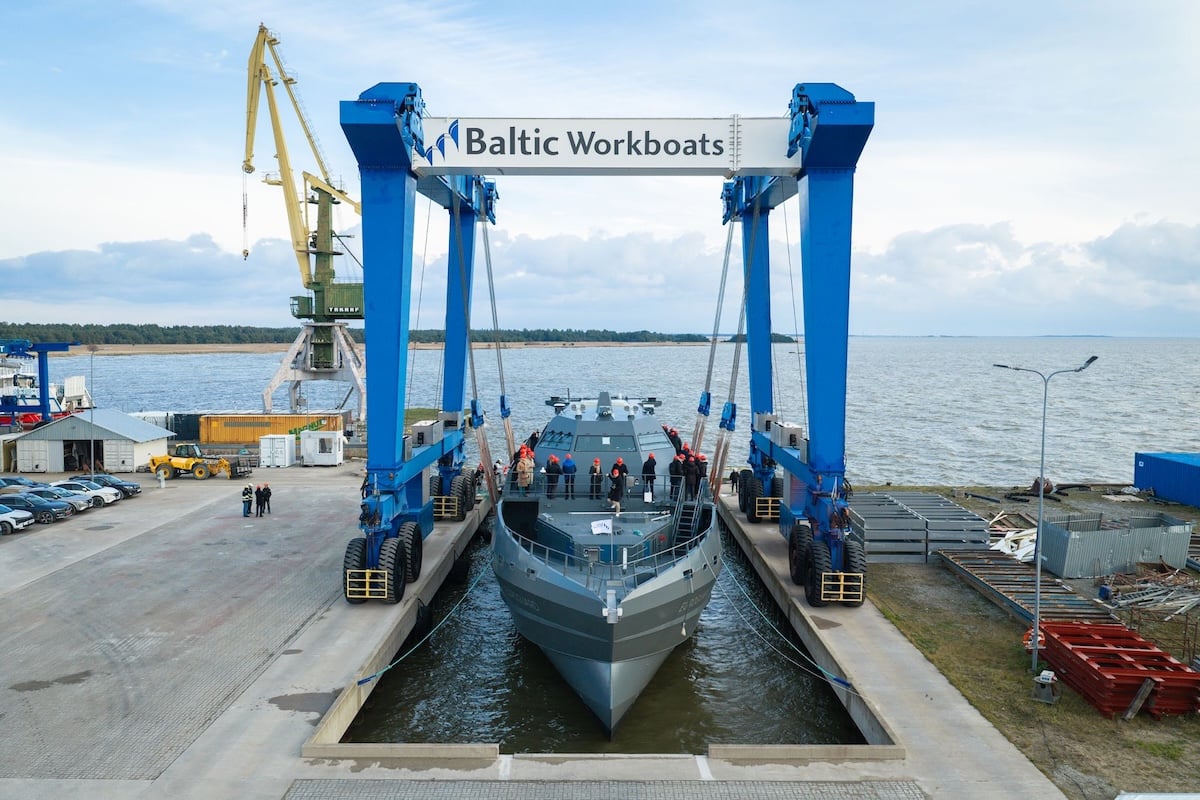
“EUROGUARD, a 45-metre modular vessel prototype and the first of its kind in Europe, shows that we can now build warships ourselves,” said Margus Vanaselja, chairman of Baltic Workboats’ management board. “This project proves that smaller allies, too, can make a truly decisive contribution to developing the defence capability of the European community.”
Built at the company’s Nasva yard on Saaremaa island, EUROGUARD is the largest warship constructed in Estonia since the restoration of independence, according to Baltic Workboats. The company said the programme had strengthened its readiness to design and build future warships for Estonia with its partners.
Although intended for research and experimentation, EUROGUARD is a fully engineered, full-scale vessel built for military missions. Outfitting and technology integration will continue before sea trials, concept testing and demonstrations during 2027 assess the systems’ performance and readiness for future maritime operations.