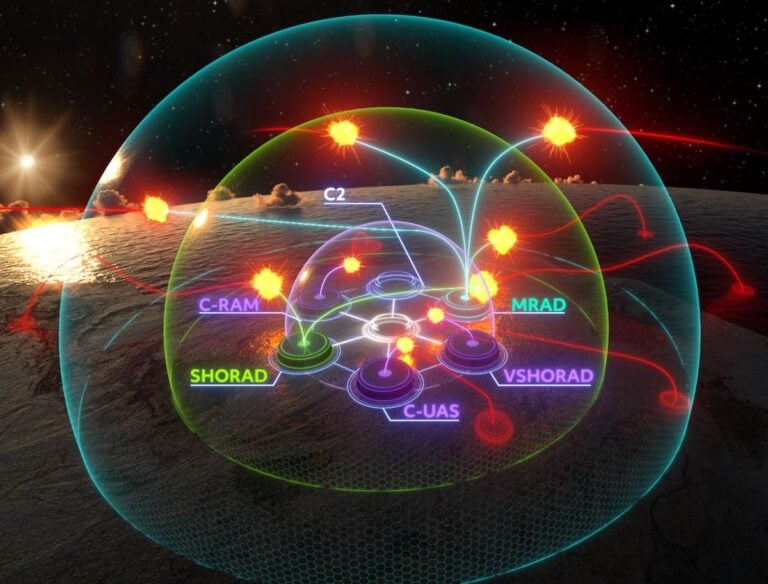

MRADR is a mobile system designed to provide persistent, 360-degree surveillance while limiting the risk of emissions revealing Marines’ positions in contested environments. It combines advanced antenna technology with signal processing to help Marines track, identify and defeat aerial threats, according to Leidos.
“Marines need air defense capabilities that can keep pace with an increasingly complex operating environment,” said Matt Becker, vice president of Leidos Defense Sensors. “This award allows us to help the Marine Corps work toward a significant increase in survivable air-surveillance capability that supports the warfighter wherever the mission takes them.”
The award follows a $32 million contract Leidos received in 2023 to develop four MRADR prototypes for the Marine Corps. The new work includes an option to retrofit previously developed prototypes and existing Marine Expeditionary Long Range Persistent Sensor systems, known as MELPS.
Leidos said it would use its engineering, manufacturing and integration experience to deliver the radars. The company linked the award to its NorthStar 2030 strategy and its focus on defense technology that meets changing customer requirements.
The company’s other sensing systems include Army Long Range Persistent Surveillance, designed to support Golden Dome for America, and the Multifunction X-Band Radar for counter-drone missions supporting homeland defense. Leidos also designs and builds electro-optical and infrared satellite payloads for missile warning and tracking.