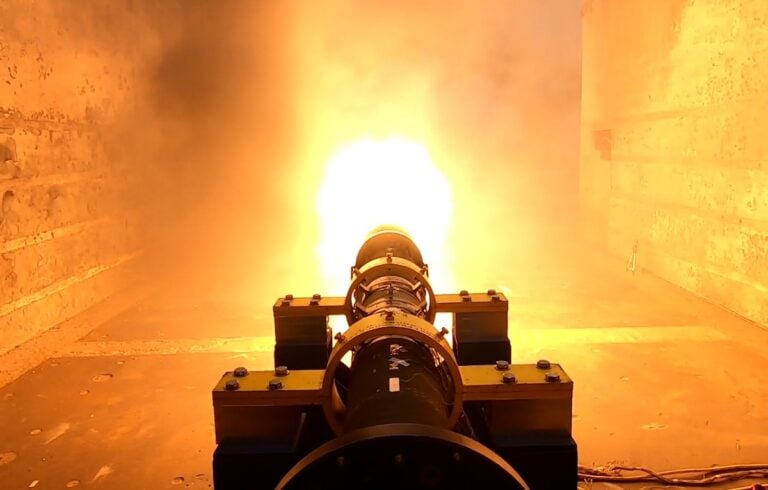
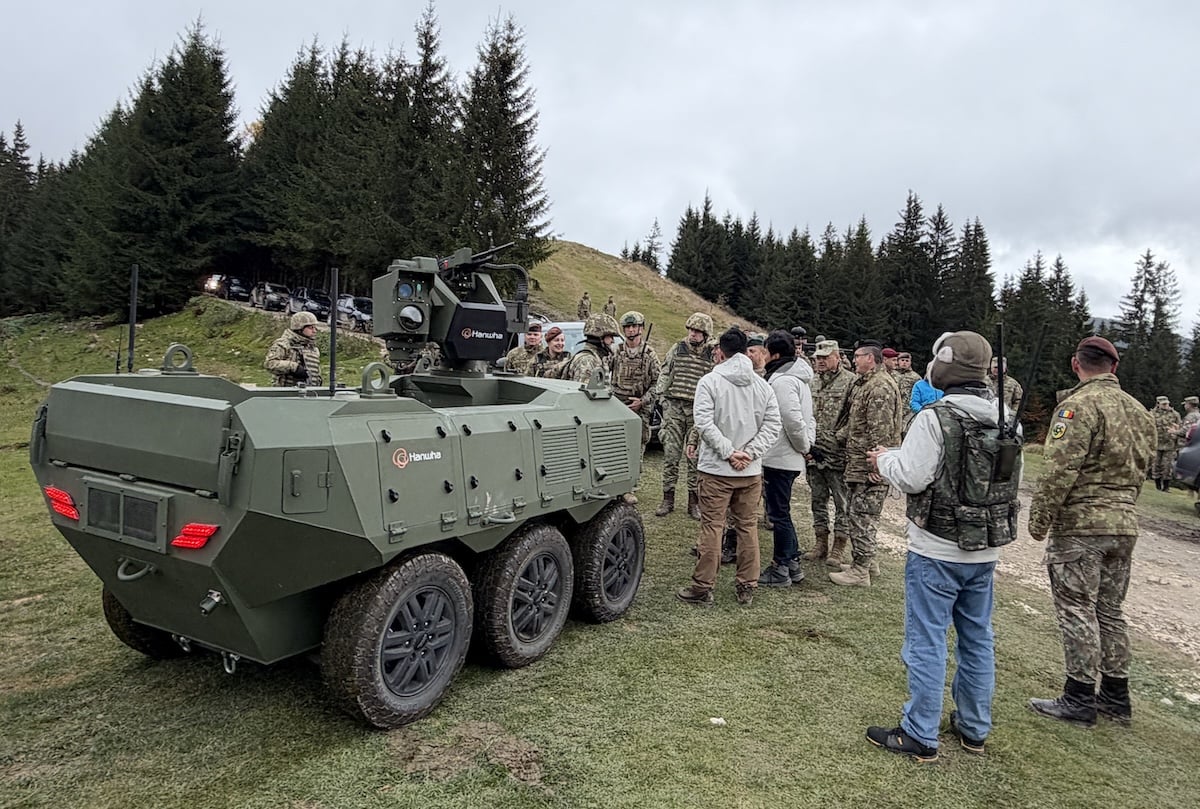
The demonstrations took place during EXPERIMENT 26.2 at the Prislop training range in Argeș County from 26 to 30 October. The Romanian Land Forces organised the exercise with military personnel and 27 defence industry participants to assess emerging technologies under realistic operational conditions.
Hanwha Systems’ counter-unmanned aircraft system completed assigned detection, tracking and electronic jamming missions and operated reliably in rain and dense fog, the company said. It used NATO-aligned communication standards to share operational information with Romanian command-and-control systems.
“One of the key achievements of this exercise was demonstrating that our C-UAS solution can work seamlessly with the Romanian military’s existing command-and-control systems,” said Jae Yong Kim, director of the C-UAS Business Center at Hanwha Systems. “This is an important step towards supporting integrated air defence operations and strengthening our cooperation with Romania and other European partners.”
The counter-drone equipment combined a short-range active electronically scanned array radar, a TAS-815K electro-optical/infrared camera, a radio-frequency scanner and a jammer. An intelligent command-and-control system coordinates the sensors and countermeasures, which can be tailored to different missions and operating environments.
The radar draws on core technologies from the multi-function radar used in the M-SAM medium-range surface-to-air missile system. Hanwha said the integration demonstrated in Romania showed potential for broader deployment in European defence environments.
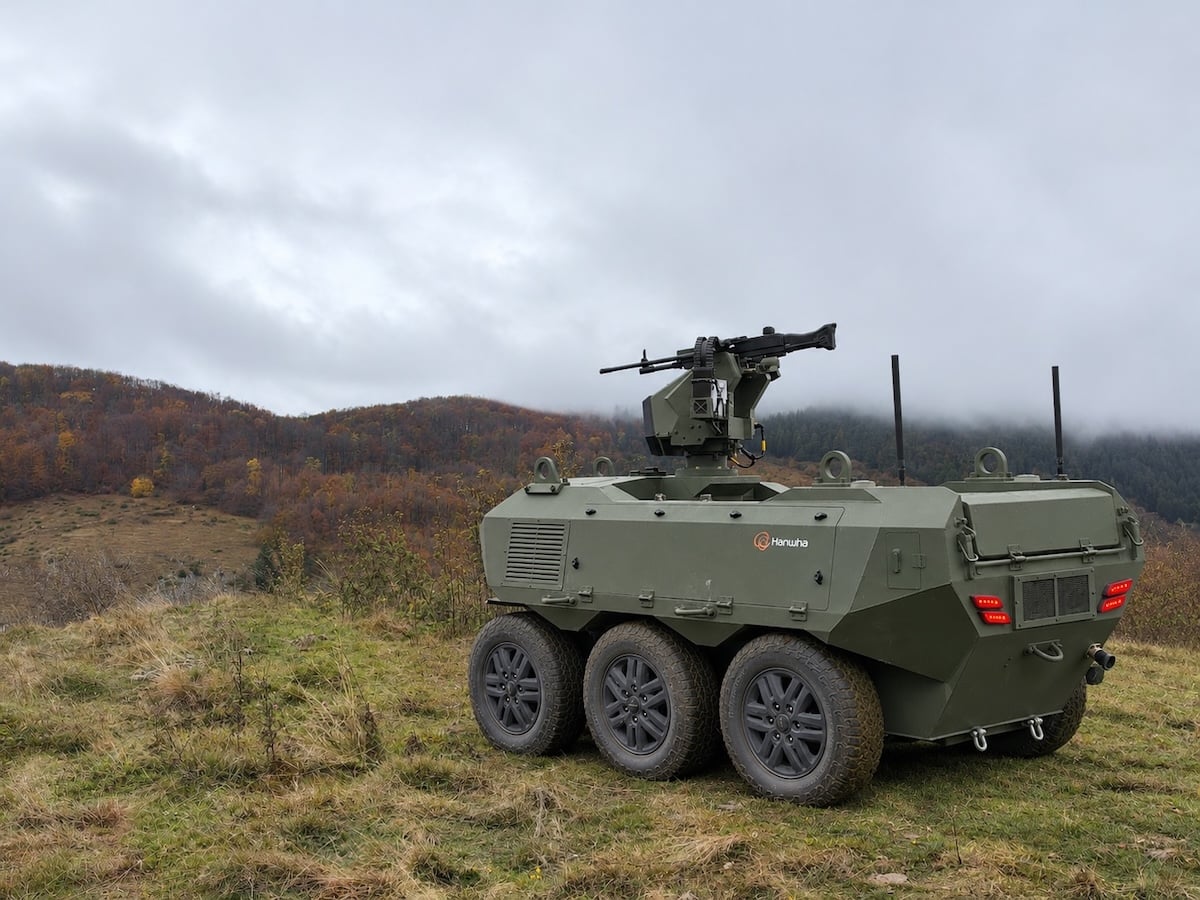
GRUNT conducted reconnaissance and surveillance across mountainous and forested terrain, using electro-optical and infrared sensors to detect concealed personnel and vehicles. The vehicle transmitted footage and position data in real time through Romania’s C4ISR network and demonstrated that it could maintain video transmission through an alternative link in the event of a primary-network failure.
“This exercise provided a valuable opportunity to demonstrate how GRUNT can operate alongside Romanian military systems and contribute to coordinated ground operations,” said Denis Lee, business development manager at Hanwha Aerospace Romania. “The successful integration with Romania’s C4ISR network is an important step towards deeper operational and technological cooperation with the Romanian Armed Forces.”
The 6×6 robotic vehicle has hybrid propulsion, autonomous and remotely controlled functions, and can carry approximately 900 kilograms. It is a next-generation development of Hanwha Aerospace’s ARION-SMET, a multipurpose unmanned ground vehicle selected for operational deployment by the Republic of Korea Army.
Hanwha’s team also deployed Milrem Robotics’ THeMIS tracked robotic vehicle at EXPERIMENT 26.2. GRUNT and THeMIS had previously participated alongside the TIGON wheeled armoured vehicle in a crewed-uncrewed teaming demonstration in Romania in May 2026, on the sidelines of the Black Sea Defense & Aerospace exhibition.
Hanwha Aerospace Romania and Estonia’s Milrem signed a teaming agreement that month to pursue opportunities in Romania’s unmanned ground vehicle programme. The partnership combines wheeled and tracked technologies and is exploring local development and manufacturing suited to Romanian military requirements.
“This exercise has deepened our understanding of the Romanian Armed Forces’ operational needs and demonstrated how our technologies can support them,” said Lino Lim, chief executive of Hanwha Aerospace Romania. “We look forward to strengthening our partnership with Romania and developing solutions tailored to its defence requirements.”
“Building on this experience, we aim to expand our participation in multinational military exercises, including NATO-led activities, to showcase our technologies and strengthen cooperation with European partners,” Lim said. The company is also developing H-ACE Europe, Hanwha Aerospace’s first European manufacturing facility, to support local production of K9 self-propelled howitzers and K10 ammunition resupply vehicles.
The broader K9 programme includes K12 armoured recovery vehicles, and Hanwha has identified potential to expand the facility into other advanced land defence systems. Its plans for the site include a long-term manufacturing and support base, technology transfer and greater cooperation with Romanian suppliers.