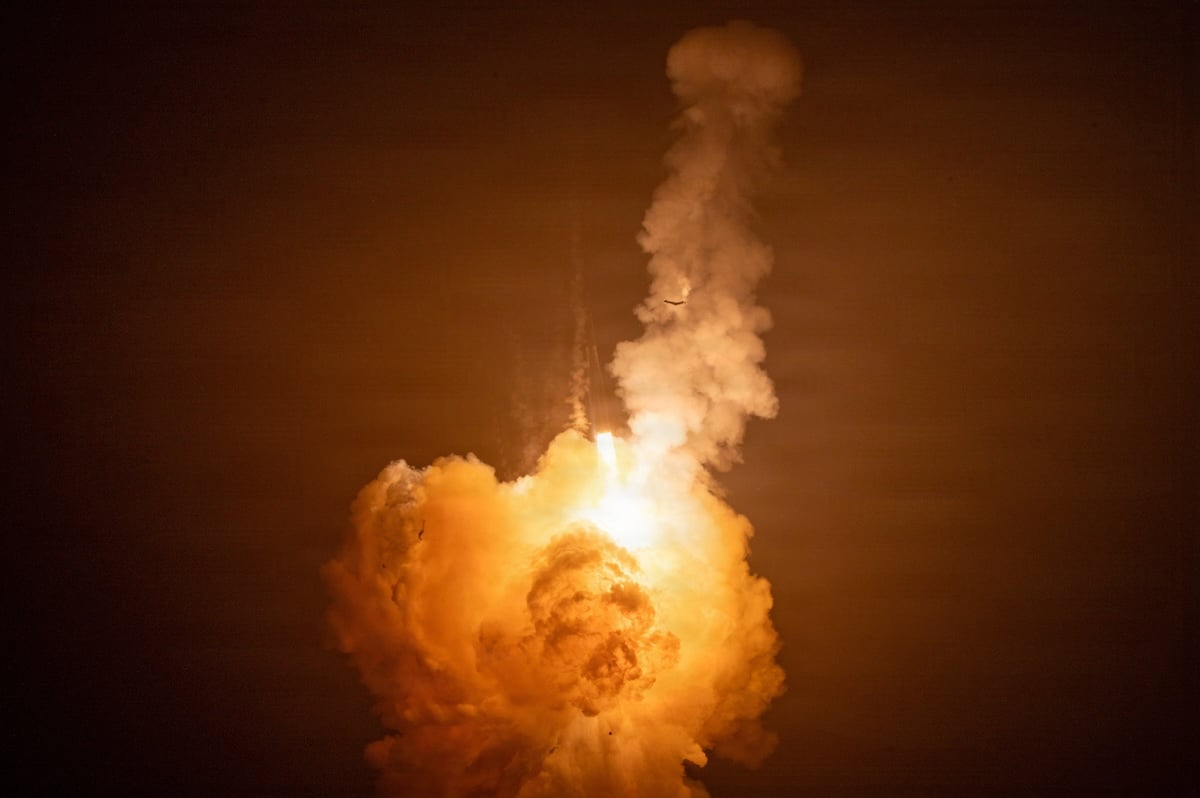
Air Force Global Strike Command said the routine test had been scheduled years earlier and was unrelated to world events. The results provide government agencies with data for sustainment, engineering and analysis of the system throughout its service life.
“The ability to conduct these rigorous, realistic tests relies on the dedication of our Airmen and is foundational to ensuring the safety and surety of the Minuteman system,” said Gen. S.L. Davis, commander of Air Force Global Strike Command. The command has completed more than 300 Minuteman III test launches.
The Air Force operates a force of 400 Minuteman III missiles as part of the nation’s strategic deterrent. They are assigned to the 90th Missile Wing at F.E. Warren Air Force Base in Wyoming, the 341st Missile Wing at Malmstrom Air Force Base in Montana and the 91st Missile Wing at Minot Air Force Base in North Dakota.
The missiles are dispersed in hardened silos connected by hardened cables to underground launch control centers, where two-officer crews maintain continuous alert. Communications systems provide the president and secretary of defense with direct contact with those crews.
If links between a launch control center and remote launch facilities are lost, specially configured E-6B airborne launch control aircraft assume command and control of the isolated missiles. Qualified missile combat crews aboard the aircraft would execute the president’s orders.
The LGM-30G Minuteman III uses three solid-propellant rocket motors and inertial guidance, with Boeing listed as the contractor. Its stated range exceeds 6,000 miles, and it reaches approximately 15,000 mph at burnout, according to Air Force specifications.
The missile weighs 79,432 pounds, or 36,030 kilograms, and measures 5.5 feet in diameter. Its hardened basing and quick reaction capability are designed to help it survive an attack and sustain its deterrent role.
The Minuteman program dates to the late 1950s, with the first version deployed in the early 1960s. Upgrades have expanded targeting options and improved accuracy and survivability, while maintenance based on removing and replacing components has supported high alert availability.