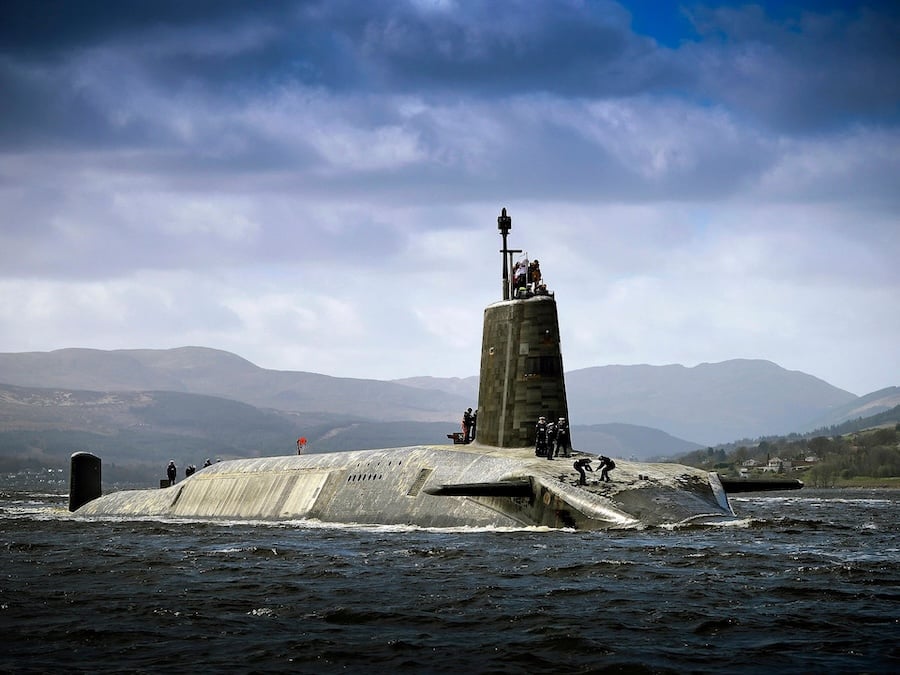
Astraea will replace the Mk4A warhead carried by Britain’s submarine-based nuclear deterrent. It will be the first UK warhead designed in the Comprehensive Nuclear-Test-Ban Treaty era without explosive nuclear testing.
The programme completed its System Design Review in August 2025, according to the *Defence Nuclear Enterprise 2026 Annual Update to Parliament*. The review examined the warhead’s design, safety, performance and ability to be manufactured.
British specialists completed hydrodynamic trials at Los Alamos the following month. The work forms part of a wider programme of laboratory experiments used to assess the weapon without conducting an explosive nuclear test.
Alignment with W93/Mk7 gives Astraea a direct connection to the United States’ equivalent warhead programme. The UK government nevertheless describes the design as sovereign and says Britain retains the industrial and scientific capability required to produce it.
The relationship is supported by the 1958 US-UK Mutual Defence Agreement and the 1963 Polaris Sales Agreement. The agreements enable exchanges involving nuclear materials, technology, non-nuclear components and scientific expertise.
The Mutual Defence Agreement was extended indefinitely in 2024, preserving the legal framework for long-term cooperation. Britain and the United States also work together on nuclear policy, operations, technology and nuclear-threat reduction.
The government has allocated £15 billion to the wider UK warhead programme between 2025-26 and 2029-30. The investment covers Astraea, continued support for the Mk4A stockpile and the infrastructure, manufacturing and scientific capabilities required for both.
AWE is expanding those capabilities through projects including the Future Materials Campus. The programme will provide facilities for nuclear-component manufacturing, material storage, fissile-material research and nuclear-material recovery.
Britain is also using the joint UK-French EPURE facility to test and assess Astraea-related technologies. The programme completed what the report described as the world’s first three-axis hydrodynamic test there in December 2025.