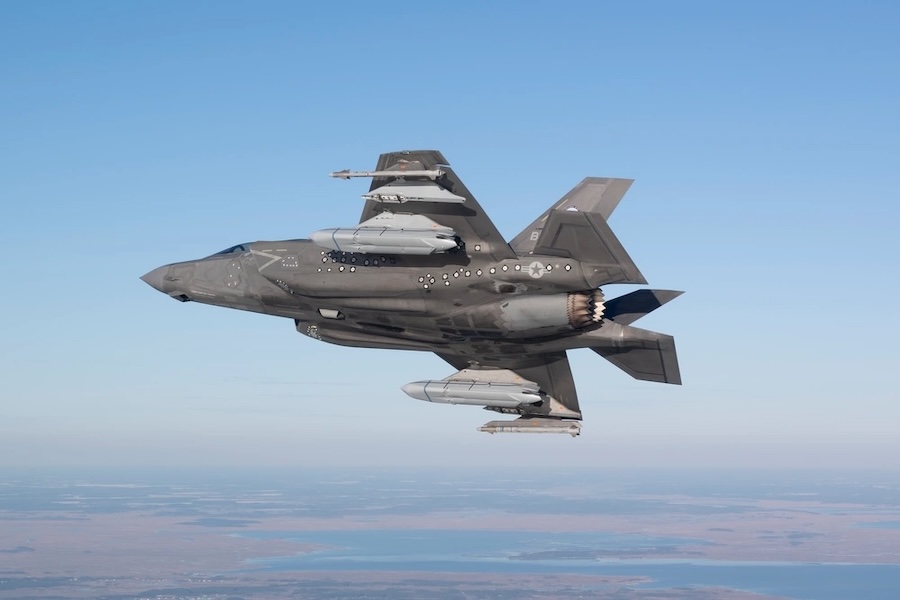
The timeline was set out in the Ministry of Defence’s 2026 Defence Investment Plan, which details almost £298 billion of planned spending over four years. While the document confirms that Britain will purchase additional F-35s, including the F-35A variant, it does not disclose the number of aircraft or divide the £2.2 billion allocation between different elements of the programme.
The F-35A purchase will allow Britain to join NATO’s aircraft-based nuclear mission, broadening the country’s contribution to the alliance’s deterrence posture. Although connected to that mission, the aircraft investment sits outside the £63.6 billion allocated to the Defence Nuclear Enterprise over the same four-year period.
The acquisition is one element of what the government describes as a “Next Generation Royal Air Force”, built around a changing mix of fourth-, fifth- and sixth-generation crewed and uncrewed aircraft. Typhoon will remain central to the force into the 2040s, while F-35s will increasingly operate alongside autonomous Collaborative Combat Aircraft and the future system being developed through the Global Combat Air Programme.
For the RAF, the F-35A will provide more than a nuclear role. The Ministry of Defence identifies Typhoon and F-35 fighters as the core of Britain’s Integrated Air and Missile Defence capability, protecting UK and NATO airspace against aircraft and cruise-missile attacks with support from Voyager tankers and Wedgetail early-warning aircraft.
Recent operations have already demonstrated the expanding demands placed on Britain’s existing F-35B fleet. According to the plan, a UK F-35B conducted the first British air-to-air engagement against a drone over Jordan during operations to defend Cyprus and Gulf partners from drones launched by Iran and its proxies.
The government is preparing to augment its crewed combat aircraft with autonomous systems designed to add mass, extend sensor coverage and carry additional weapons. A £300 million Collaborative Combat Aircraft programme is expected to produce a flying demonstrator by 2030, with the Ministry of Defence seeking to bring an operational capability into service as soon as possible.
Those autonomous aircraft are ultimately intended to operate from both land bases and Britain’s aircraft carriers. The plan says they will fly ahead of crewed fighters in contested airspace, improving the survivability and lethality of the wider combat-air force.
The Lightning Force will also receive new stand-off and long-range weapons under the government’s wider £11.1 billion investment in weapons and munitions. That effort will run alongside the £460 million SPEAR Capability 3 programme, although the document does not identify the other weapons or provide individual delivery schedules.
F-35 investment will proceed in parallel with a further £1.1 billion to upgrade and sustain Typhoon and £8.6 billion for GCAP over the next four years. The government said additional F-35 purchases would also benefit from the programme’s substantial UK industrial workshare, supporting its broader effort to use rising defence expenditure to strengthen British aerospace capacity.
The plan points to at least £70 billion of further investment in air capabilities between 2030 and 2035, including additional crewed and uncrewed aircraft. The Ministry of Defence cautioned, however, that its figures represent current priorities rather than binding commitments and that individual programmes could still be delayed, rescoped, reprioritised or cancelled.