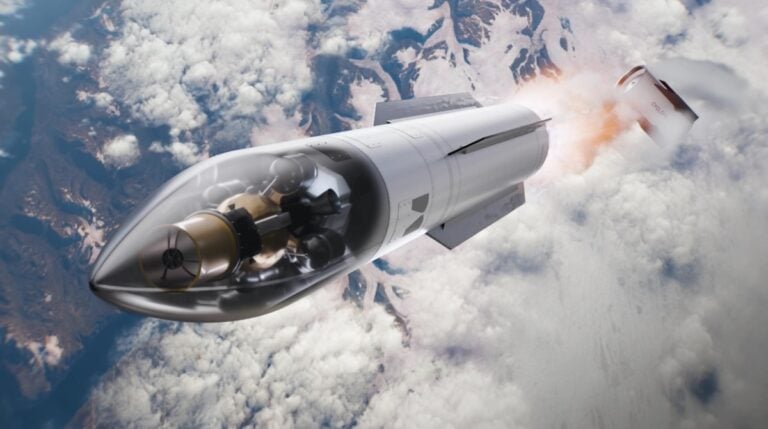
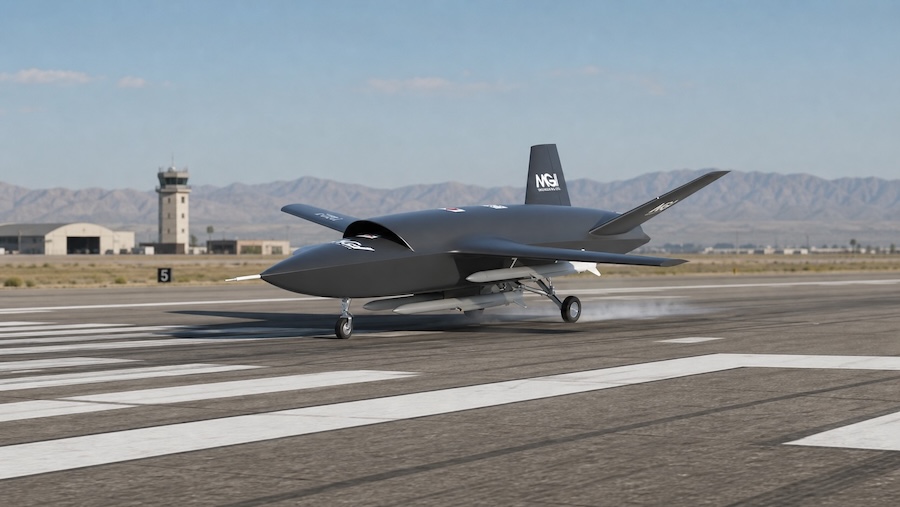
MGI describes Vortex as the first UK-built Autonomous Collaborative Platform of its kind. The aircraft is designed to fly without a pilot and operate alongside crewed fighters.
The launch follows recent testing of MGI’s TigerShark deep-strike programme under the UK Ministry of Defence’s Project BRAKESTOP. Vortex is designed to combine long range, payload capacity and near-supersonic speed.
The aircraft has a maximum take-off weight of 3,500 kg. MGI lists a range exceeding 4,000 kilometres and a top speed approaching Mach 0.85.
Its cruise speed is Mach 0.71. MGI says the aircraft can carry up to 1,000 kg of weapons, sensors or other mission payloads.
The aircraft is intended to use Rolls Royce Orphus engines or similar powerplants. The propulsion system would provide between 12 and 16 kilonewtons of thrust.
Vortex is designed specifically for manned-unmanned teaming. A Typhoon or F-35 could direct several Vortex aircraft as autonomous wingmen.
The aircraft would share sensor data and respond to changing mission conditions. It is also designed to execute coordinated tasks without constant ground control.
MGI says Vortex could continue operating when communications are jammed or disrupted. That capability is intended for operations in contested airspace.
The company is positioning Vortex for the UK’s Autonomous Collaborative Platforms programme. The Ministry of Defence initiative is focused on affordable, AI-supported uncrewed aircraft for the Royal Air Force.
“Vortex is the logical next step in the journey we’ve been on since SkyShark and TigerShark. This isn’t an experiment, it is a fully capable collaborative combat aircraft, engineered at a price point that makes it possible to field at genuine scale,” said Mike Gascoyne, CEO of MGI Engineering.
“That changes the economics of air power, and it changes the risk calculus. You can put Vortex into the most dangerous environments without putting a pilot there with it.”
MGI lists an operating altitude between 20 metres and 12,000 metres. The aircraft has a manoeuvrability envelope ranging from -2g to +7g.
The company says Vortex is designed for intelligence, electronic warfare and strike missions. It is also intended for suppression of enemy air defences.
The aircraft measures 11 metres in length and has a 7.6-metre wingspan. Its size is comparable with a light combat aircraft.
Vortex includes a 400 kg internal payload bay and four external mounting points. Two are under the wings and two are mounted on the fuselage.
The stations can carry weapons, sensors or electronic-warfare equipment. Operators can also combine different payload types for specific missions.
Vortex joins MGI’s wider family of autonomous air systems. That portfolio also includes SkyShark, TigerShark and LeopardShark.
SkyShark is a short-range one-way effector. TigerShark is a long-range deep-strike cruise missile, while LeopardShark is an ultra-low-cost development ACP.