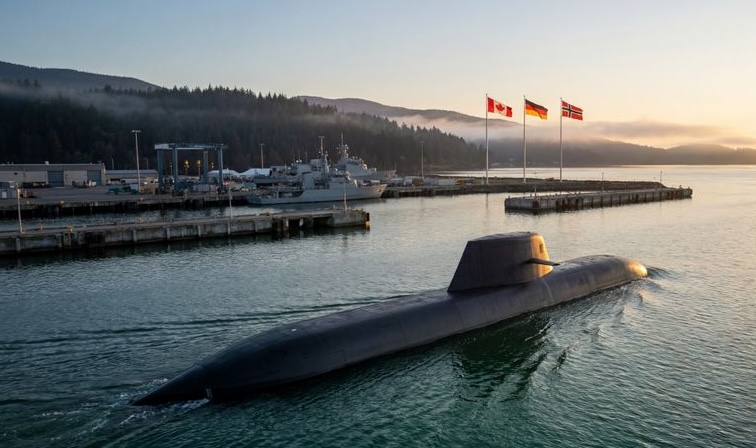
The project is intended to deliver up to 12 modern submarines to replace Canada’s ageing Victoria-class fleet. The government said the current fleet will remain operational into the mid-to-late 2030s, although only one of four submarines is now seaworthy.
Canada said submarines are critical to defending threats near and far from its shores and to providing underwater surveillance across the country’s maritime approaches. The government said this capability is essential for a country with the longest coastline in the world.
The government said long-standing assumptions behind Canadian defence and security are being upended. It said climate change is causing the Arctic to warm nearly three times faster than the global average, creating a shift that adversaries are looking to exploit.
TKMS’ 212CD submarine has ultra-low acoustic and magnetic signatures and was described by the government as one of the stealthiest submarines in the world. Canada said the platform is capable of Arctic patrol, undersea surveillance and special forces deployment, and is fully interoperable with NATO.
The government said the submarines would allow the Royal Canadian Navy to detect, track, deter and, if necessary, defeat adversaries in all three oceans bordering Canada. It said the procurement would strengthen Canadian security through a platform shared by Germany and Norway, two of Canada’s close allies.
Canada and TKMS will now enter negotiations to finalise the contracts and all arrangements required to deliver the project. Canada said it will conclude contracting no later than the end of 2027, with the first four submarines to be delivered ahead of schedule in 2034.
If negotiations with TKMS are unsuccessful, Canada may designate Hanwha Ocean as the preferred supplier and enter into negotiations. The project is being advanced by the Defence Investment Agency and is aligned with Canada’s Defence Industrial Strategy.
The government said the project follows a Partner approach under the Build-Partner-Buy framework, working with trusted allies to develop and deliver capabilities while securing industrial and economic benefits for Canada. It said the programme will prioritise investment across the Canadian supply chain, create high-paying jobs, support Canadian defence industries and maximise benefits for Canadian workers and businesses.
Prime Minister Mark Carney said Canada was acting in response to a more dangerous security environment. “In a more dangerous and divided world, Canada must be prepared to defend our interests, protect our citizens, build our economy, and secure our future.”
“To that end, we are making the largest defence procurement in our nation’s history with speed, ambition, and discipline. Canada’s next submarine fleet will secure our coastlines and waters, and their construction will have enormous, lasting benefits for Canadian industries and workers.”
“Together with our German and Norwegian Allies, we will build at speed and scale to expand our strategic capabilities and create greater strategic autonomy. We will build this fleet to build Canada strong.”
“Today’s decision will provide the Royal Canadian Navy a critical capability, ensuring we can defend and secure Canada’s vast coastline. From coast to coast to coast, this historic investment in the Canadian Armed Forces will bring strong economic benefits and jobs across the country,” said David J. McGuinty, Minister of National Defence.
Industry Minister Mélanie Joly said the procurement would also support Canada’s industrial base. “This historic submarine procurement represents more than an investment in Canada’s security – it is an investment in Canadians. By leveraging the Industrial and Technological Benefits Policy, we are creating good-paying jobs, strengthening domestic supply chains, supporting Canadian businesses and innovators, and delivering long-term economic benefits across the country.”
Secretary of State for Defence Procurement Stephen Fuhr said the process showed Canada could act quickly while maintaining scrutiny. “Today’s announcement demonstrates that Canada can move at the speed of relevance. Completing a competitive process of this scale in roughly eight months, while maintaining a rigorous and fair evaluation, is an important milestone in modernising defence procurement.”
“It reflects an understanding that national security and economic security go hand in hand. We evaluated proposals on their ability to deliver world-class capability to the Royal Canadian Navy, and on the long-term benefits they will create for Canadian workers, industry, and innovation through our Build-Partner-Buy approach.”
“Finally, this process identified two highly credible solutions. By naming both a preferred supplier and a reserve supplier, we’ve strengthened the resilience of this program and positioned Canada to deliver this critical capability faster and with greater confidence.”
The government said the procurement followed a multi-stage process, including a request for information issued from September 2024 to February 2025 and the identification of two qualified suppliers on 26 August 2025. Proposal instructions were issued in November 2025, proposals were submitted in March 2026, and a bid clarification and amendment process aligned with Canada’s Defence Industrial Strategy concluded on 29 April 2026.
Canada said the project supports its broader commitments to sovereignty, continental defence and collective security with allies, including through NATO and NORAD. The government said it has reached defence spending of 2% of GDP for the first time since the fall of the Berlin Wall, transformed defence procurement and secured more than 20 defence and security partnerships in a year.
The Defence Investment Agency is intended to modernise procurement by centralising expertise, cutting red tape and streamlining decisions. The government said the agency supports implementation of the Defence Industrial Strategy and will help accelerate defence investments.
The Defence Industrial Strategy is intended to position Canadian industry to benefit from $180 billion in defence procurement opportunities and $290 billion in defence-related capital investment opportunities in Canada over the next 10 years. The government said the submarine project is part of a wider effort to invest in Canada’s people, capabilities, industry and partnerships.