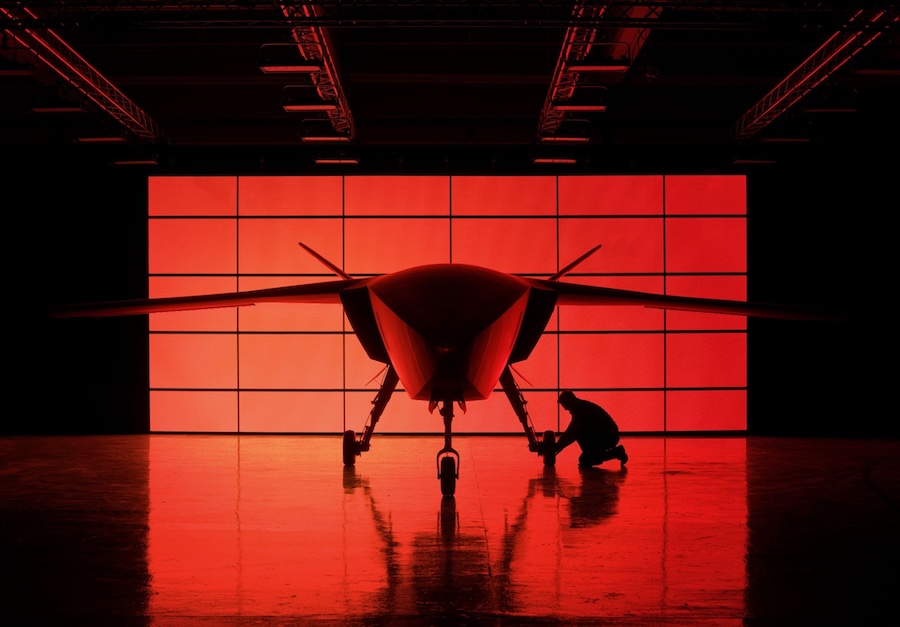
The German defence electronics group and Helsing agreed the partnership in February 2026 to support development of the CA-1 Europa. HENSOLDT is providing sensor technologies spanning radar, optronics, self-protection and electromagnetic warfare for the AI-powered autonomous combat aircraft.
The order also brings HENSOLDT’s airborne self-protection technology into the unmanned combat aircraft segment. CAIRAS will form part of the AMPS-MR, or Airborne Missile Protection System, configuration installed on the CA-1 Europa.
“The integration of CAIRAS into an unmanned system marks a turning point: self-protection was long a matter for manned platforms. Now it is becoming a fundamental requirement for autonomous systems that must survive and make decisions independently,” said Christina Canitz, Head of the Optronics Division at HENSOLDT.
“With CAIRAS as part of the AMPS suite, we are demonstrating that HENSOLDT is thinking ahead for this new generation of aircraft from the outset, rather than retrofitting them with protection.” The deployment will also mark the first use of HENSOLDT’s AMPS system on an unmanned aerial vehicle.
The AMPS-MR configuration combines the CAIRAS missile warning system with HENSOLDT’s Kalætron radar warning system. It also includes a dispenser system designed to deploy decoys against detected threats.
CAIRAS uses dual-colour infrared technology to detect approaching missiles passively and at an early stage, without emitting detectable signals. The system comprises a central processing unit and as many as seven latest-generation infrared sensors.
HENSOLDT says the configuration provides a high probability of detection while limiting false alarms. It can detect and localise incoming fire and provide complete spherical 360-degree coverage around the aircraft.
CAIRAS will also support the CA-1 Europa’s wider situational awareness functions. Infrared imagery collected by the system can be processed into a real-time panoramic view of the aircraft’s surroundings.
Passive detection is particularly relevant for an unmanned aircraft because there is no pilot on board to assess threats manually. The CA-1 Europa therefore depends on reliable sensor data that can be analysed by machines and used to support autonomous responses.
Data collected by CAIRAS can also be transferred to HENSOLDT’s MDOcore software suite for data fusion. This allows the system to support the CA-1 Europa’s survivability in contested operational environments without revealing the aircraft’s position through active emissions.