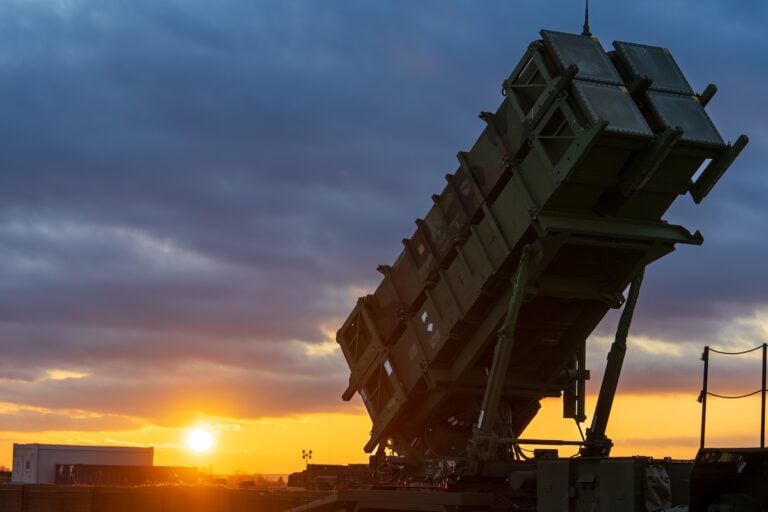
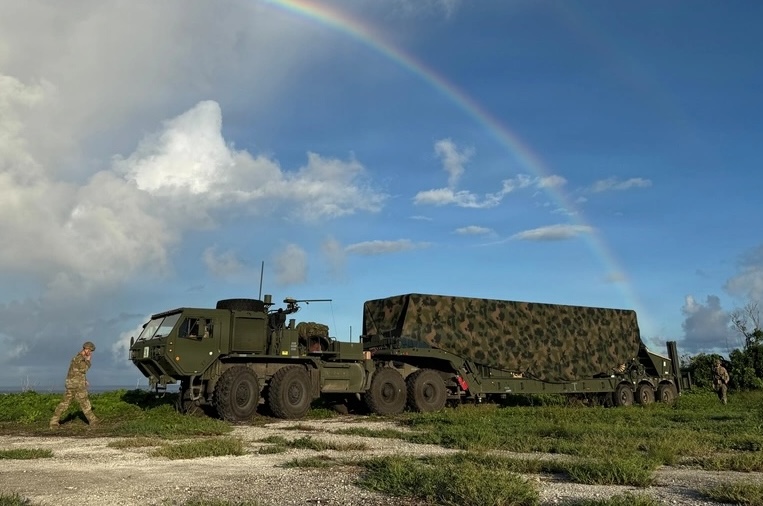
The missiles were operated by troops assigned to Multi-Domain Command-Pacific, which was formed through the recent merger of the Washington-based 7th Infantry Division and the 1st Multi-Domain Task Force. Adm. Samuel Paparo, head of U.S. Indo-Pacific Command, reviewed the unit during Valiant Shield 2026.
War Department imagery of the deployment was released on Sunday, almost a month after the exercise concluded. The timing drew attention to the Army’s expanding missile role in the Pacific, where U.S. forces are working to sharpen long-range fires, distributed operations and maritime strike options.
According to a Pacific Fleet release, Valiant Shield 2026 focused on operations against enemies on land, in the air and at sea in a contested environment. In recent years, the exercise has included more scenarios relevant to a peer fight between the United States and China.
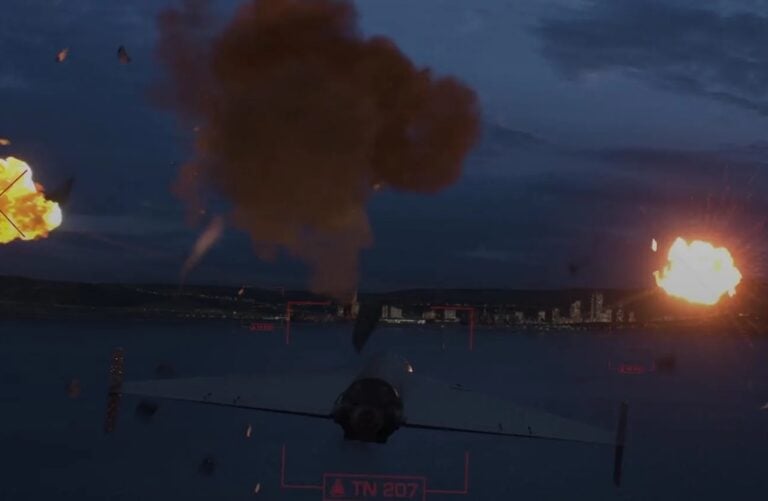
The 2026 exercise included several notable milestones beyond the Dark Eagle deployment. These included the use of a Royal Australian Air Force fighter drone, the sinking of a decommissioned amphibious assault ship by a Japan Maritime Self-Defense Force attack boat, and a U.S. Marine Corps Iron Dome air defense live-fire.
Guam remains a central U.S. military outpost in the Western Pacific because it hosts a strategic airfield and naval base. Its status as an American territory also allows Washington to station intermediate-range missile systems without the same basing-access and presence concerns it faces elsewhere in the region.
From Guam, Dark Eagle can strike targets 2,175 miles away, putting Chinese coastal provinces within range. That reach gives the system a direct role in the long-range strike architecture the Army and Navy are developing for Pacific contingencies.
The Army and Navy have identified conventional hypersonic weapons as a way to give commanders faster response options against threats at extended ranges. Both services are fielding variants of the Common-Hypersonic Glide Body, called Dark Eagle by the Army and Conventional Prompt Strike by the Navy.
The Army previously sent Dark Eagle west of the international date line last summer for the U.S.-Australian Talisman Sabre exercise. That deployment marked the weapon system’s first overseas deployment after expeditionary deployment rehearsals were conducted inside the continental United States in 2024.
Ground-based missile systems such as Dark Eagle are now at the center of the Army’s Pacific modernization efforts. Outside the Korean Peninsula, the service is shifting some focus from mechanized maneuver toward motorized units designed for littoral, jungle and maritime operations.
To help counter Chinese naval forces, the Army wants mobile missile launchers able to strike maritime targets at extended ranges of up to 621 miles. The service has also introduced the Mid-Range Capability, a ground-based Mark 41 vertical launching system, for maritime strike operations.
Since 2024, the Mid-Range Capability has been deployed to the Philippines, Australia and Japan. The Army has also carried out two Pacific live-fires from the launcher using SM-6 and Tomahawk missiles, underscoring the service’s broader push to make long-range land-based fires a more visible part of U.S. Indo-Pacific strategy.
Source: USNI News.